Preface
The Luoyang Museum officially announced that from October 19 it would close for a full year. Word spread online that it was because the legendary Imperial Seal had been dug up. The memes flew thick and fast, but the thought that I had never been to Luoyang made me book a visit for the 17th first thing on the morning of the 15th, and I set off at once for this thousand-year-old capital I had long wanted to see.
A Glimpse Outside
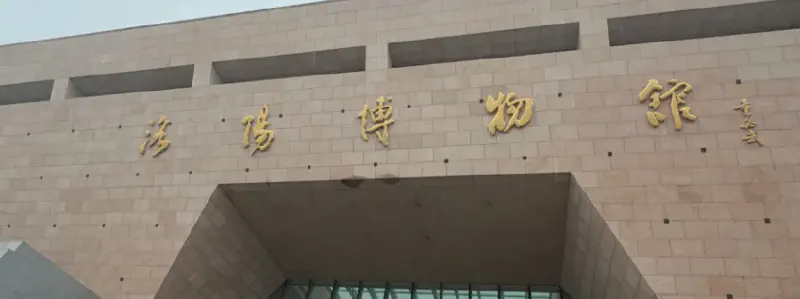
Let me skip the rest of the 16th after arriving in Luoyang. On the 17th I took the metro early to the museum, got off at Wenbo Park station and still had more than 800 meters to walk. It was drizzling, and when I arrived there were still more than half an hour to opening. I snapped a rough photo of the museum facade, not very sharp.
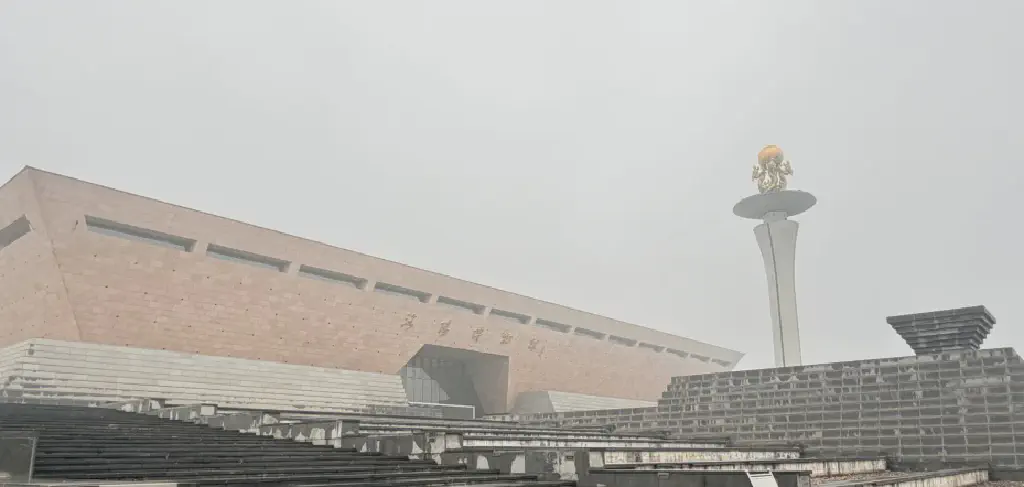
The building’s design actually carries a message. Based on the idea of “a tripod steadies the realm, the cauldron is set at Luoyi”, the main body resembles a bronze square ding, symbolizing Luoyang’s place as the seat of royal power through thirteen dynasties and the foundation of Heluo civilization.
The golden sculpted column in front of the plaza is modeled on the Tianshu of Sui-Tang Luoyang, a commemorative column from the Wu Zhou period that stands for the golden age of the eastern capital.
On the right of the photo is a Han que tower, following the Han-Wei gate-tower form. Together they link Luoyang’s high points across Xia-Shang-Zhou (the ding), Han-Wei (the que) and Sui-Tang (the Tianshu).
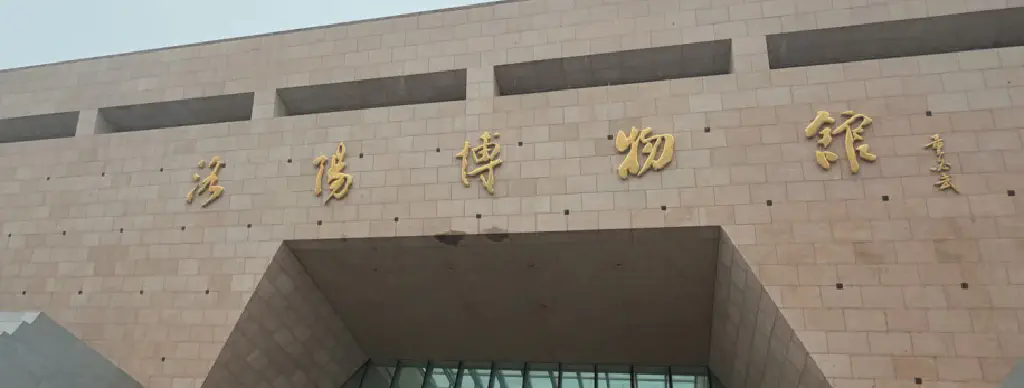
The characters “Luoyang Museum” on the sign were written by Dong Biwu, then Vice Chairman of the state, at the time the museum was founded.
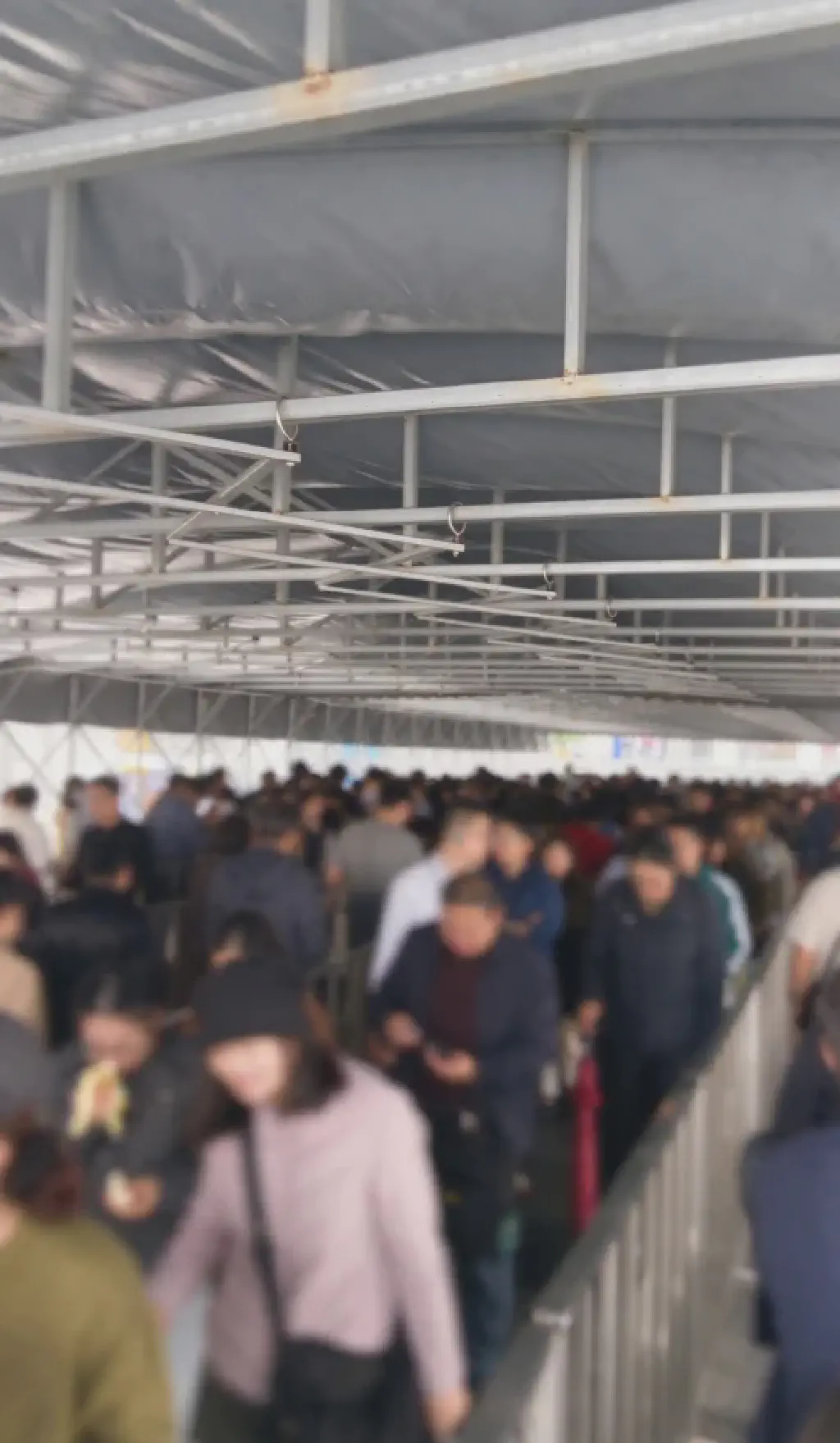
Even on a rainy day and arriving well before opening, there were already several long, winding queues at the entrance — probably the imminent closure and the weekend combined.
The Treasures Hall
With so many visitors, once inside I headed straight for the Treasures Hall on the second floor to see with my own eyes those pieces famous across the world.
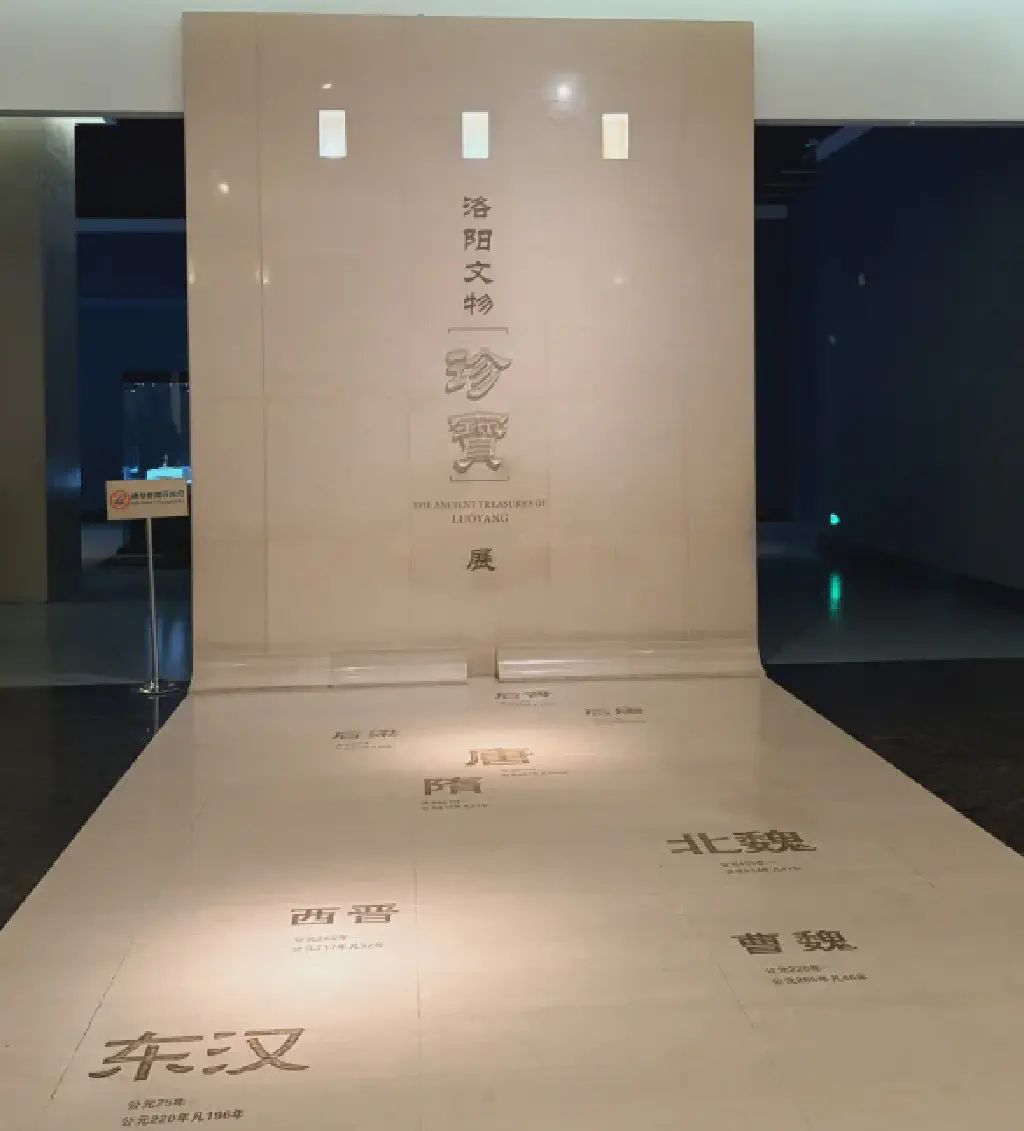
The Treasures Hall displays dozens of major pieces, from Xia-Shang to the Qing dynasty, all of them rare to see anywhere else. Below are the artifacts I photographed in the hall, organized with help from AI.
01 A Bronze Jue (Late Xia Dynasty)
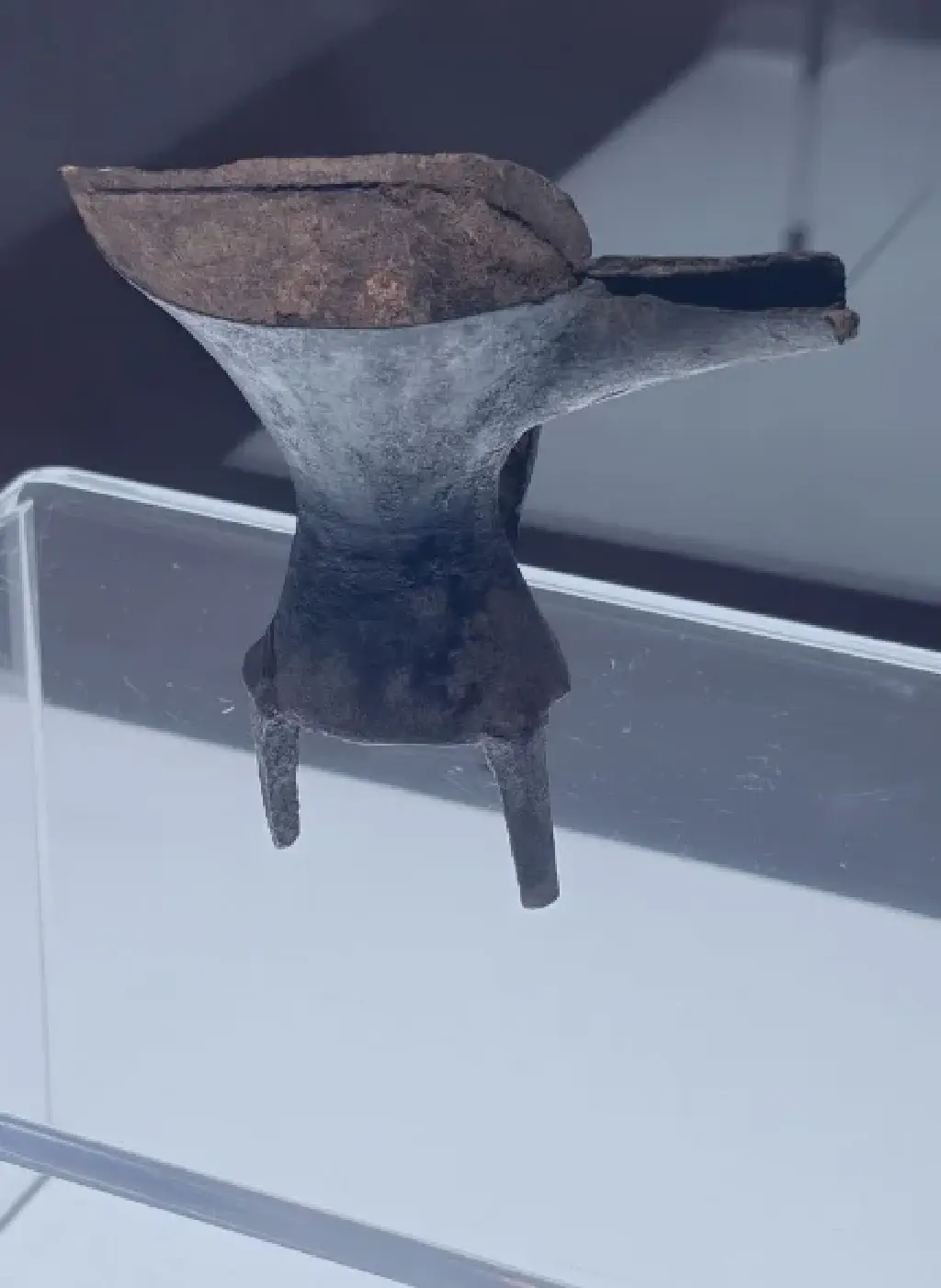
The bronze jue is one of the earliest bronze wine vessels known in China and the physical origin of the ritual vessel name “jue”. With a waisted body, flat base and three legs, a long spout on one side and a tail on the other, its form is archaic; casting marks still remain on the surface, and it lacks the dense ornament of later Shang and Zhou bronzes.
It witnesses the Luoyang plain’s first step into bronze civilization — in the Erlitou era, the “first royal capital of China”, the Central Plains already commanded complex piece-mold casting.
One-line highlight: China’s earliest ritual wine vessel, the opening work of Chinese bronze civilization.
02 A Bronze Square Lei with the Inscription “Mu Gu” (Late Shang Dynasty)
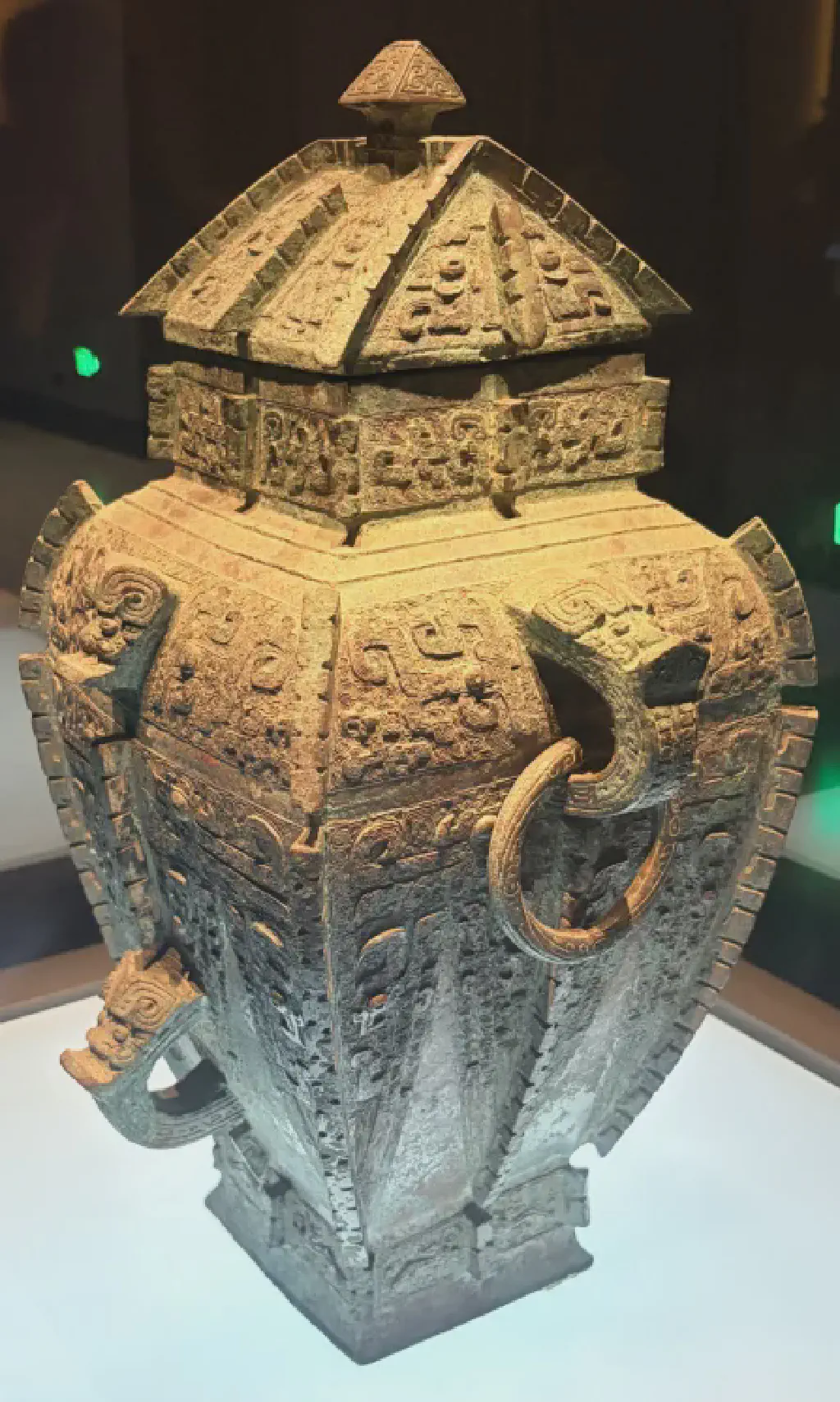
The square lei was a grand vessel for holding wine among the Shang elite, tall and sharply angular. The body is covered with taotie masks and kui dragon motifs over a fine ground of cloud-and-thunder scrolls, with animal-head handles holding rings. Inside is cast the two-character inscription “Mu Gu”, recording a marriage alliance between the Mu clan and the state of Gu in Shang times.
Though unearthed from a Western Zhou tomb, it is a Shang relic, reflecting the marriage networks among Shang vassal states and the ritual standing of Chengzhou Luoyi.
One-line highlight: Two characters, “Mu Gu”, hold a tale of a cross-state marriage in the Shang dynasty.
03 A Bronze Zun with Taotie Masks (Shang Dynasty)
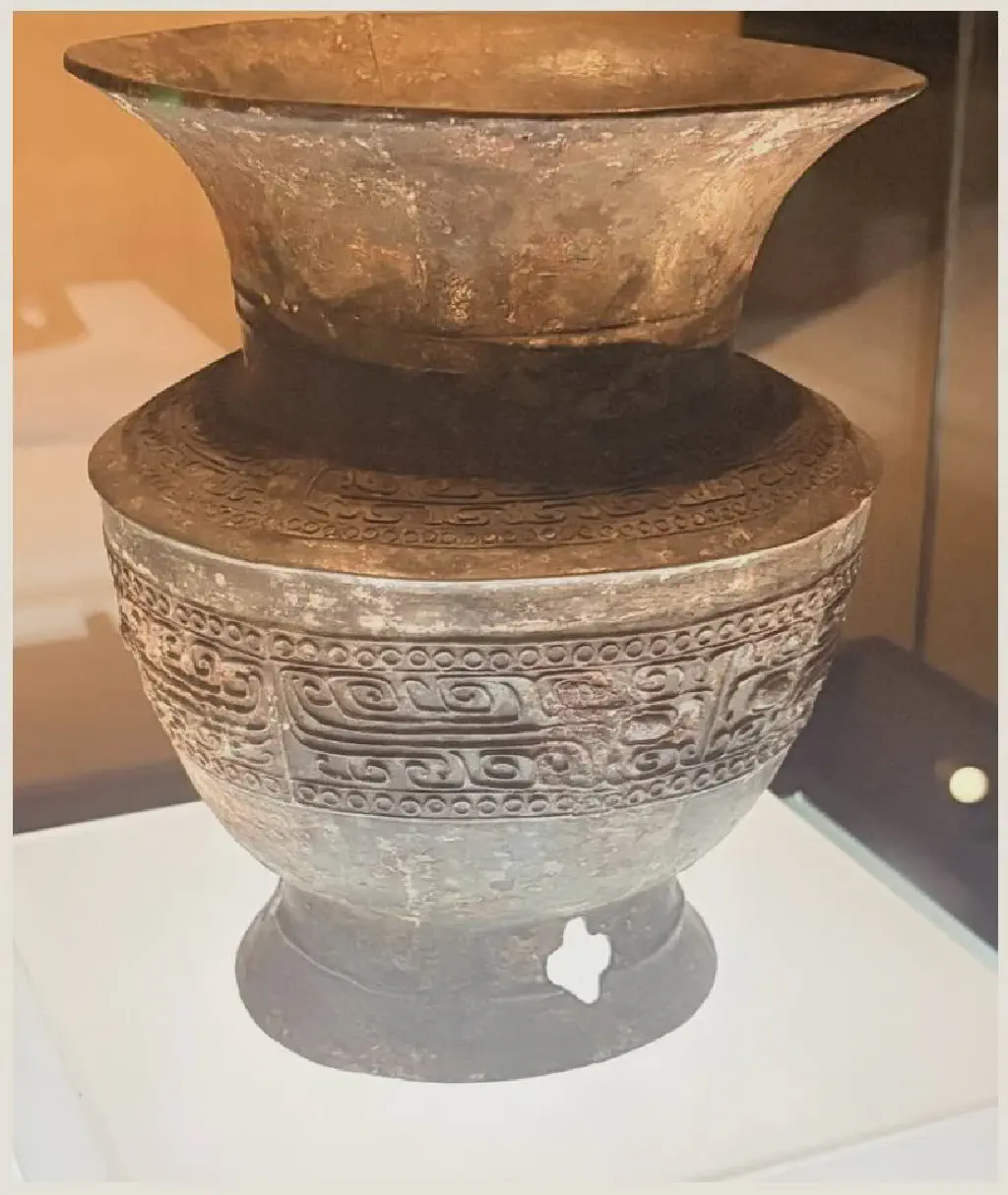
A wide mouth, constricted neck, swelling belly and high ring foot — the classic Shang form for a bronze zun. Neck and foot carry bowstring bands and taotie masks, while the belly is dominated by a spread taotie face over a cloud-and-thunder ground, the three-layer technique intricate and powerful.
The zun was an important wine ritual vessel in Shang times, used in sacrifice and feasting. Its discovery shows the Heluo region was already inside the Shang ritual sphere.
One-line highlight: A bravura display of the Shang three-layer casting technique.
04 A Square Ding with Taotie Masks (Early Western Zhou)
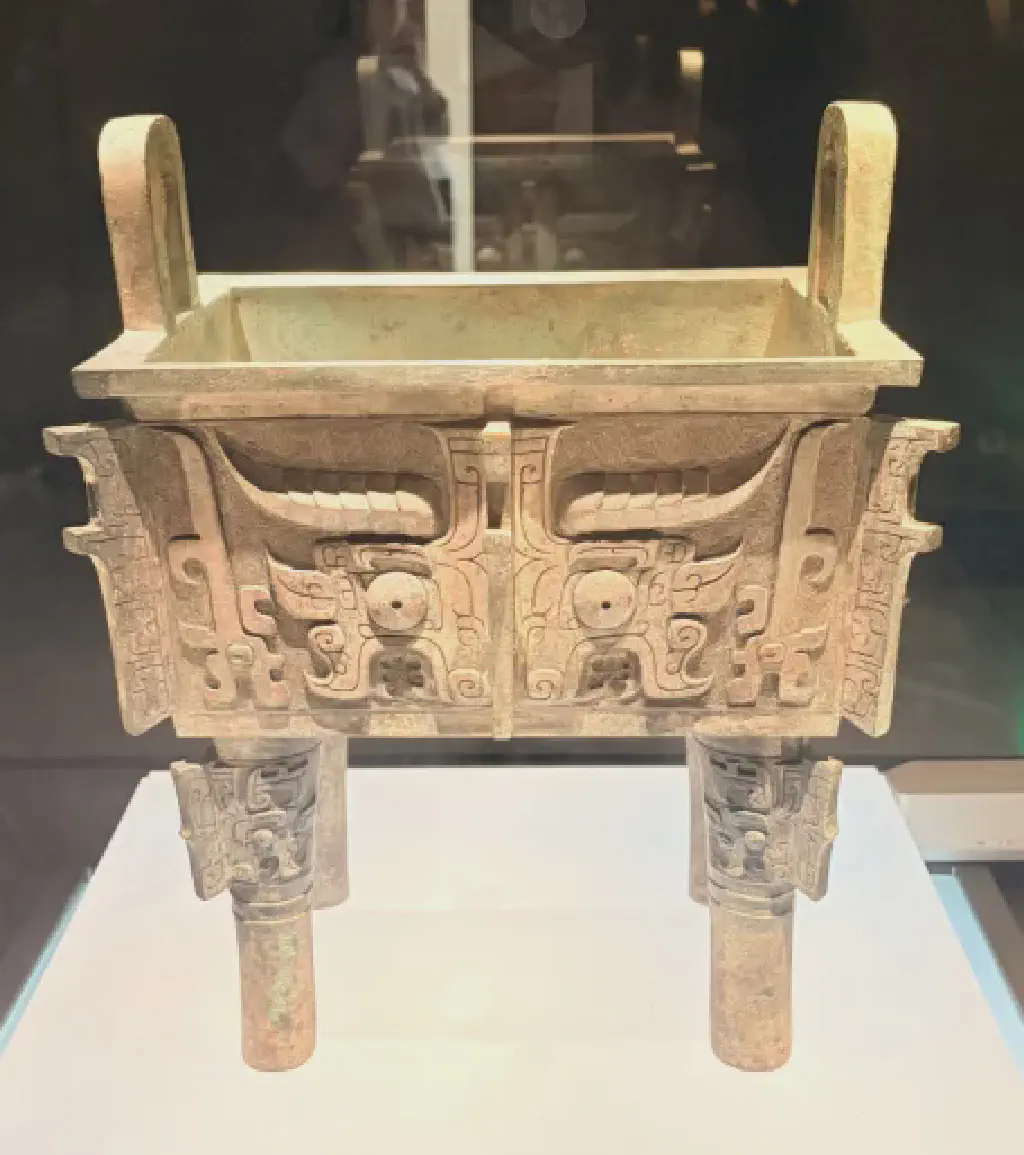
Upright handles, square belly and four columnar legs — the standard model for an early Western Zhou square ding. Each of the four sides bears a large taotie mask in relief, with bulging eyes and vigorous lines, the whole solemn and severe. The ding headed the ritual vessels that “marked rank and distinguished station”.
Luoyang was Chengzhou, the eastern capital of Western Zhou, and this ding represents the ritual scale of Zhou royal sacrifice and investiture at Luoyi.
One-line highlight: The ding that “set the realm”, a ritual heavyweight of the Zhou house in Luoyang.
05 A Bronze Square Yi of Shu Pin (Early Western Zhou)
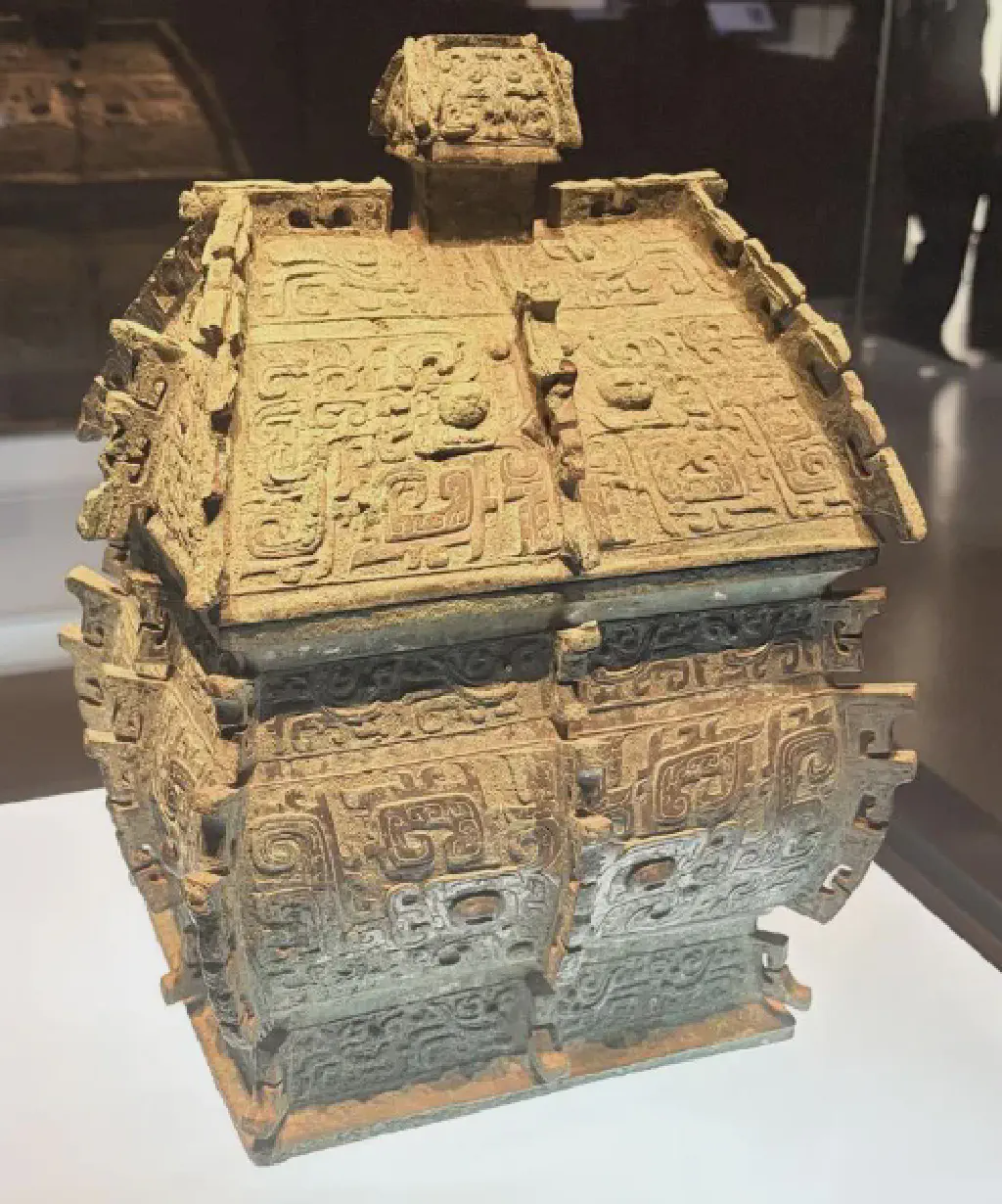
The lid rises like a four-sided roof, and the knob is roof-shaped too, so the whole reads as a miniature temple hall. The body is covered with phoenix-bird and taotie motifs, and inside is cast the inscription “Shu Pin was granted cowries by the royal lady Si, and made this precious ritual vessel”, recording a reward given by the Zhou queen to the nobleman Shu Pin.
Very few square yi of this curved-belly type survive; most comparable pieces are now abroad.
One-line highlight: A miniature temple hall whose inscription freezes a moment of royal gift-giving.
06 A Round Ding Made by the King (Spring and Autumn)
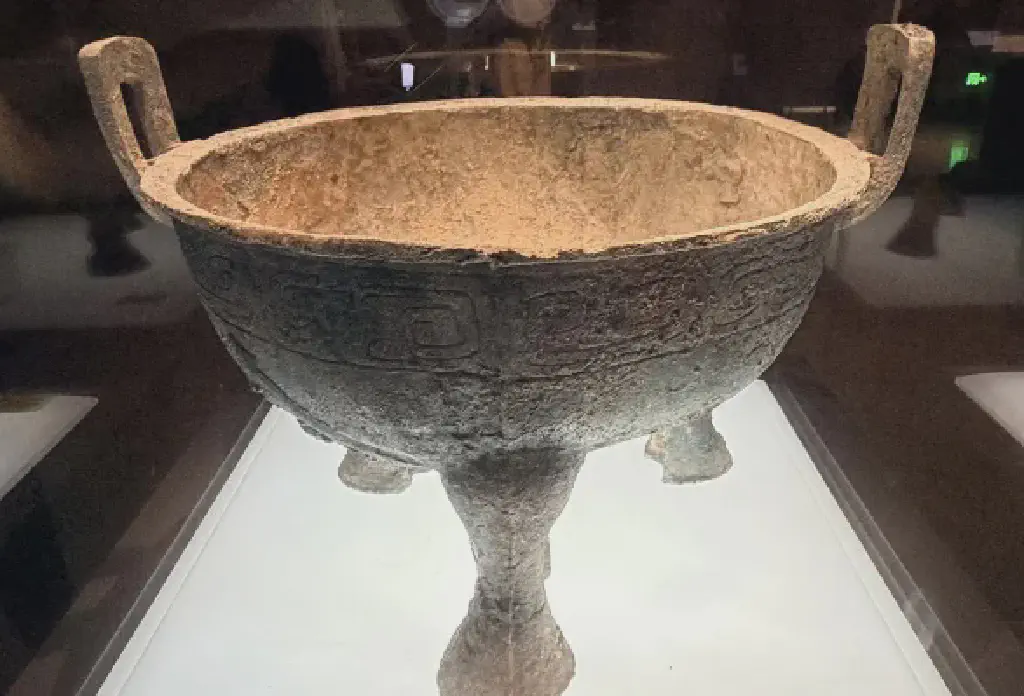
Upright handles, a deep belly and three columnar legs, the belly girdled with a band of qiequ scrolls and coiled animal forms — a typical Eastern Zhou bronze ding. Compared with Shang and Zhou ritual vessels, the ornament shifts from severe taotie masks to fluent, geometric qiequ, evidence of ritual loosening in the Spring and Autumn period.
The stories of “setting the ding upon the Central Plains” and “asking the weight of the ding” both happened at Luoyang.
One-line highlight: The ding behind “asking the weight of the realm” looks exactly like this.
07 A Bronze Ding with Gold and Silver Inlay and a Spout (Warring States)
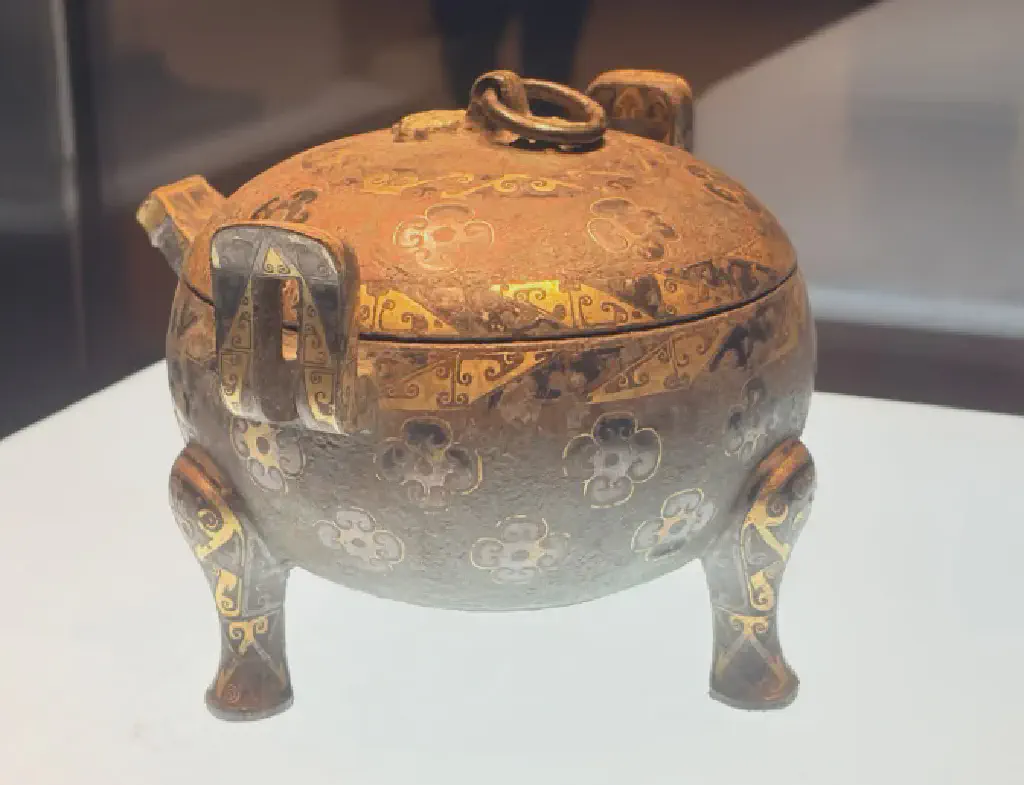
A round ding with a long spout on one side for pouring, quite unlike the heavy solemnity of Shang and Zhou ding. The body is inlaid with gold and silver wire in cloud scrolls and rosettes, gold and silver interleaving in gorgeous effect. Gold-and-silver inlay was the finest bronze decoration of the Warring States.
It came from a buried hoard, perhaps hastily hidden by nobles during wartime.
One-line highlight: A Warring States “luxury item” ding, shimmering with gold and silver.
08 A Gilt-bronze Feathered Figure (Eastern Han)
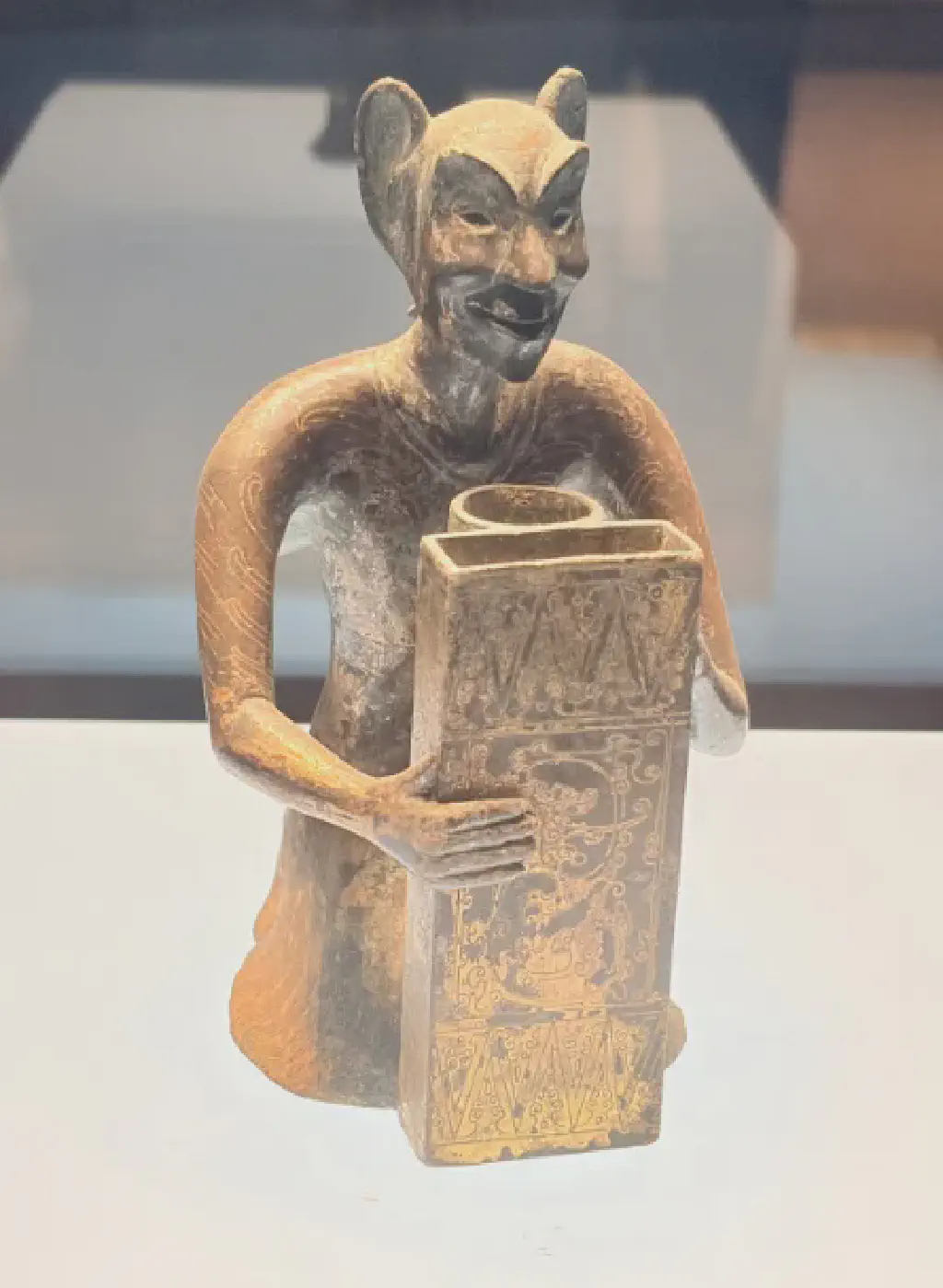
The feathered figure has a pointed face and large ears and wears a smile, kneeling to hold a decorated square tube, the whole body gilt and chiseled with cloud scrolls. The feathered immortal is a classic image of Han religious belief — people believed that growing wings and riding the clouds to heaven would bring deathlessness.
It is both a masterpiece of Han gilding and a direct reflection of Eastern Han noble ideas about ascending to immortality.
One-line highlight: A little figure “cultivating immortality”, the Han dream of becoming a transcendent.
09 A Blood-amber Figure Riding a Ram (Cao Wei)
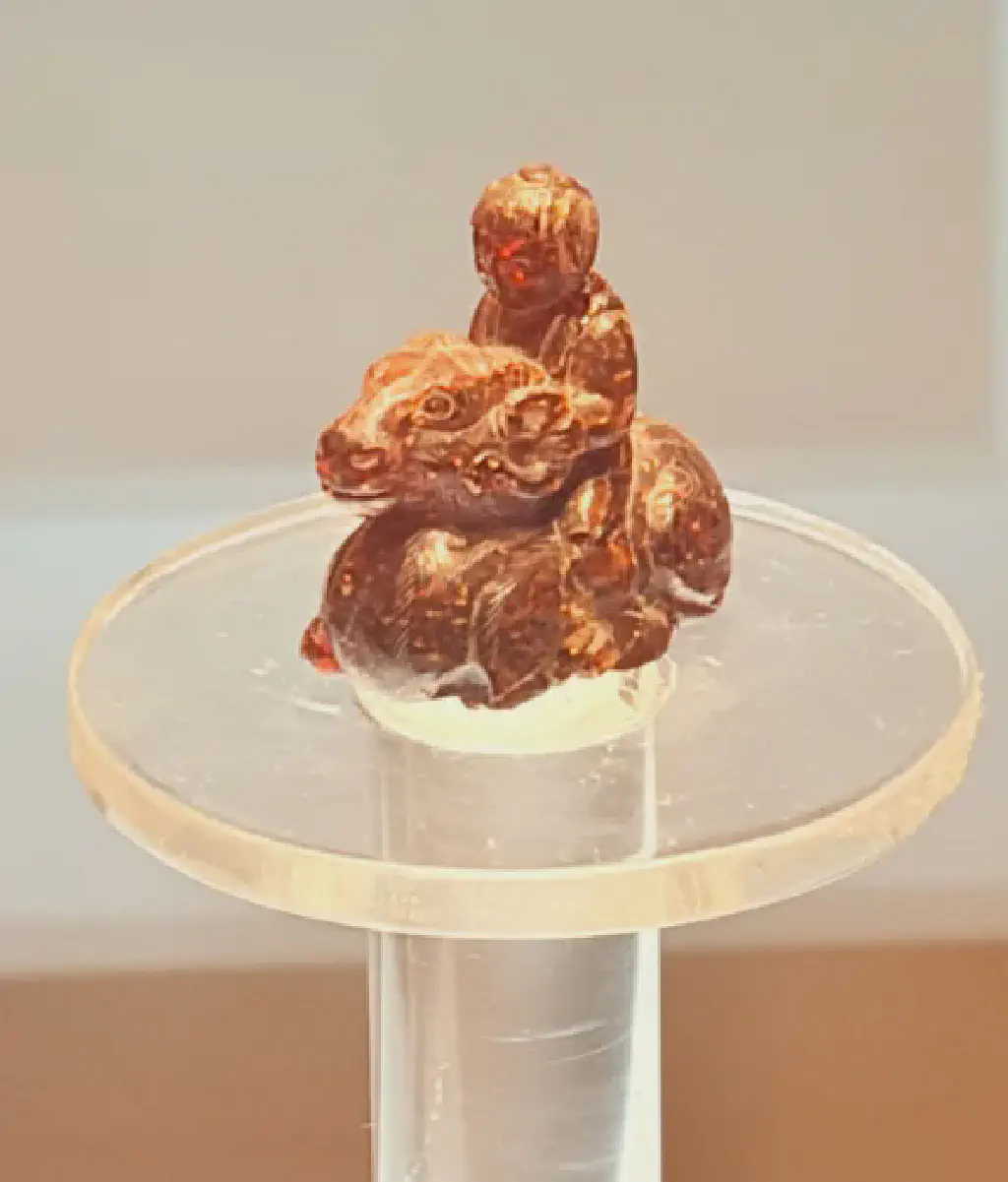
A boy sits calmly on a reclining ram; the amber is translucent with a blood-red sheen, a rare amber round carving from the Wei-Jin period. “Ram” (yang) echoes “auspicious” (xiang), meaning good fortune and peace. Cao Wei favored plainness, and small ornaments and display pieces like this are common in noble tombs.
One-line highlight: One small blood-red ram, carrying the good fortune and plainness of Cao Wei.
10 A Cao Wei White Jade Cup (Cao Wei)
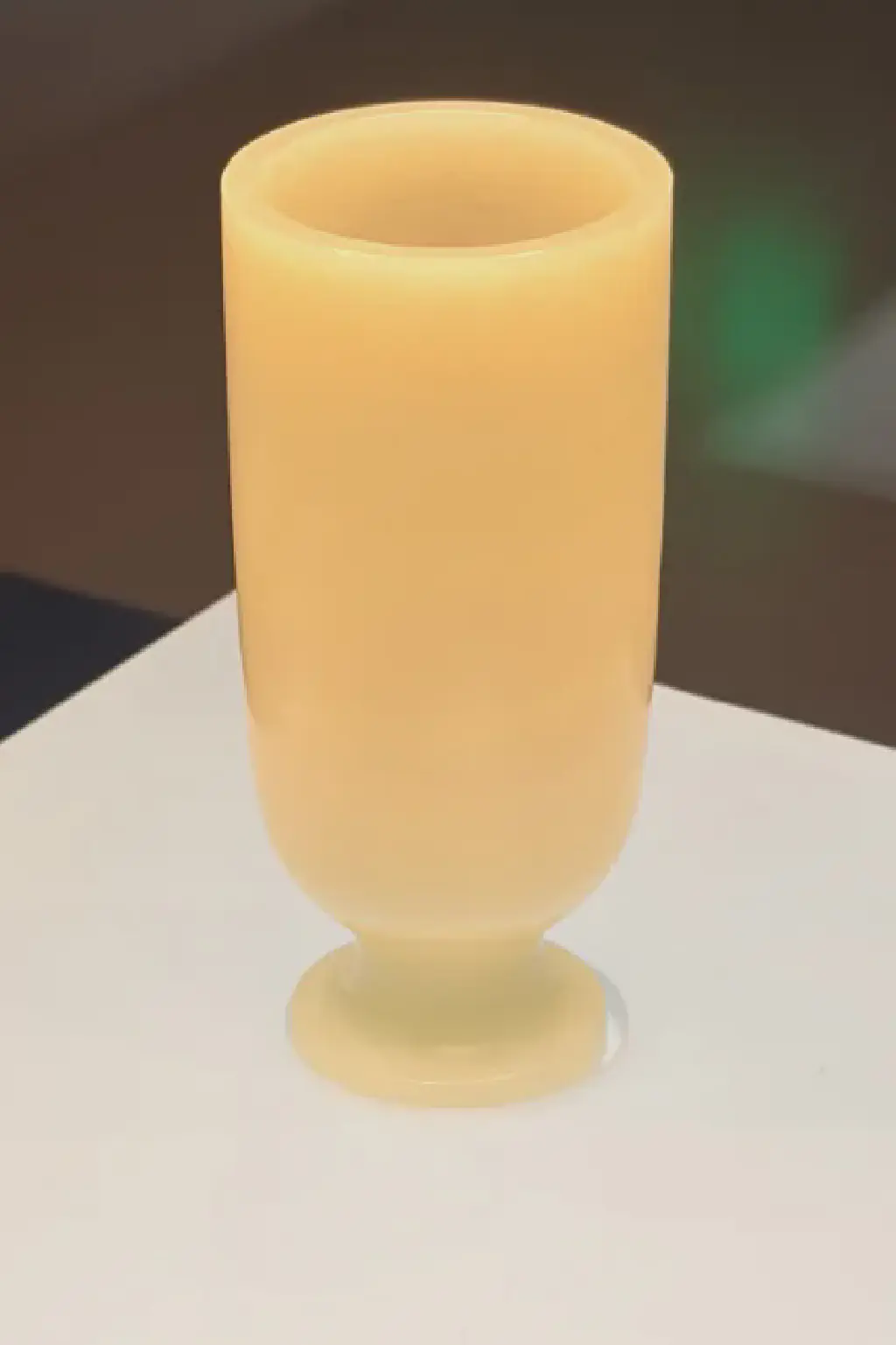
Polished from a single block of Khotan white jade, entirely plain with no ornament at all, its lines simple and fluent. It stands in sharp contrast to the dense decoration of Han jade and is the emblem of the Cao Wei aesthetic of plainness. Cao Pi promoted modest burial and rejected lavish ornament; this “beauty of the unadorned” is the minimalist signature of Three Kingdoms taste.
One-line highlight: A cup plain to the extreme, and the boldest statement of Three Kingdoms aesthetics.
11 A Fragment of the Zhengshi Stone Classics (Cao Wei)
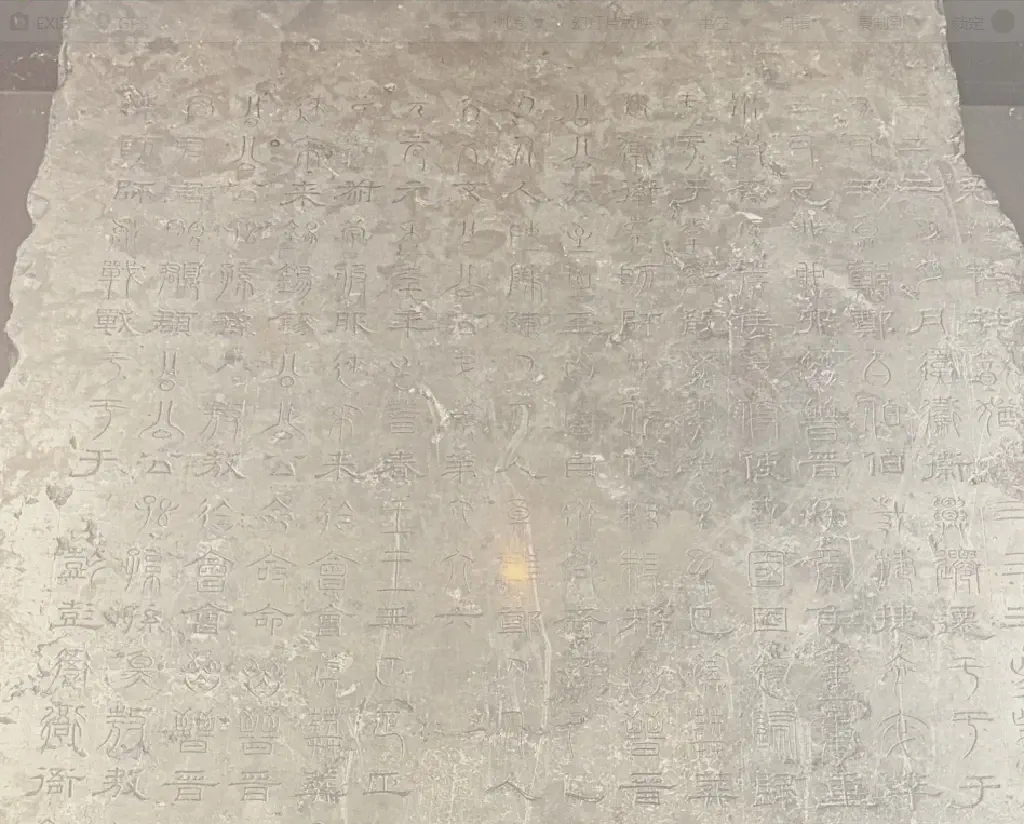
Confucian classics carved at the Luoyang Imperial Academy during the Zhengshi era of Cao Wei, each character written in three scripts — Warring States seal script, Qin small seal and Han clerical. It is China’s earliest “standard textbook carved in stone”, serving the state purpose of unifying the canon and regularizing character forms.
The Luoyang Academy was the highest seat of learning since Han times, and this fragment shows Luoyang was still the national center of classical education under Wei and Jin.
One-line highlight: Each character written three times over — China’s earliest “standard textbook”.
12 A Clay Buddha Face from Yongning Temple (Northern Wei)
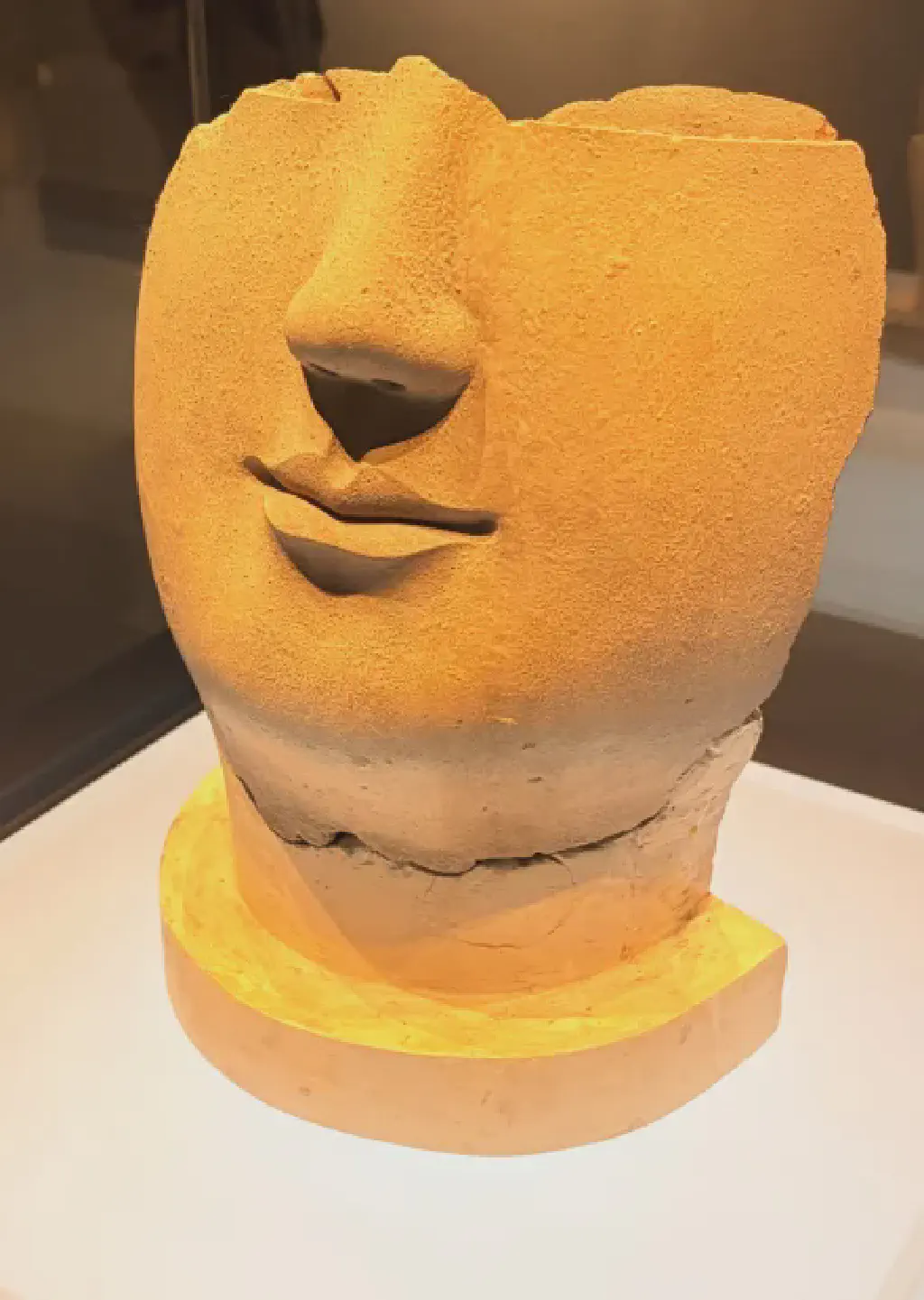
Only the lower half of the face survives, the corners of the mouth subtly raised, the smile calm and gentle — it has been called “the Mona Lisa smile of the East”. Yongning Temple was a Northern Wei imperial monastery at Luoyang, its nine-storey wooden pagoda over a hundred meters tall, the tallest building in East Asia at the time. The pagoda burned after a lightning strike, and the clay images were fired hard by the blaze and so survived.
It is the peak of Buddhist art’s Sinicization under Northern Wei.
One-line highlight: The world’s most evocative half-smile, from the ruins of a fire.
13 A Black-glazed Sancai Horse (Tang Dynasty)
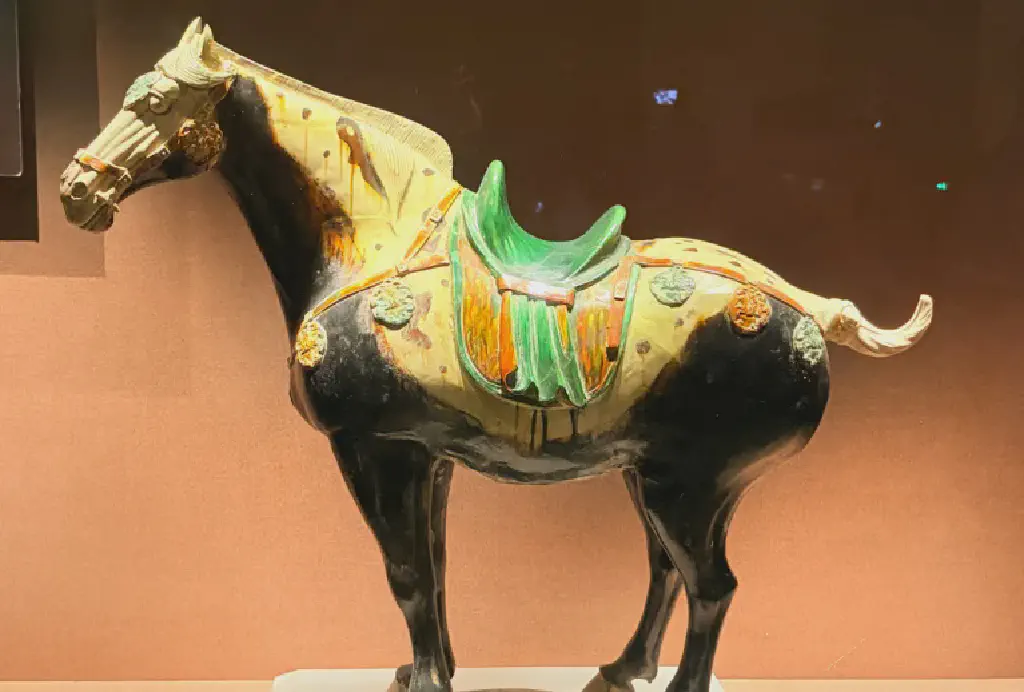
The body is glazed black overall, with only the bridle and saddle cloth picked out in green, yellow and ochre sancai, the horse plump, powerful and precisely modeled. Black glaze is extremely rare in Tang sancai — it required high firing temperatures and the color was hard to control; only two complete examples survive nationwide, the other in the National Museum of China.
It comes from the tomb of An Pu, a descendant of An state in the Western Regions and leader of the Six Hu Prefectures under the Tang, and is direct material evidence of Silk Road exchange and the equestrian culture of the High Tang.
One-line highlight: One of only two black horses in the country, the rarest thing in Tang sancai.
14 A Sancai Camel (Tang Dynasty)
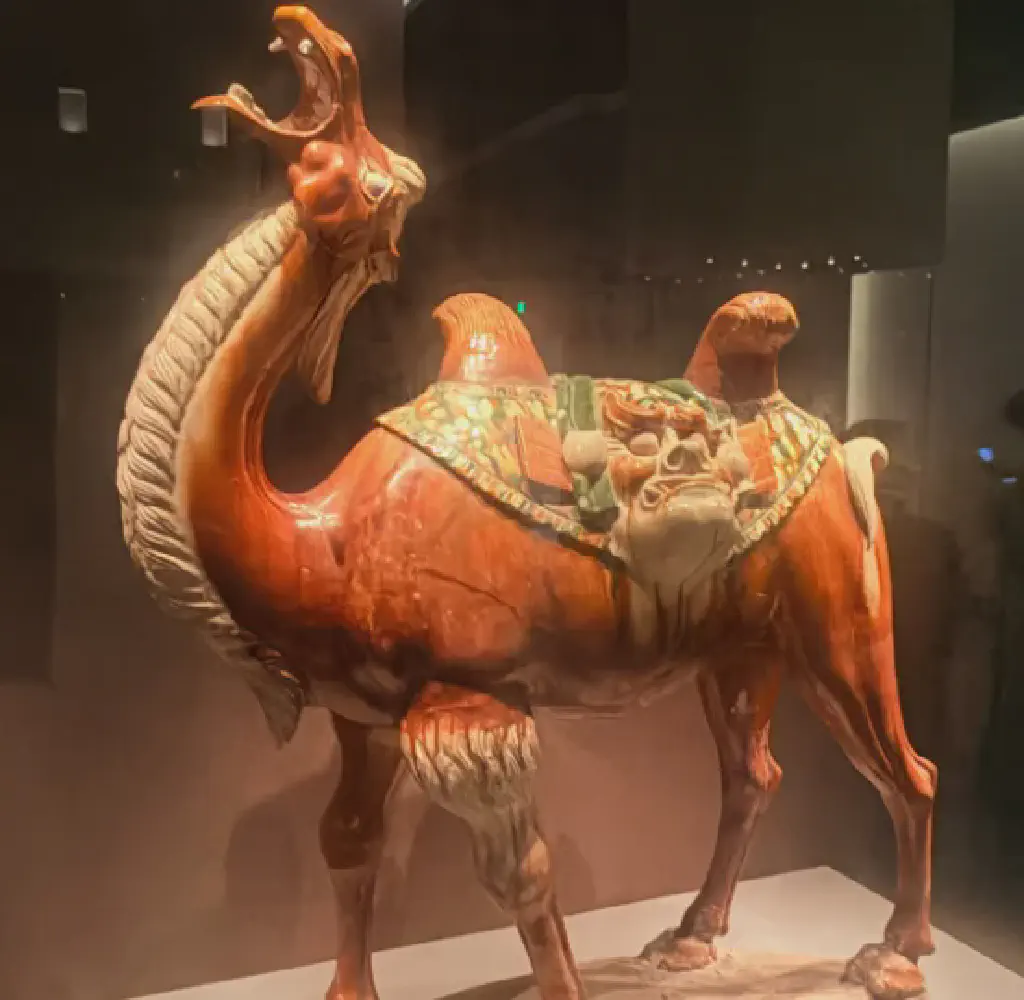
The camel raises its head and brays, twin humps raised, carrying bolts of silk and an animal-mask pack frame, the body in ochre-yellow glaze. It is the most emblematic beast of burden on the Silk Road and came from the same tomb as the black-glazed horse, together reflecting Luoyang’s prosperity as the eastern terminus of the Silk Road in Tang times.
One-line highlight: The “truck driver” of the Silk Road, carrying a whole Tang empire of trade.
15 A Tang Sancai Lamp Stand (Tang Dynasty)
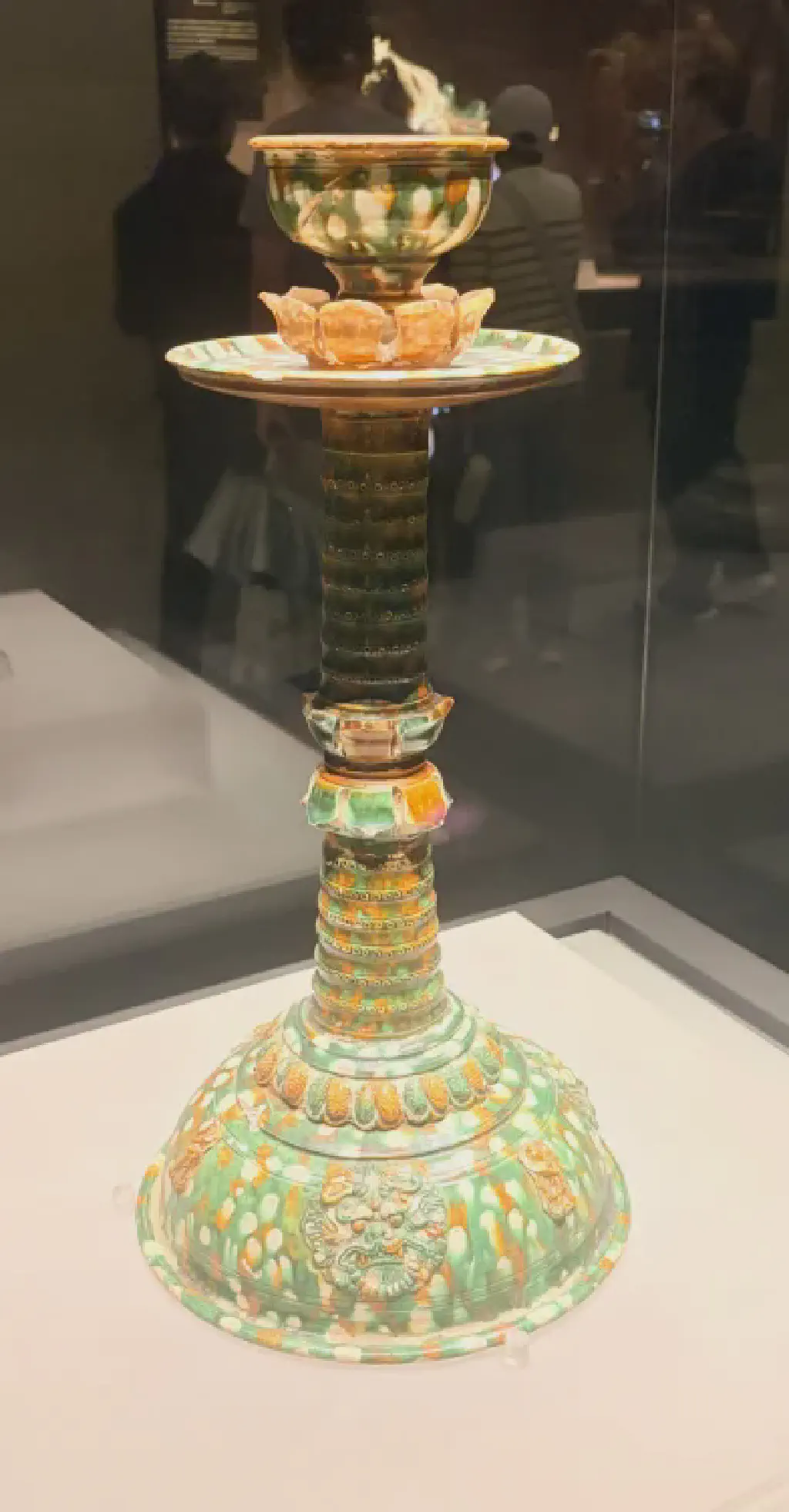
The whole takes a multi-tiered pagoda form: a massive base, a shaft modeled with lotus petals, bead strings and animal masks, a drip pan at the middle and a small bowl-shaped lamp at the top. The yellow, green and white glazes run and mottle; at once a pagoda and a practical lamp, it is a rare Tang example combining architectural model and lighting.
One-line highlight: A “pagoda lamp”, the Tang noble’s dual-purpose home shrine and light.
16 A Painted White Pottery Horse and Groom (Tang Dynasty)
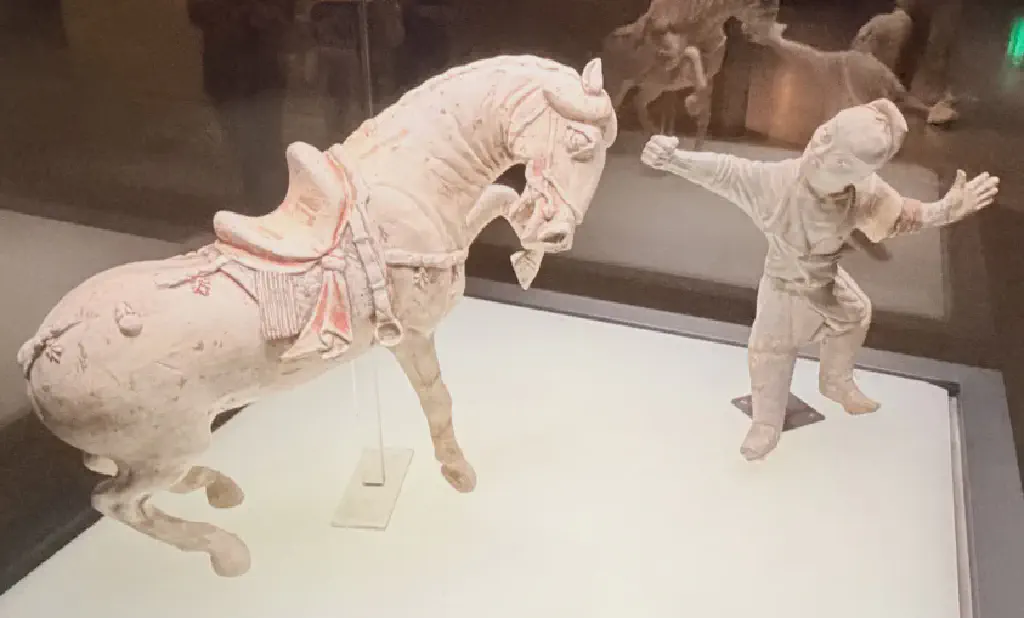
The horse lowers its head while the groom reaches out to take the rein, caught in a lively moment of interaction. The horse is white pottery throughout, with traces of red pigment on bridle and saddle; the groom has a foreign face with deep-set eyes and a high nose, the typical look of a Tang foreign general or groom.
It contrasts with Tang sancai: painted white pottery was also an important class of Tang tomb figure, plainer and more naturalistic.
One-line highlight: A foreign groom leading a horse, a snapshot of the cosmopolitan Tang street.
17 A Mirror with Gold and Silver Floral Inlay (Tang Dynasty)
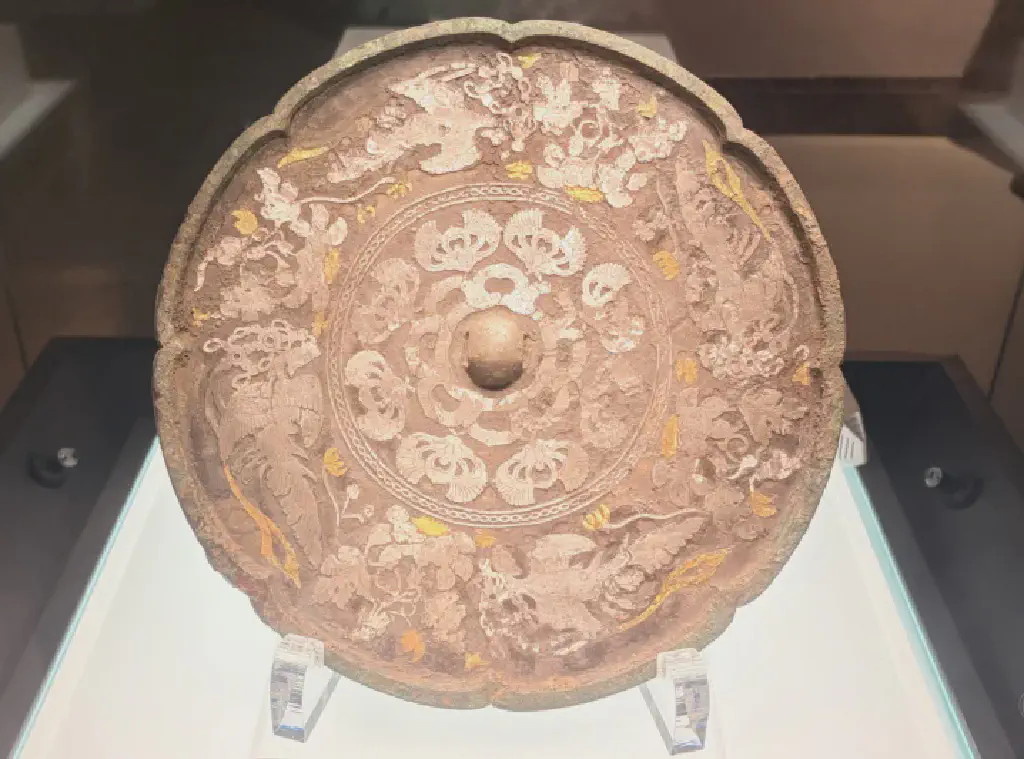
Phoenixes, flowers, birds and scrolling stems were cut from gold and silver foil, applied to the back of the mirror, then repeatedly lacquered and polished until foil and lacquer lay flush — this is “flat gold-and-silver inlay”. The process was slow and costly, reserved for the imperial family and the highest nobility.
Phoenixes with spread wings and full-bodied blossoms fix the splendor of the High Tang on a single bronze mirror.
One-line highlight: Gold and silver “set into” a mirror, the height of High Tang bling.
18 A Nestorian Stone Pillar (Tang Dynasty)
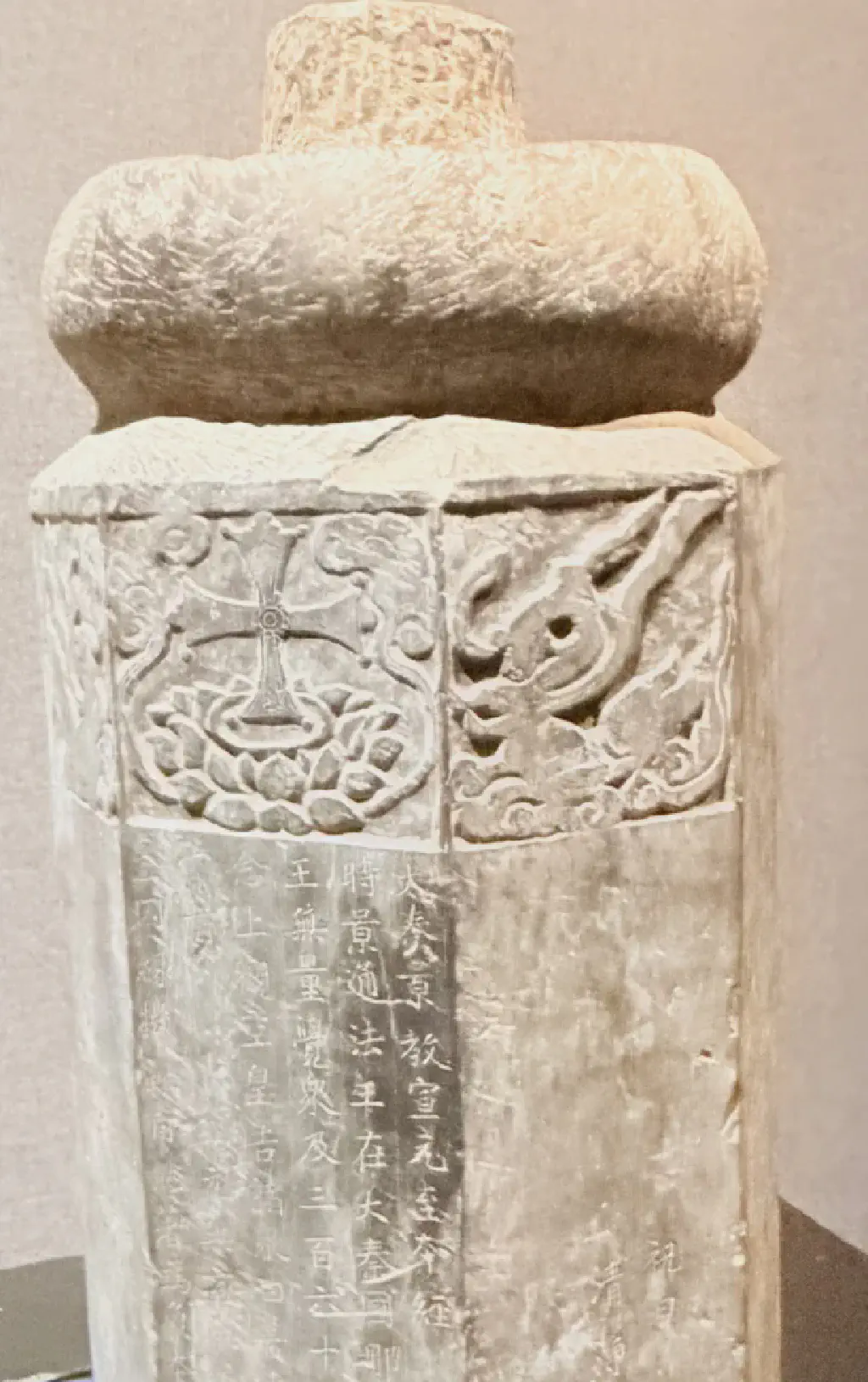
An octagonal stone column: one face bears a cross on a lotus seat in relief, the others carry the Nestorian Sutra of the Origin and Foundation and a dedicatory note. “Nestorianism” was the Church of the East, which reached China in Tang times; “Da Qin” meant the Roman Empire.
Apart from the Nestorian Stele in Xi’an, this is a rare Tang Christian carving in China, showing that Luoyang was an eastern meeting point of religions in the Silk Road era.
One-line highlight: A cross held up by a lotus — Tang Luoyang even had a “church”.
19 A Silver-gilt Statue of the Sixth Panchen Lama (Qing Dynasty)
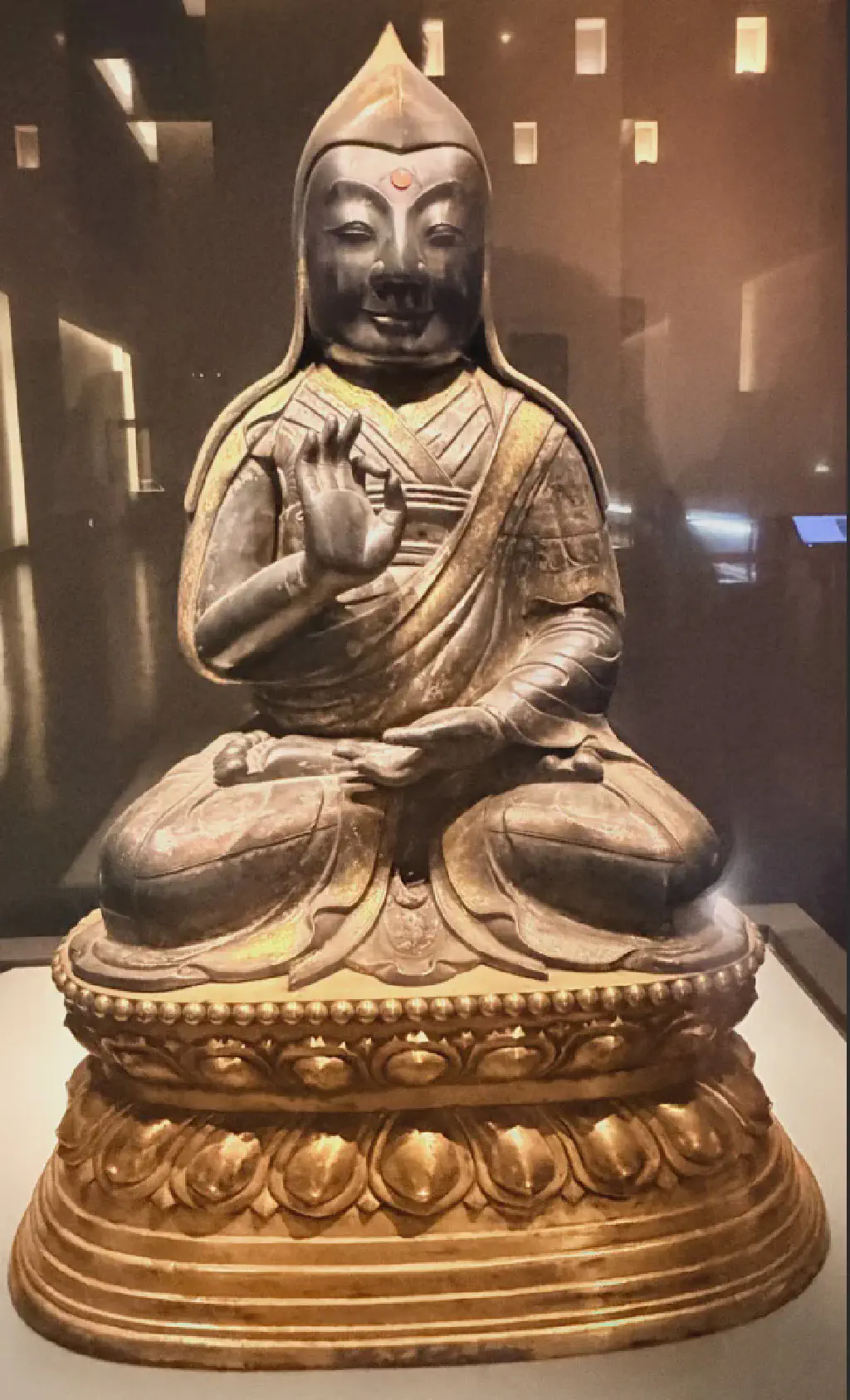
The Panchen wears a gilt-topped pandita hat and sits cross-legged, right hand at the chest in the gesture of teaching and left in meditation; the robes are finely chiseled and the lotus throne richly gilt, in Qing court style. Its presence in the museum reflects the convergence of many ethnic cultures in Luoyang.
One-line highlight: Qing court craftsmanship, keeping Tibetan Buddhist beauty in Luoyang.
The more than twenty major pieces in the Treasures Hall, from Xia to Qing, span more than four thousand years of history and are precious evidence of Heluo civilization and the origins of China.
The Sancai Hall
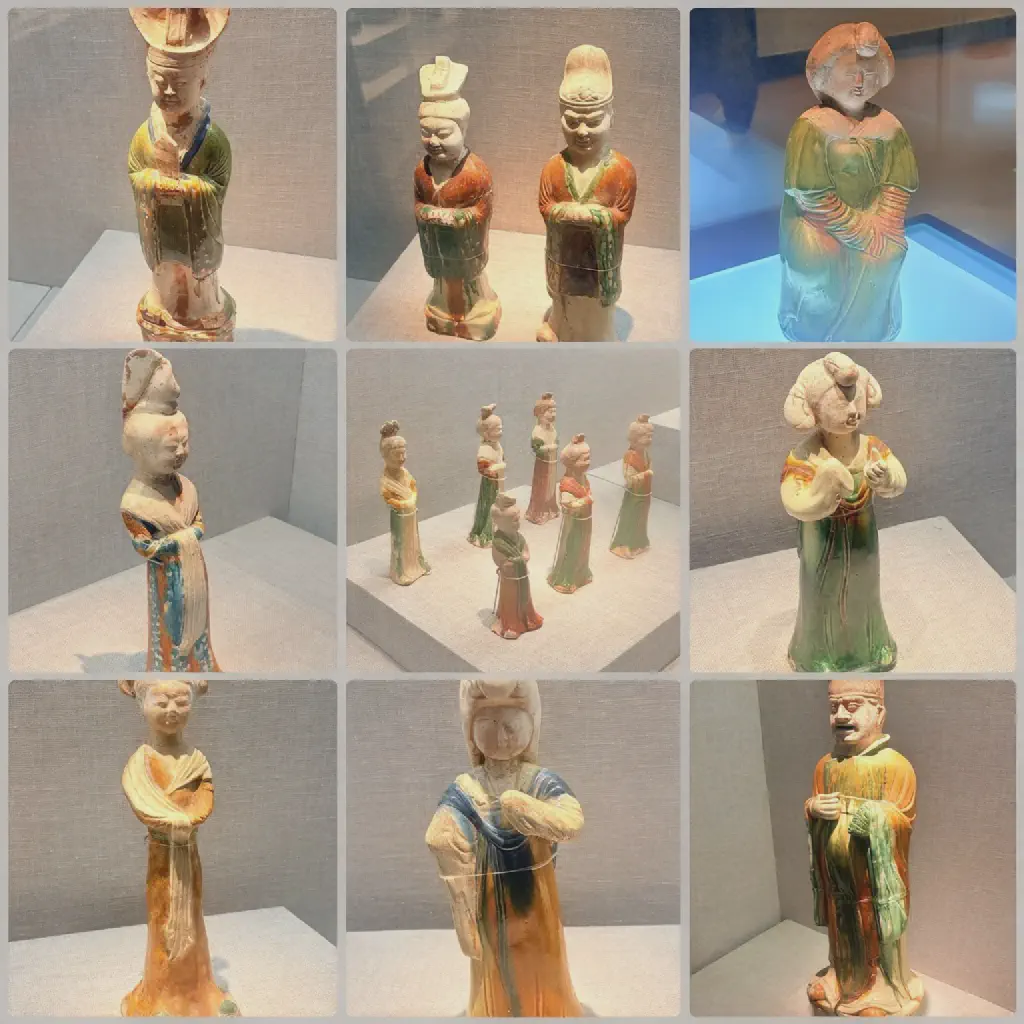
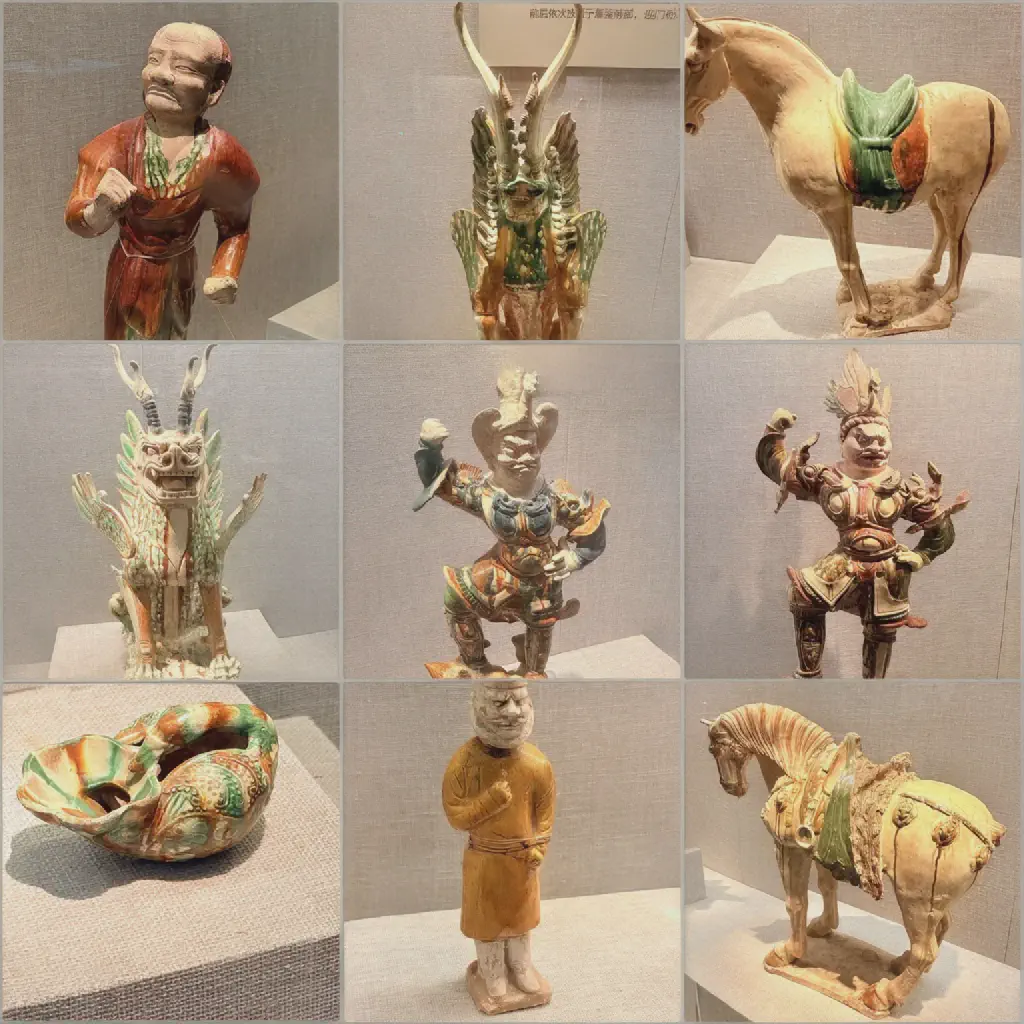
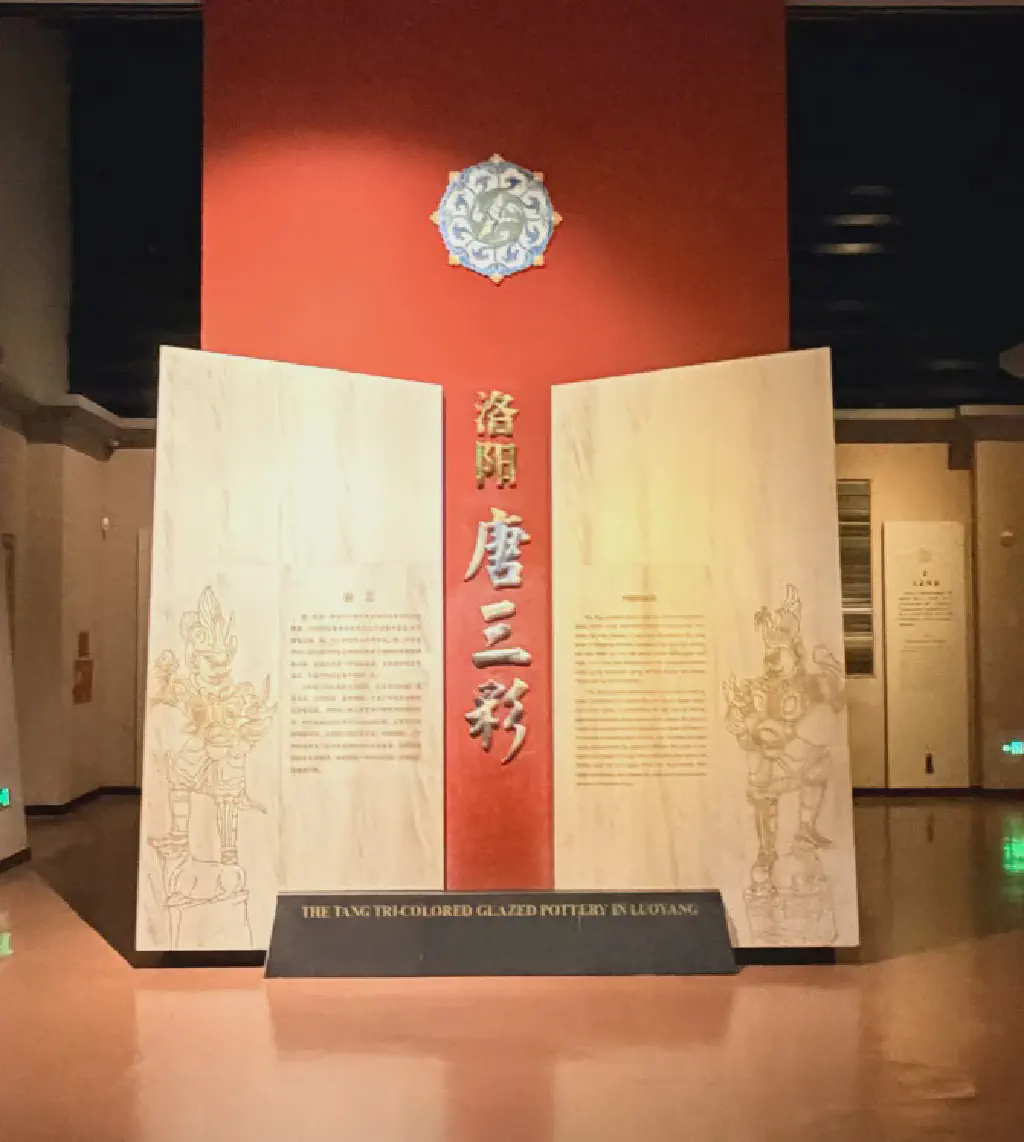 As the eastern capital of the High Tang and the sacred capital of Wu Zhou, Luoyang has a spectacular collection of Tang sancai, roughly divided into sancai camels, sancai horses, sancai female figurines, civil official figurines, warrior figurines, tomb guardian beasts and sancai vessels.
Whether it is the hairstyles and expressions of the female figurines or the many foreign figures, the objects vividly convey the grandeur of the High Tang and the richness of the museum’s holdings.
The Qing Palace Gallery
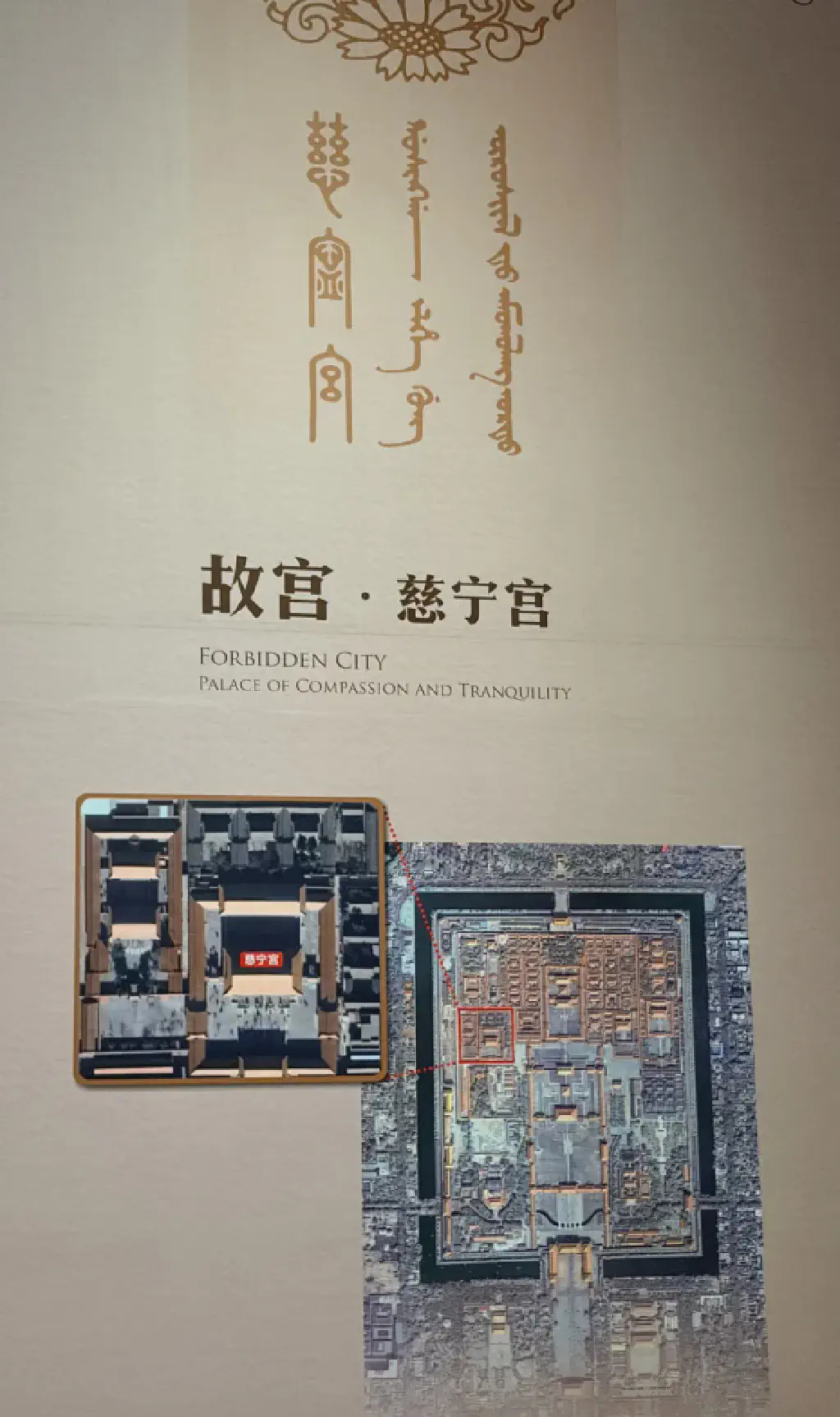
After 1949, part of the Palace Museum collection — mainly Buddhist artifacts from the Great Buddha Hall of the Cining Palace — was allocated to the Luoyang Museum for safekeeping. Some of the finest pieces are displayed here.
1. The Qianlong Golden-thread Nanmu Pagoda
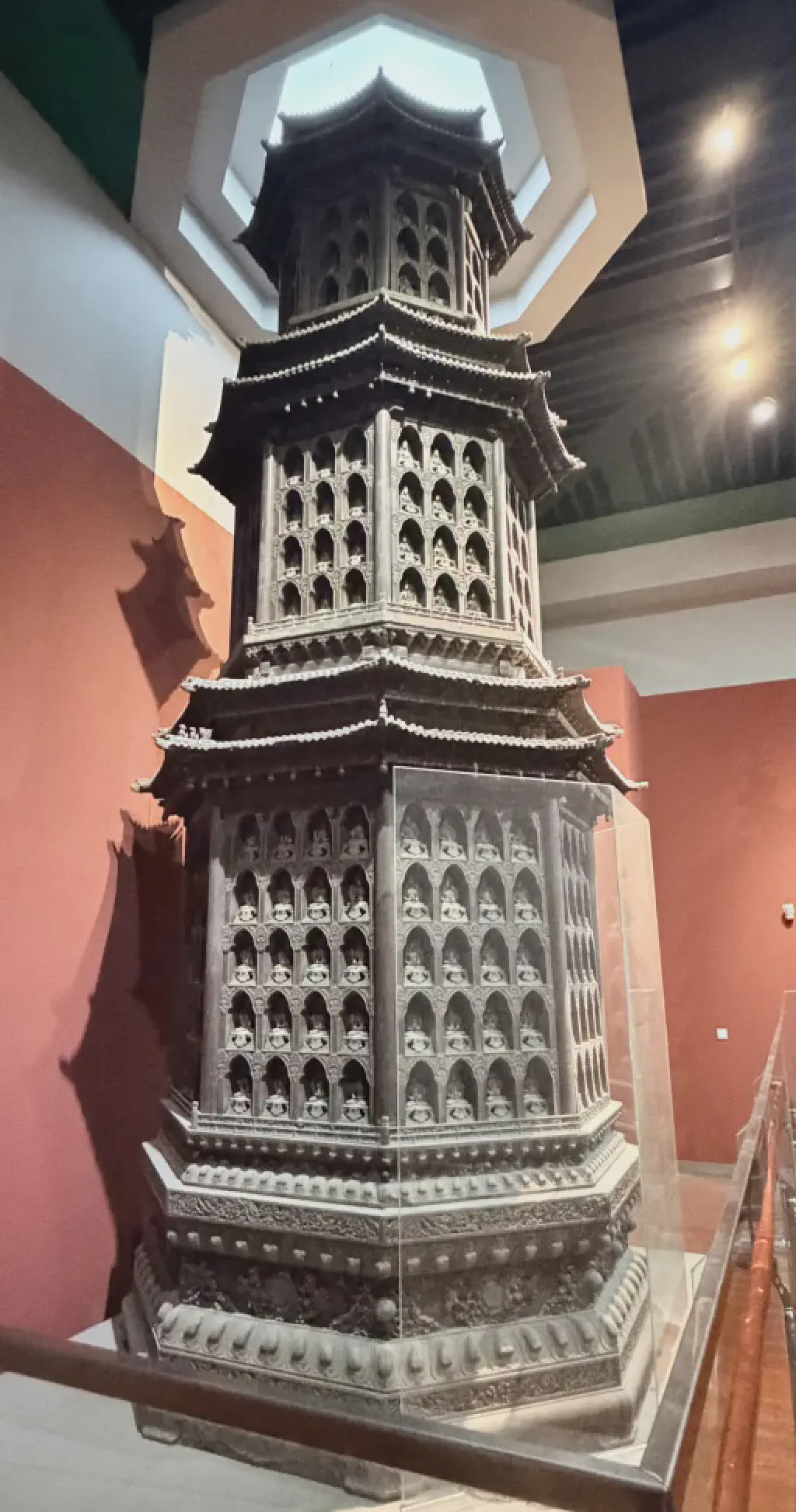 This is the single most important piece in the Qing Palace gallery. In the twenty-sixth year of Qianlong (1761) the emperor had it made especially for the seventieth birthday of his mother, Empress Dowager Xiaoshengxian, the model for Zhen Huan in the TV drama.
- About six meters tall and nearly four tons, a three-storey octagonal pavilion with double eaves, built entirely with mortise-and-tenon joints, without a single iron nail, and it can even be dismantled and reassembled in full;
- Made throughout of precious golden-thread nanmu, with 304 niches on the body, each holding a gilt-bronze Amitayus;
- The octagonal sumeru base is carved with lotus petals and scrolling flowers; the intricate, dignified woodwork is the peak of Qing court carpentry
2. Glass Eight Treasures and Enamel Seven Jewels
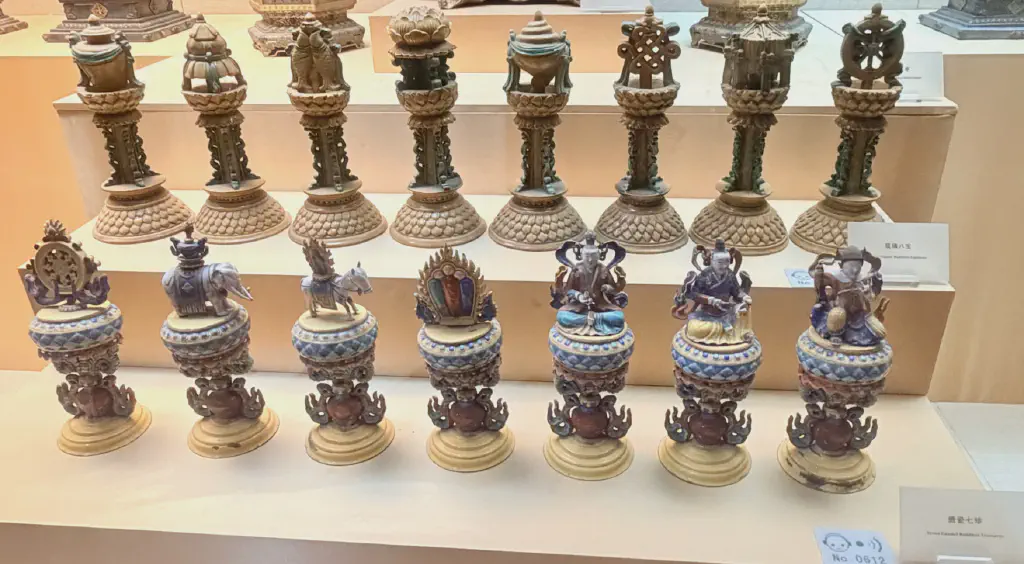
Complete sets of altar offerings, the standard equipment of Qing palace worship:
- The Eight Treasures (eight auspicious symbols): wheel, conch, parasol, white canopy, lotus, treasure vase, golden fish and endless knot, each with an auspicious meaning;
- The Seven Jewels (seven treasures of the wheel-turning king): golden wheel, wish-granting jewel, queen, minister, white elephant, thoroughbred horse and general, symbols of a chakravartin’s merit; this set of colored-glaze offerings is richly colored, with tier upon tier of lotus bases — they once stood in neat rows on the offering table of the Cining Palace Buddha hall.
3. Gilt-bronze Buddhas of the Three Times
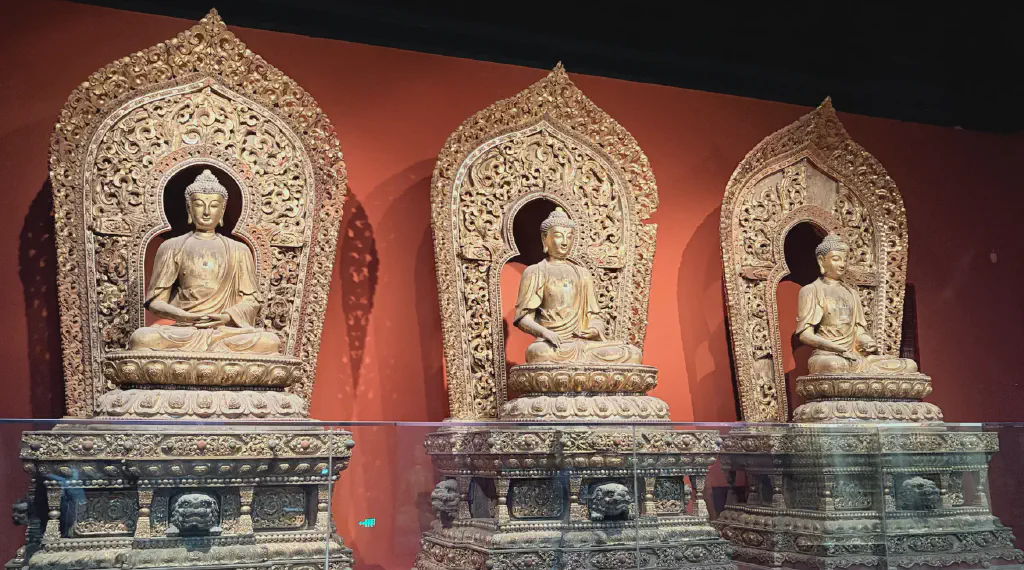
A group of three gilt-bronze figures, from left to right: Medicine Buddha, Shakyamuni and Amitabha.
- Each figure has a huge openwork halo carved with flame patterns and scrolling vines, thickly gilded and opulent;
- The sumeru pedestals below are decorated with lions. These were the main icons of the Cining Palace Great Buddha Hall, representing the eastern Pure Land of Lapis Lazuli, the Saha world and the western Pure Land — the classic Chinese Buddhist grouping and the core images of imperial worship.
4. A Zitan-framed Screen with Carved Wood and Inlaid Jade, “Farm Life”
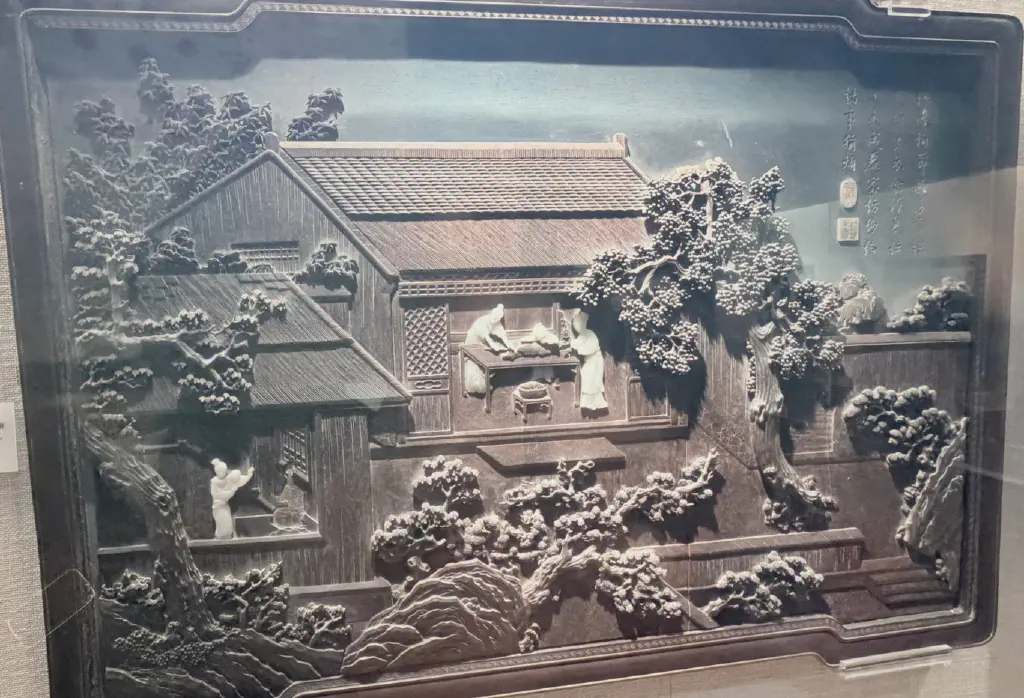
A Qing court decorative hanging screen, framed in zitan, deeply carved with courtyards and landscape and with figures inlaid in white jade. The scene depicts everyday work in a farm household and is accompanied by imperial poems. The interesting part: the empress dowager, living deep in the palace, used this screen to picture rural life — a rare rustic subject among palace inlay works, with refined wood carving and jade inlay.
5. A Gilt-bronze Eleven-faced Avalokiteshvara
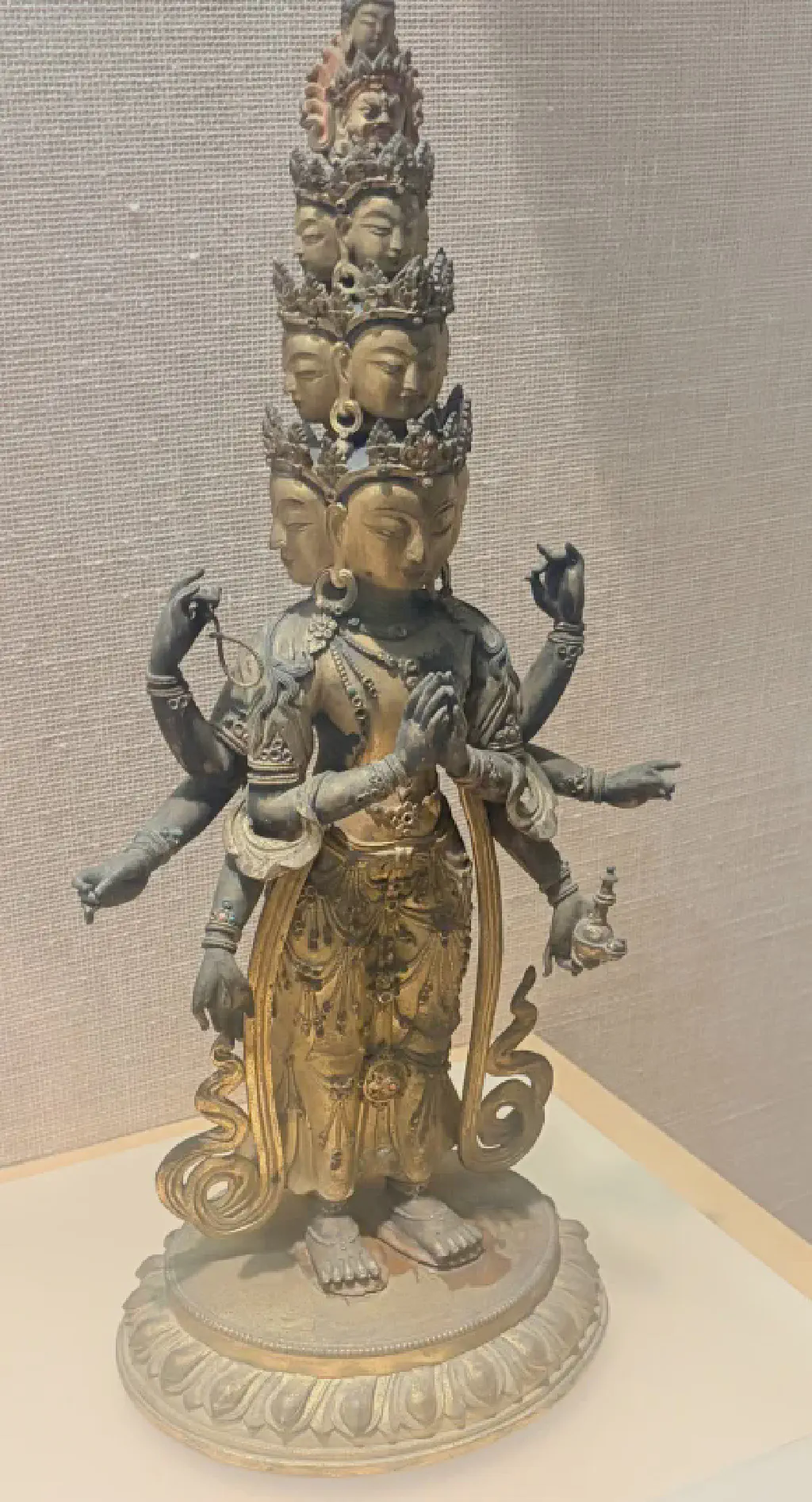
The eleven-faced Avalokiteshvara is an important form of the bodhisattva in Tibetan Buddhism.
- Eleven faces are stacked in tiers on the head, with multiple arms extended, each hand holding a ritual implement;
- Fully gilt bronze, with lively necklaces and ribbons and a regular lotus throne. The eleven faces mean the bodhisattva watches over beings in every direction, averting disaster and bringing blessing; it is an important Tibetan-style image from the Cining Palace hall.
6. Gilt-bronze Five Offering Bodhisattvas
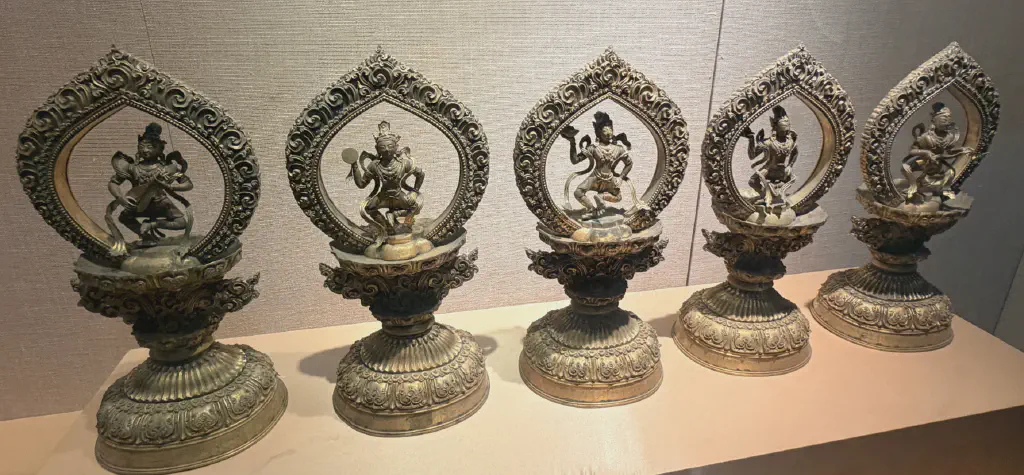
This striking group of gilt five offering bodhisattvas (the five wonderful desires) also comes from the Cining Palace Great Buddha Hall. They form the “five wonderful desires” offering: the five figures correspond to the Buddhist five desirable qualities — form, sound, fragrance, taste and touch — five kinds of offering that delight the buddhas and bodhisattvas:
- Sound: holding a pipa, an instrument that stands for sound
- Form: holding a round mirror that reflects all phenomena, standing for form
- Fragrance: holding a conch that holds incense, standing for fragrance
- Taste: holding a bowl of fruit, standing for taste
- Touch: holding silk, its softness standing for touch
What the figures are like:
- Each offering goddess is in a lively dancing pose with celestial garments flying;
- Behind each is a large peach-shaped flame halo carved all over with scrolling foliage;
- The bases are multi-tiered lotus thrones, fully gilded; the elaborate, sumptuous workmanship marks a complete Tibetan-style set of altar offerings.
The Heluo Civilization Exhibition
The ground floor holds the museum’s core permanent display, the “Heluo Civilization Exhibition”, a general history survey running from prehistory to the Tang and Song.
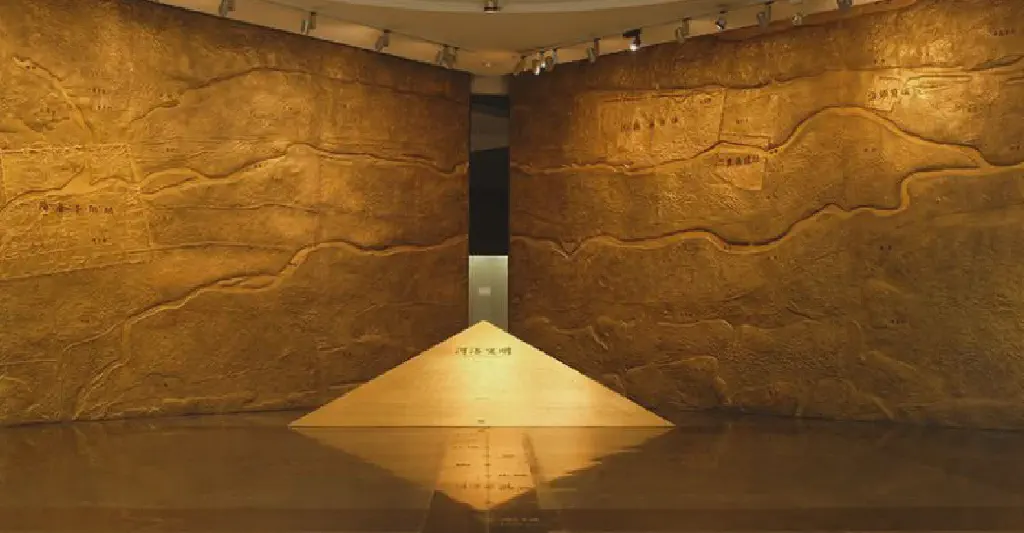
Prehistoric Period
The Yellow River elephant fossil, one of the museum’s signature pieces, is the first thing you see on entering: a complete skeleton of an ancient elephant from fifty thousand years ago. Breathtaking.
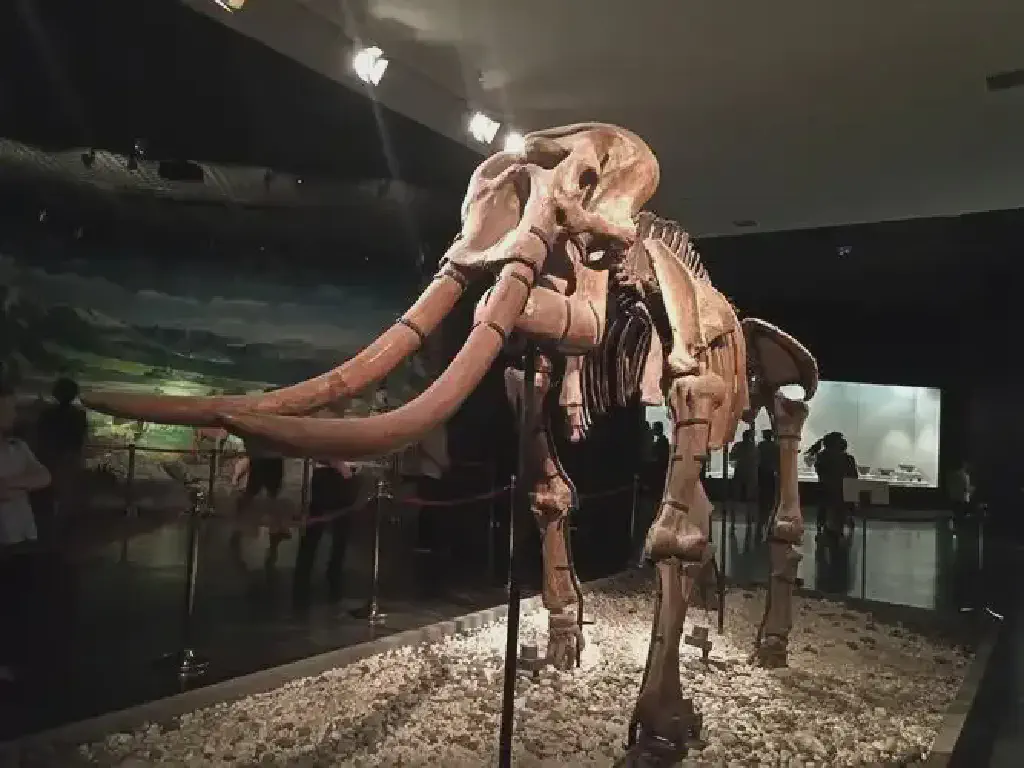
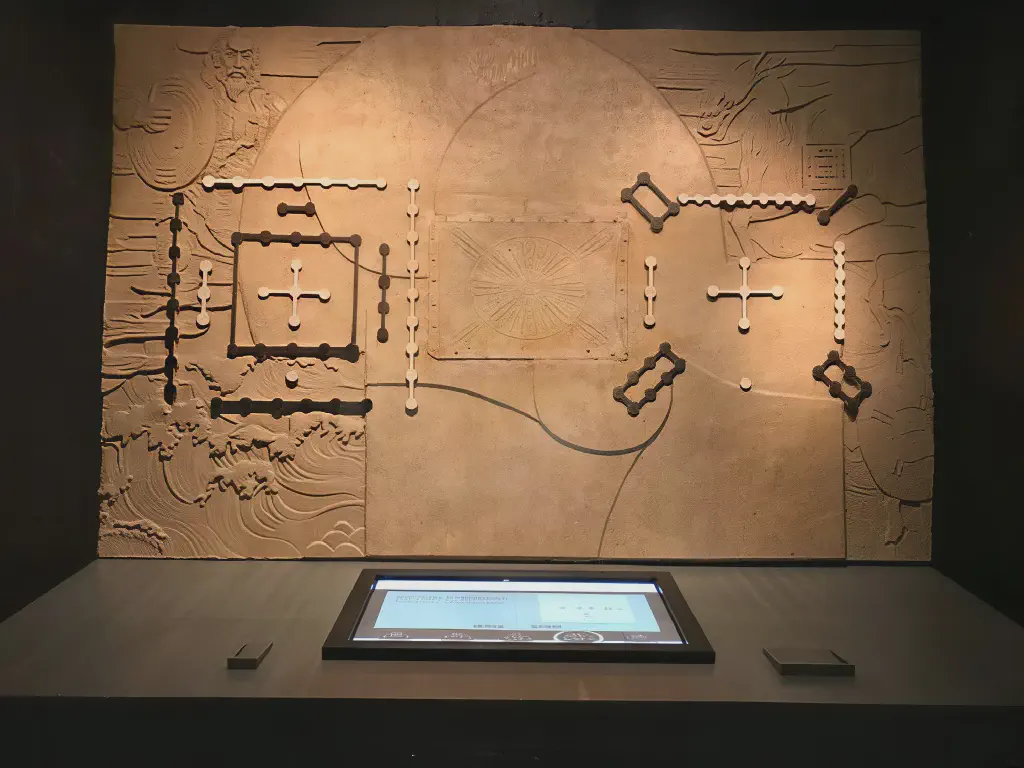
A panel on the Hetu and Luoshu. The Great Commentary to the Book of Changes says: “the Yellow River gave forth the diagram, the Luo River gave forth the writing, and the sages took them as their model.” The Heluo region is where the Hetu and Luoshu originated and the home of the Zhouyi trigrams. Legend has it that Fuxi drew the eight trigrams from the Hetu, and that when Yu the Great was taming the floods a divine turtle rose from the Luo bearing the Luoshu, after which he succeeded and divided the world into nine provinces.
Xia and Shang Period
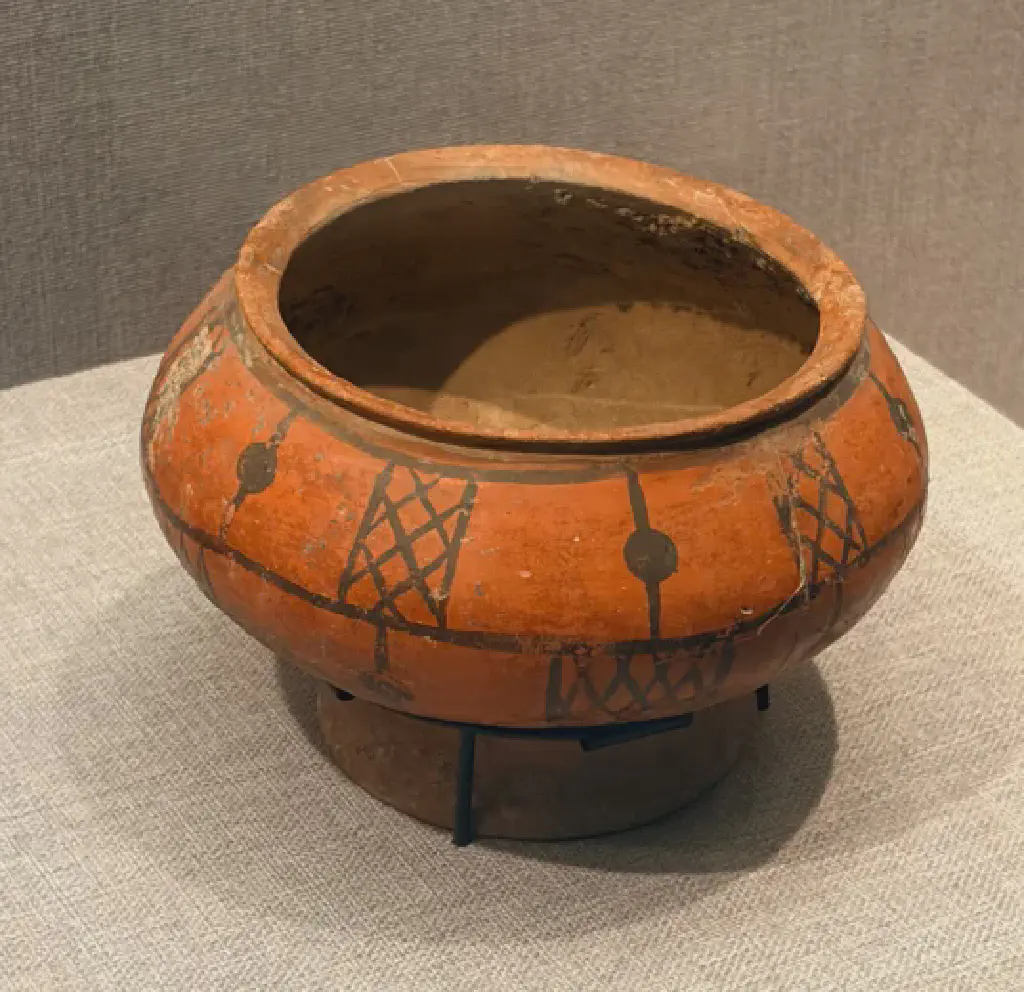 A Yangshao culture pottery jar, more than five thousand years old, representative of prehistoric painted pottery in the Heluo region and a storage vessel used daily by Yangshao people along the Yi River.
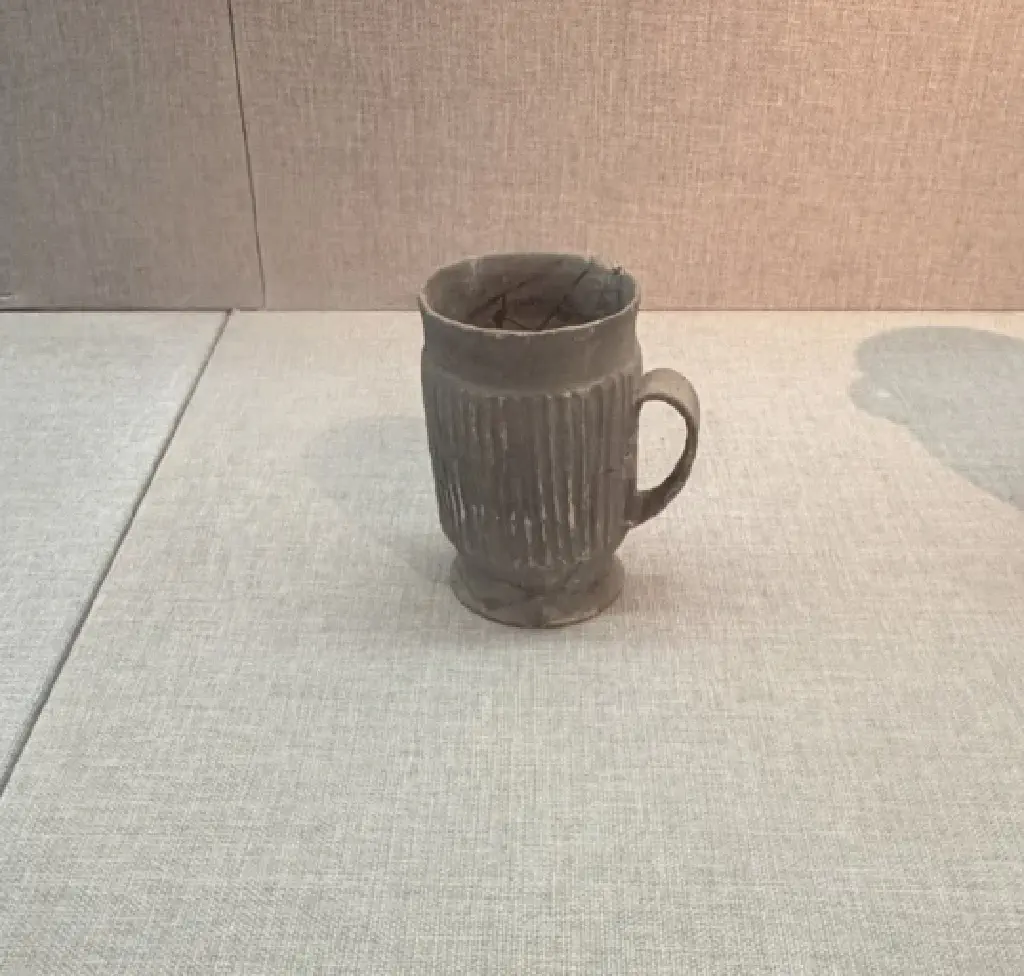
A Xia dynasty grey pottery cup, strikingly similar to a modern beer mug.
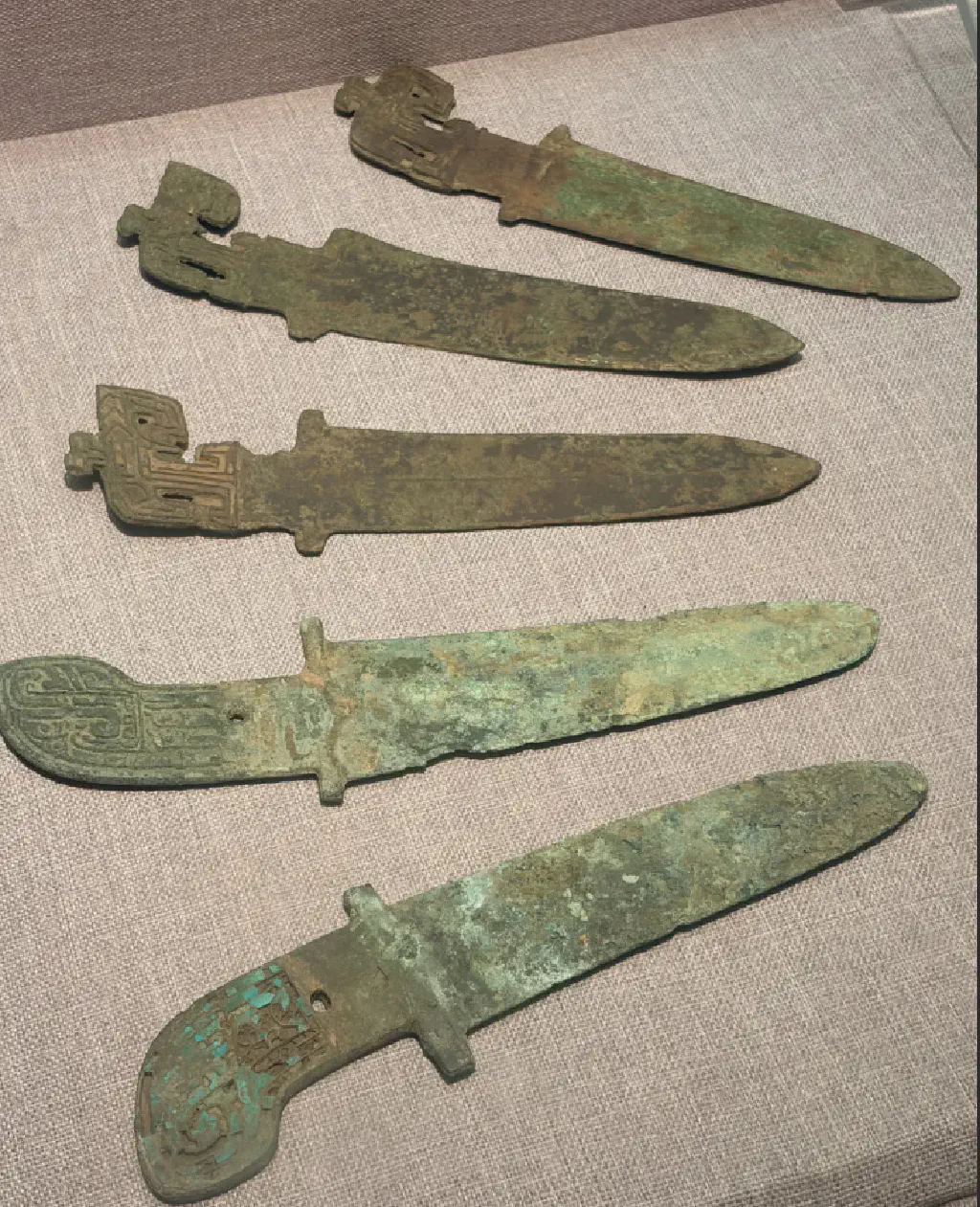 A Shang bronze ge dagger-axe with a curved tang. Its main motifs are kui dragons and phoenixes, typical Shang imagery; compared with the earlier Erlitou Xia ge it is already more ornamental and more ritualized.
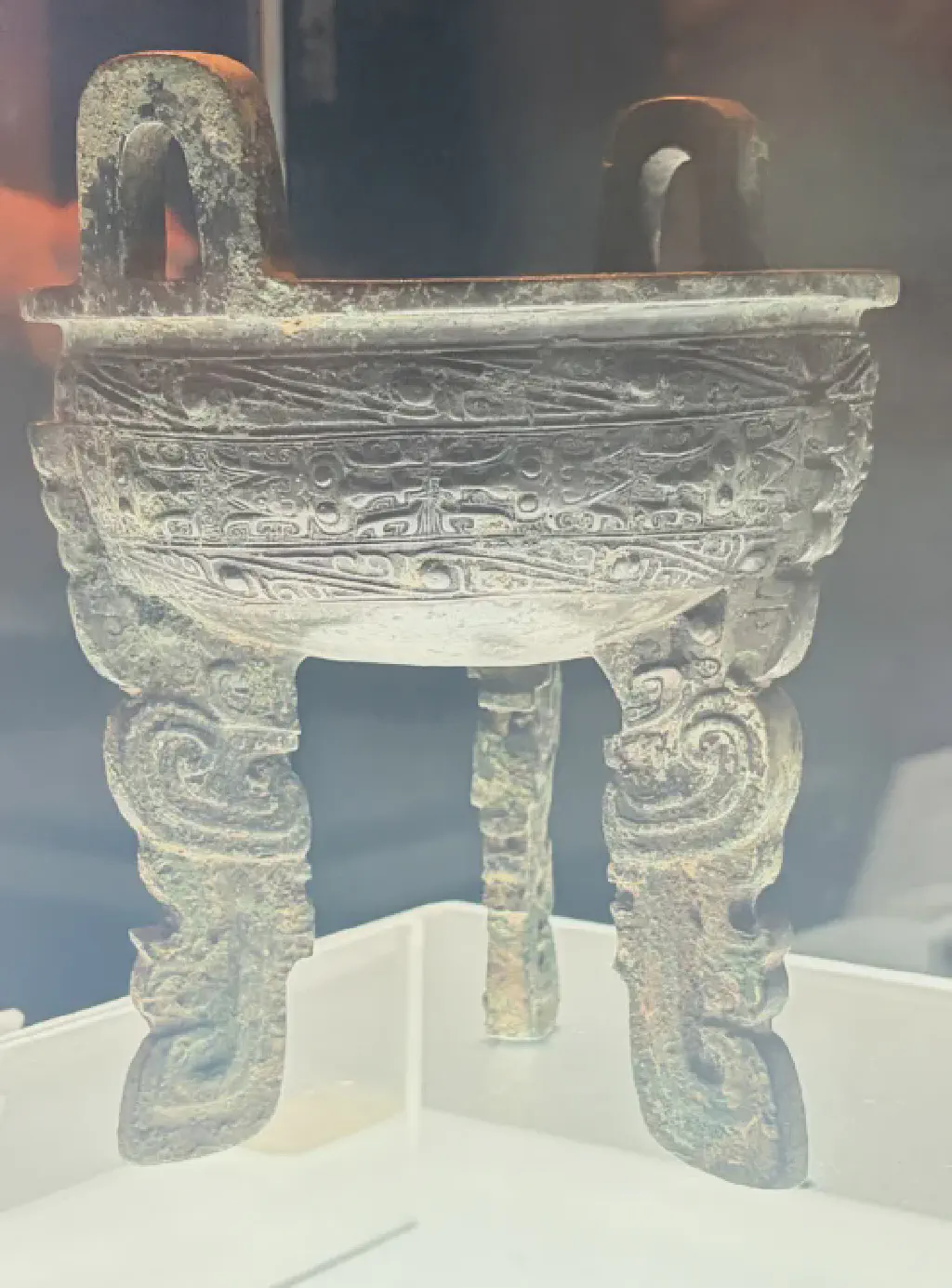 A Shang bronze ding with flat legs, inscribed “Zi Shen fu Ji” — a ritual vessel used by the nobleman Zi Shen to sacrifice to his ancestor Fu Ji.
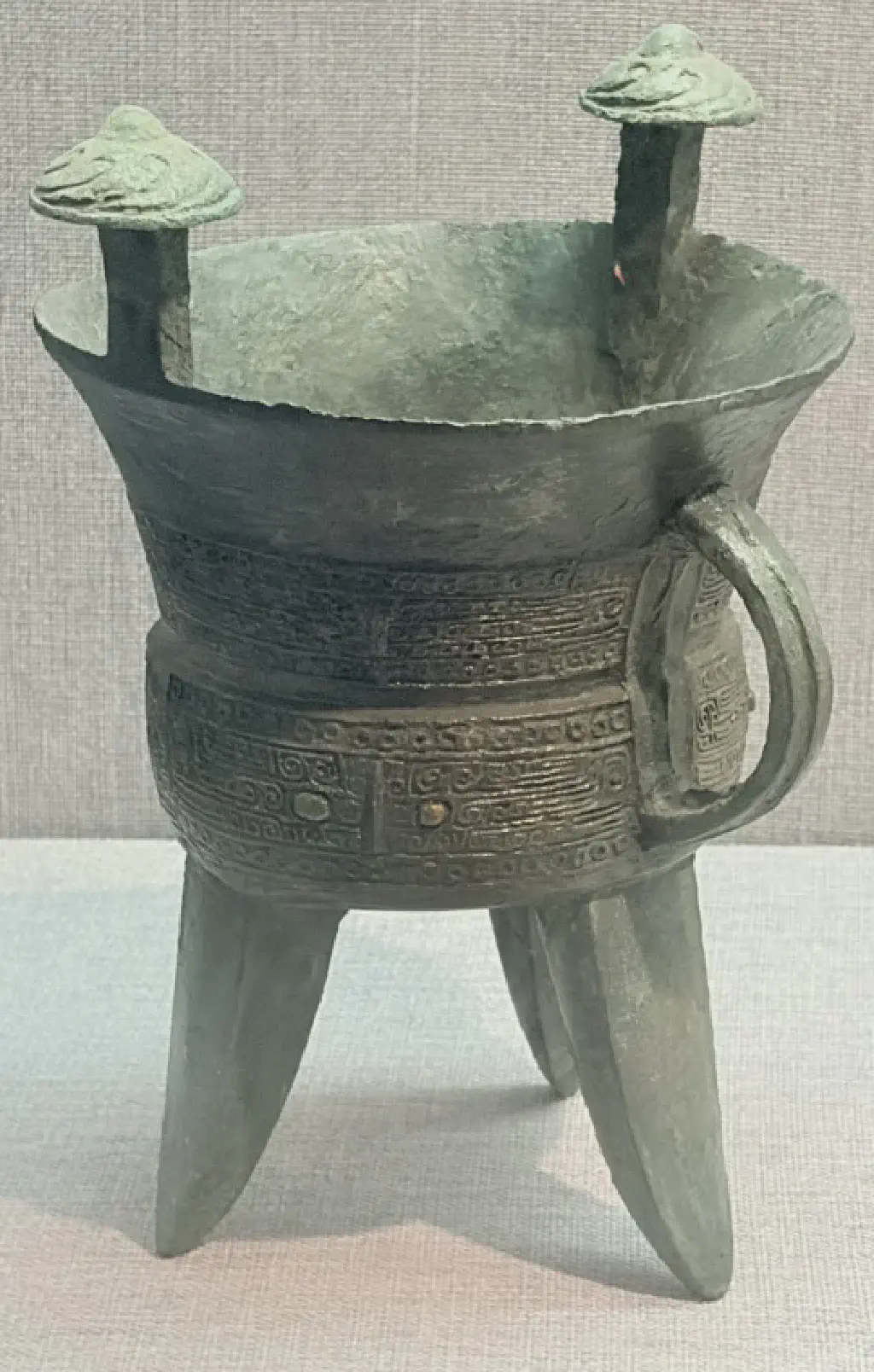 A Shang bronze jia with taotie masks, the typical Shang vessel for warming wine (unlike the jue it has no pouring spout), one of the Shang wine ritual set alongside the jue and gu.
Zhou Dynasty Bronzes
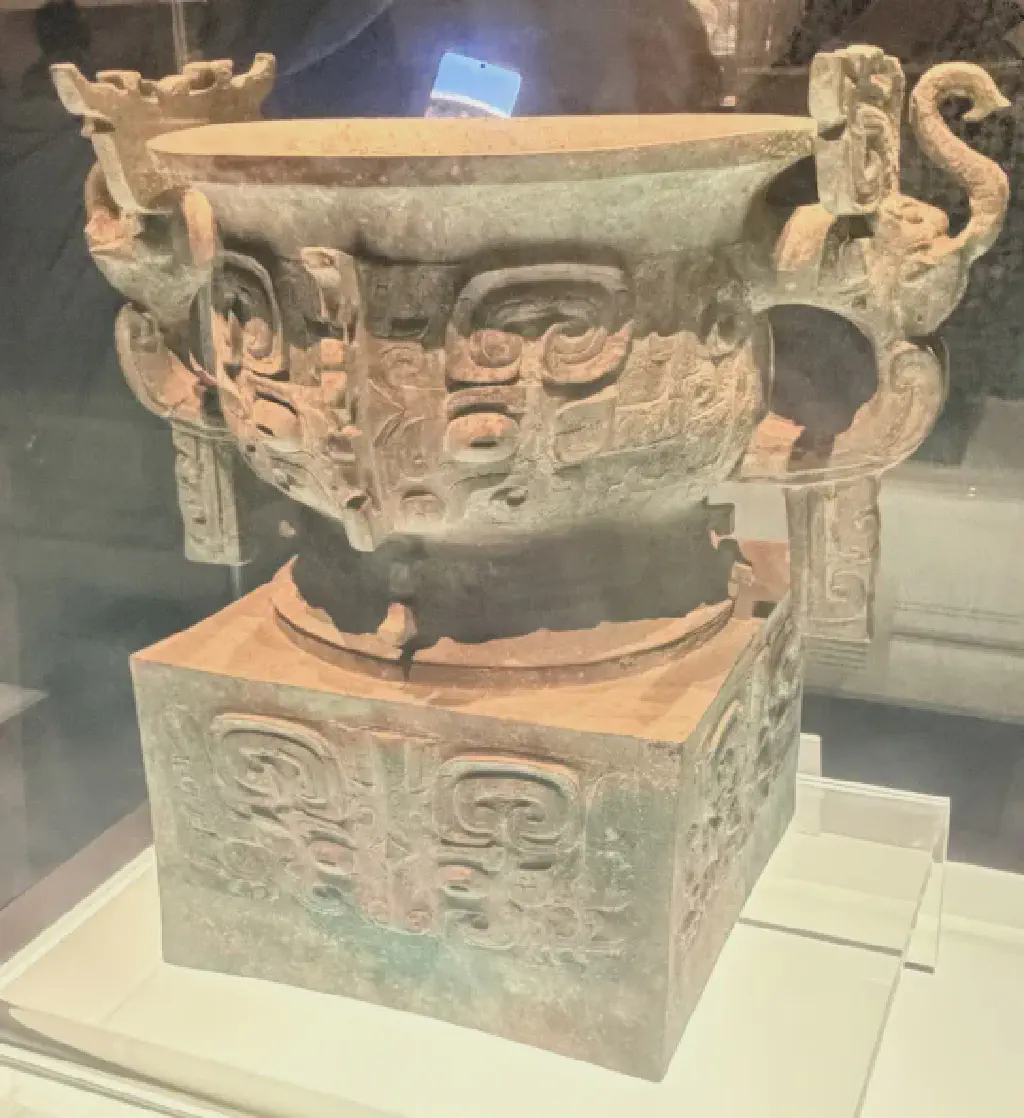 A Western Zhou gui with taotie masks on a square base. The gui was one of the most important Western Zhou ritual vessels, used to hold millet and other grains at sacrifices and banquets. In the Zhou ritual system ding and gui came in sets: “the ding holds meat, the gui holds grain”, with nine ding and eight gui for the Son of Heaven and seven ding and six gui for the feudal lords, marking rank.
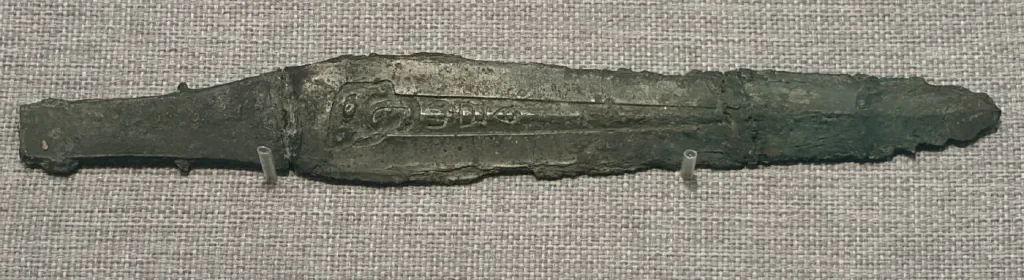 A Western Zhou bronze sword of Feng Bo. The blade bears animal-head motifs and the inscription “Feng Bo”; it was a nobleman’s personal ornament rather than a weapon for battle.
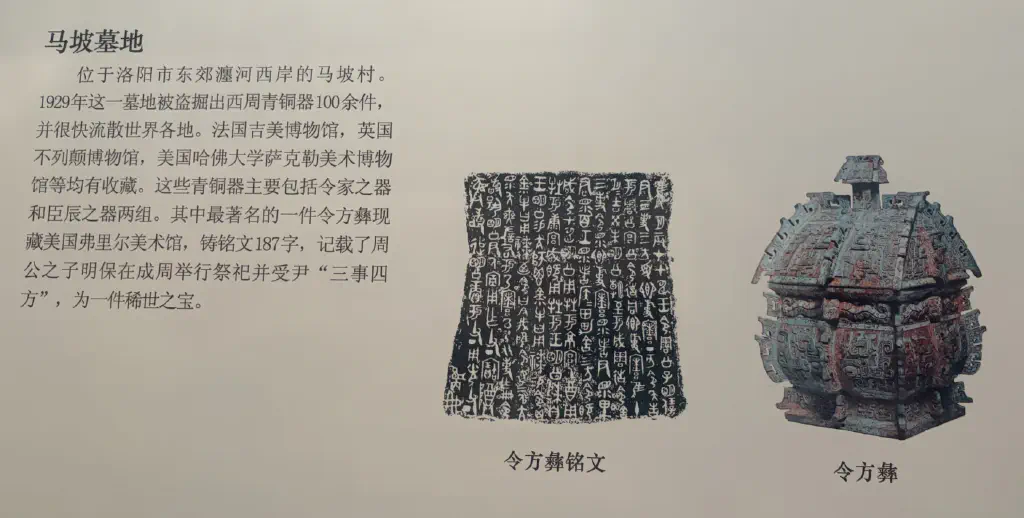 The Mapo cemetery, an important early archaeological discovery — sadly its treasures are now abroad.
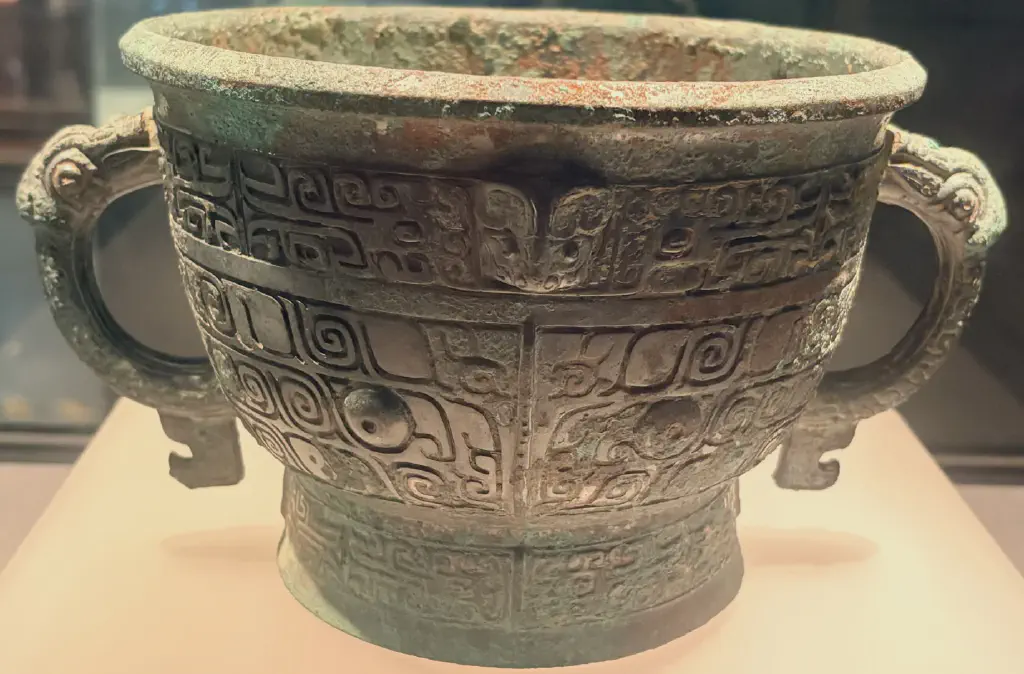 The Wang Ren gui. The decoration runs in two registers: kui dragons above, a large taotie mask below, rich and splendid; the ring foot also carries kui dragons. The inscription inside reads Wang Ren, showing the vessel belonged to “Wang Ren”. Ren is a clan name; Wang Ren was a woman of the Ren clan married into the Zhou royal house.
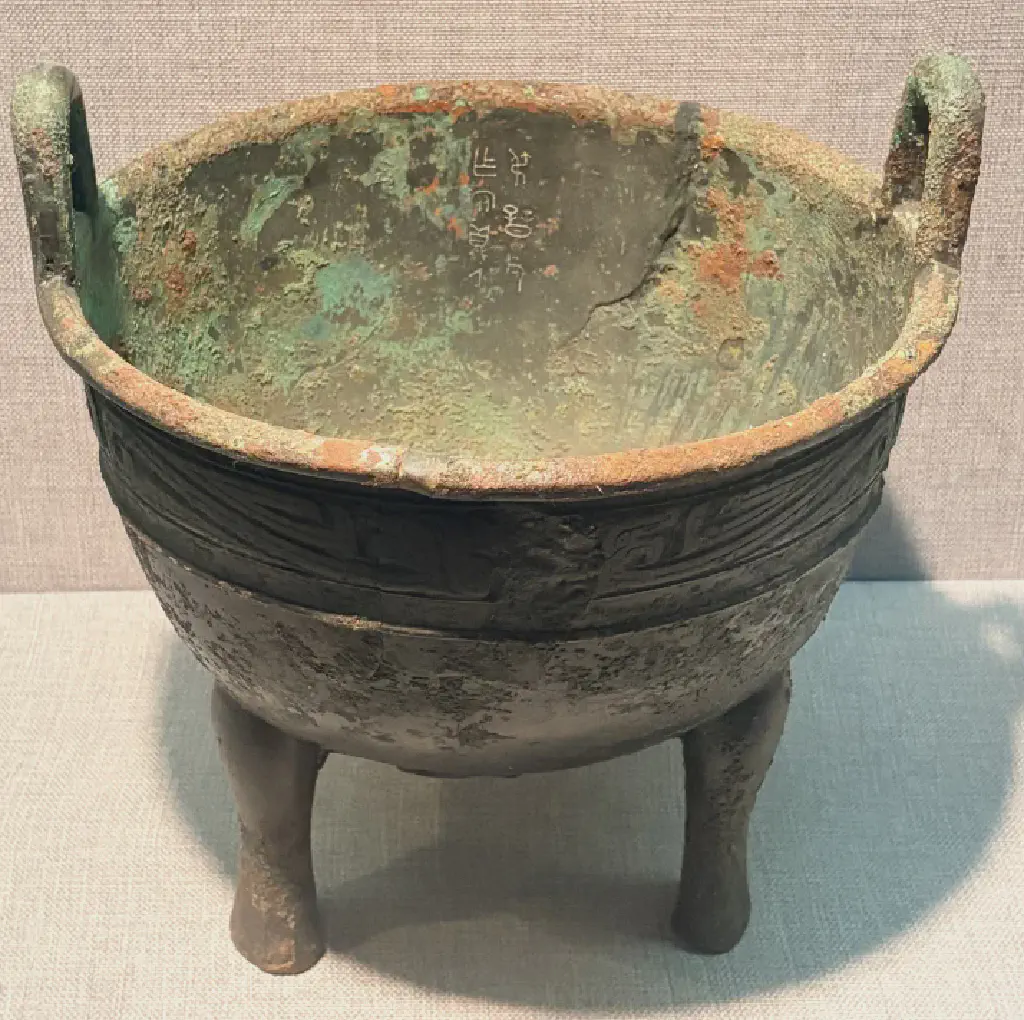 A Western Zhou round ding with two upright handles, a rounded belly and three hoof-shaped legs, a band of qiequ scrolls below the rim (a motif popular from the mid Western Zhou, simplified from earlier taotie masks). The inscription on the inner wall reads: Shu Fu made this precious ding.
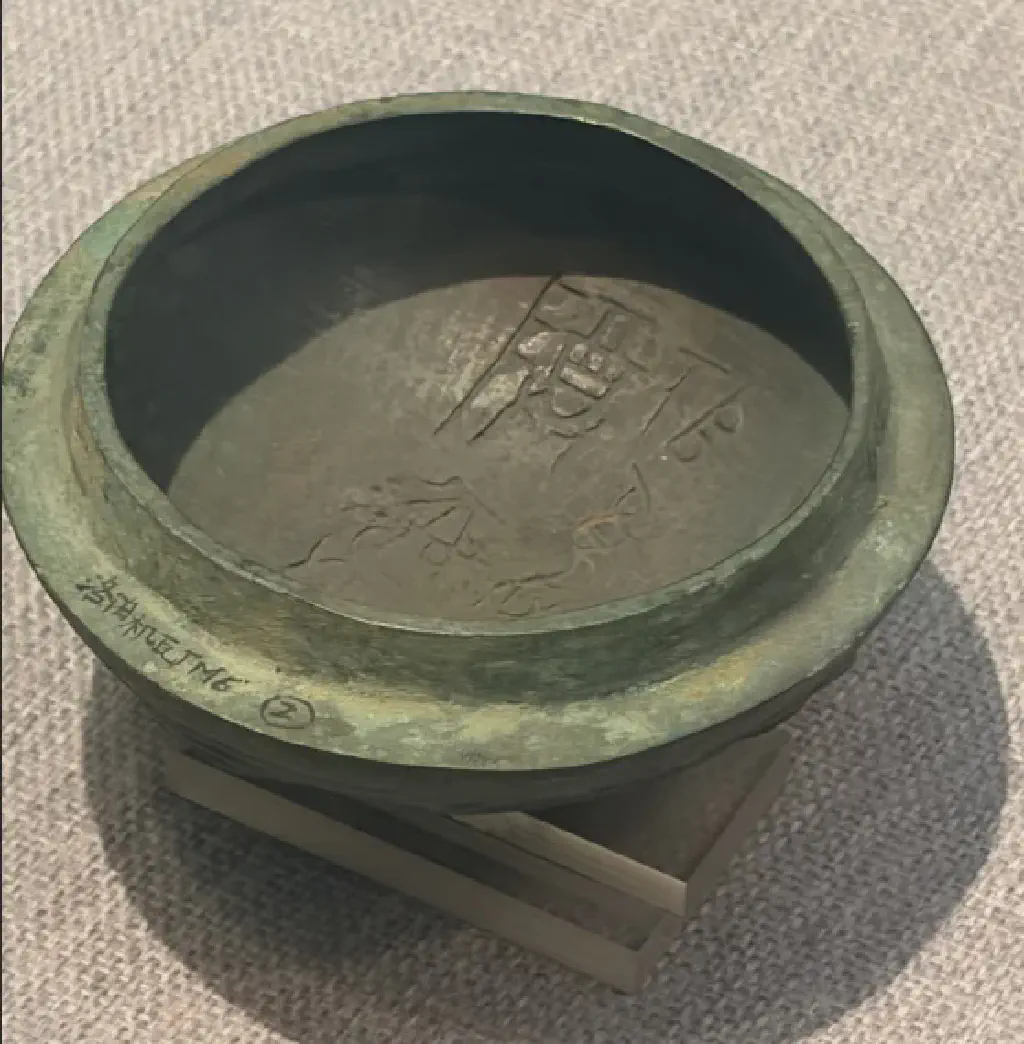 The lid of a bronze hu; the body it belonged to is lost and only the lid survives. The inscription inside reads: Shi Huo made this ritual vessel.
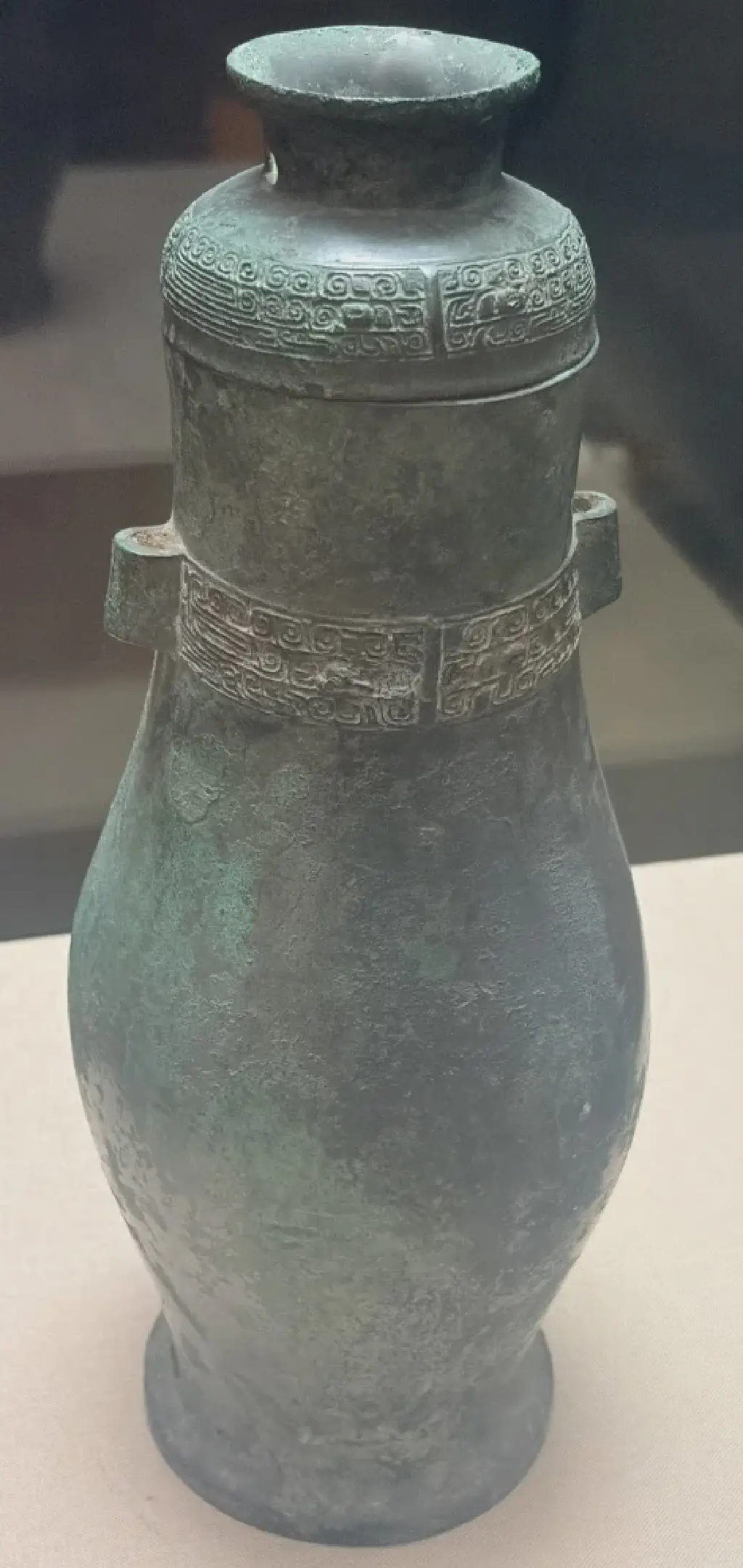 The Kao Mu hu, a lidded hu with tubular handles, slender and elegant. The inscription “Kao Mu” shows the owner was a noblewoman.
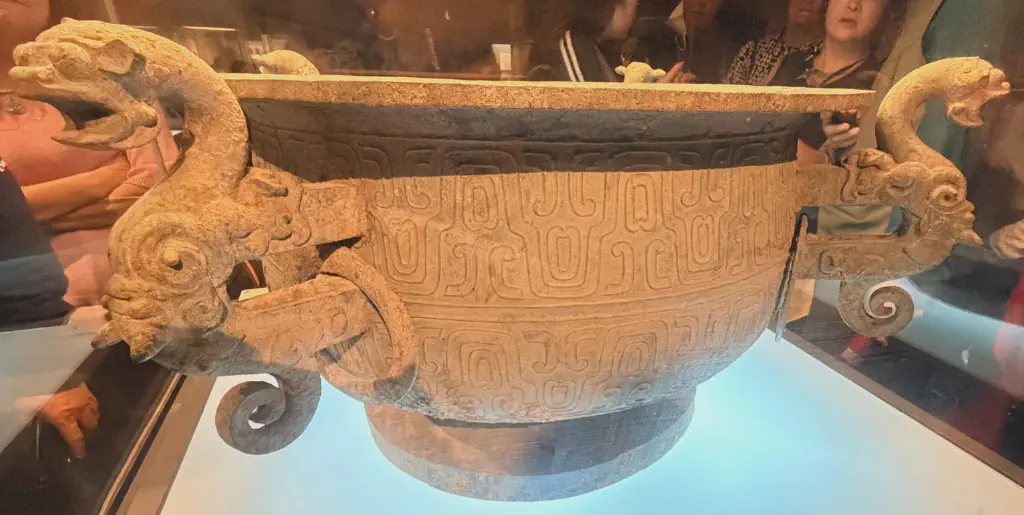 The Qi Hou yu, a heavyweight Spring and Autumn treasure of the museum, huge and imposing. The handles on either side are great dragons with raised heads and coiled bodies, rings hanging below them; the body is covered with continuous intertwined kui dragon scrolls in flowing lines, above a broad, thick ring foot. The inscription reads: Qi Hou made this precious yu for his daughter Zhong Jiang — the ruler of Qi casting the vessel for his own daughter, direct evidence of a marriage alliance between Qi and the Eastern Zhou royal house.
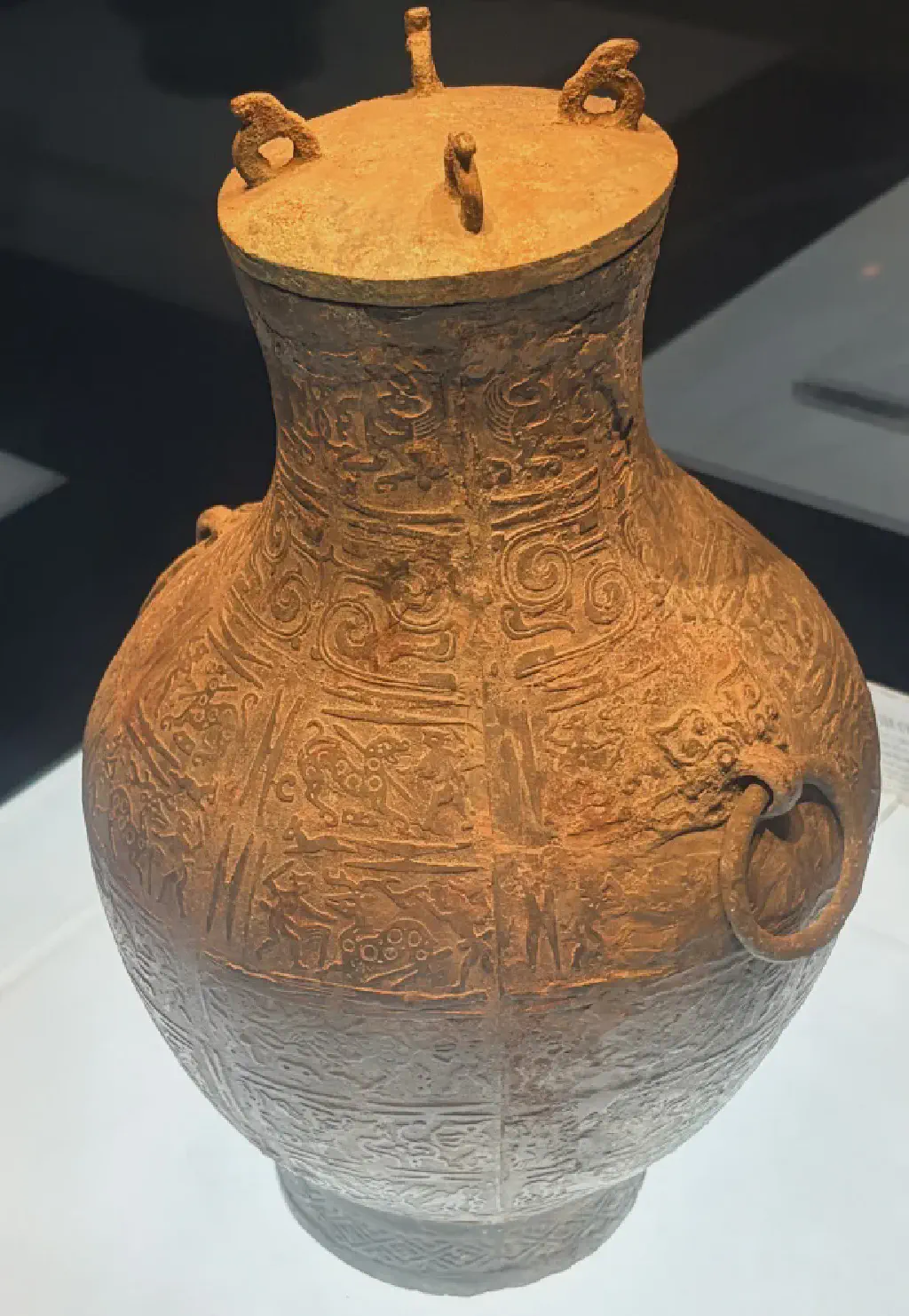 A Warring States hu with hunting scenes, arranged in registers from top to bottom: birds seizing snakes, hunting, banqueting and music-making. You can see hunters with bows and raised spears chasing animals, birds and beasts running and fleeing, the figures full of movement — a popular Warring States type of pictorial bronze. It marks the beginning of narrative imagery that depicts real life directly.
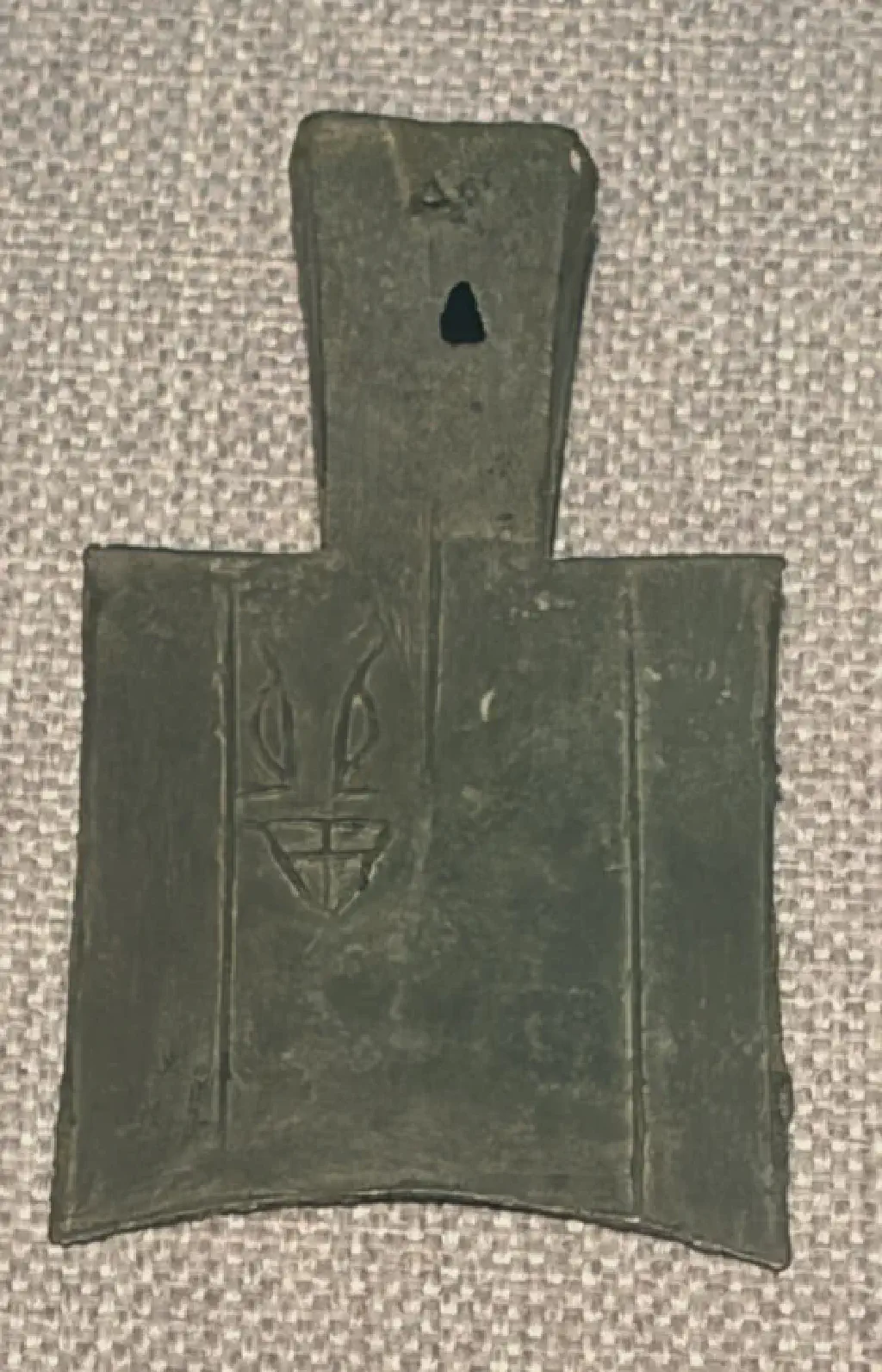 Cloth money circulating in the Eastern Zhou royal domain of Luoyi.
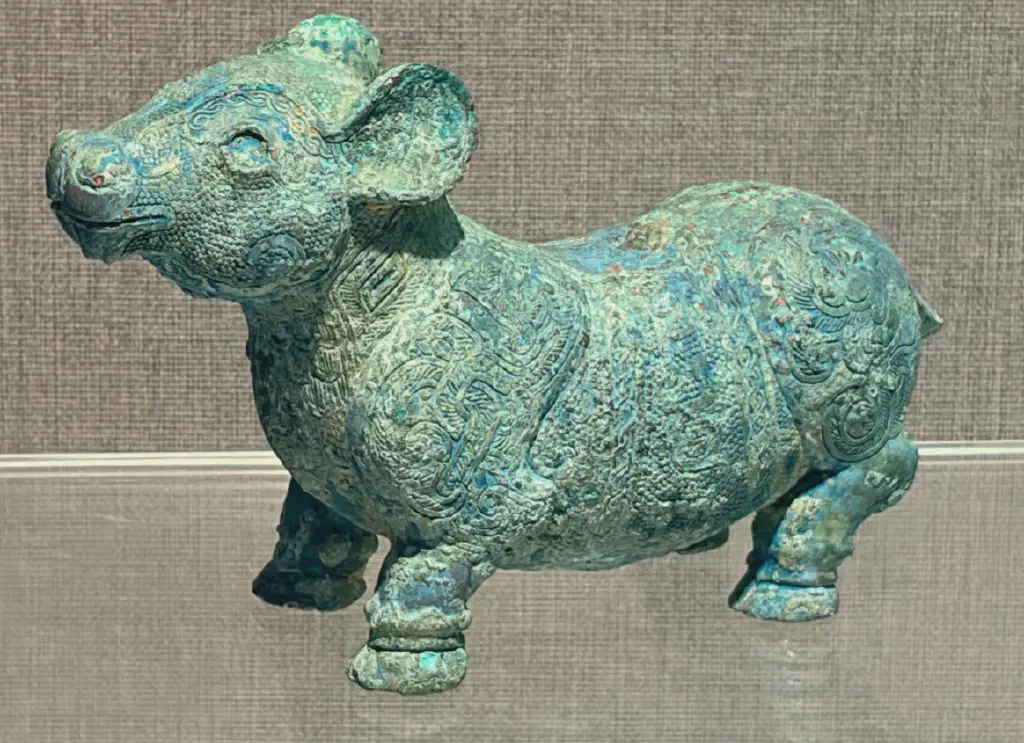 A Warring States bronze xi (xi zun) with scale patterns, an extremely popular “bronze pet”. The form is a plump auspicious beast, a xi, not any single real animal but a sacrificial creature the ancients combined from several. The whole body is covered in fine, orderly scale patterns with cloud scrolls; the body is stocky with short legs and round ears, its expression endearing. It originally had a lidded opening on its back for pouring in wine — a wine vessel used in sacrifice.
Han, Wei, Jin and Northern and Southern Dynasties
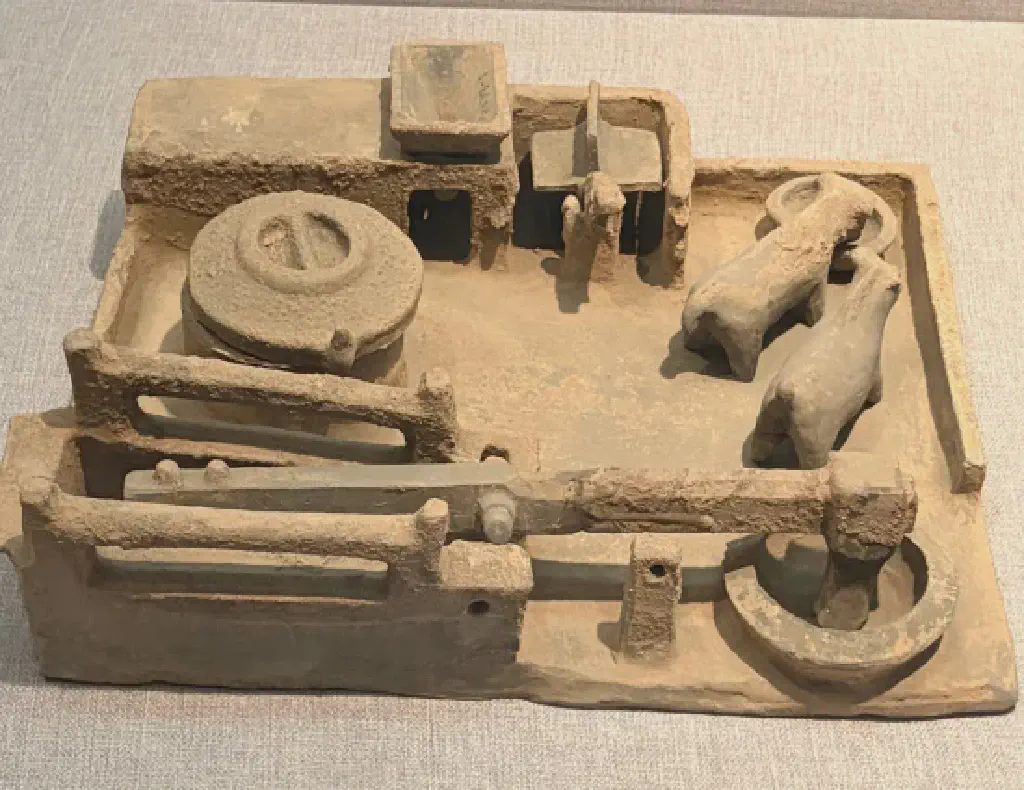 An Eastern Han pottery grain workshop, a tomb model. The Han believed in serving the dead as in life, transplanting the world they knew into the next. This piece shows a self-sufficient grain-processing workshop, grinding flour and husking rice in one continuous line, with an animal pen at the back — a complete set.
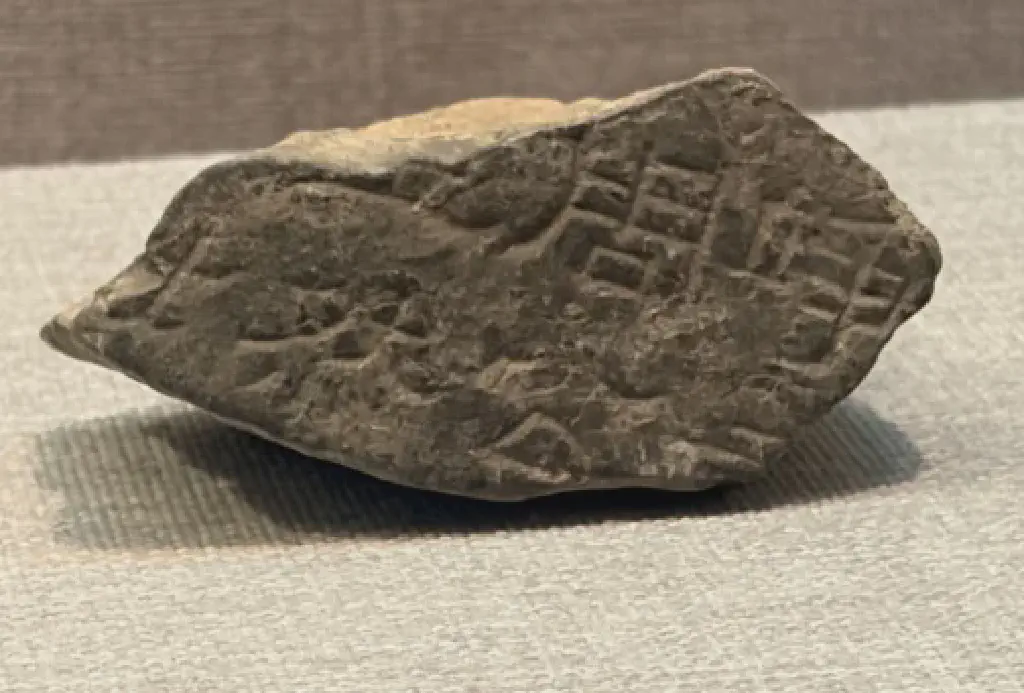 A fragment of the Xiping Stone Classics. The Xiping Stone Classics were the first officially sanctioned standard text of the Confucian canon in Chinese history. Under Emperor Ling of Han, because hand-copied editions were full of errors, Cai Yong petitioned the court to have the six classics — the Book of Changes, Book of Documents, Analects and others — collated officially, written in clerical script and carved on 46 stelae set up before the Eastern Han Imperial Academy south of Luoyang, as the standard for scholars everywhere to copy and study. The Eastern Han equivalent of an official textbook.
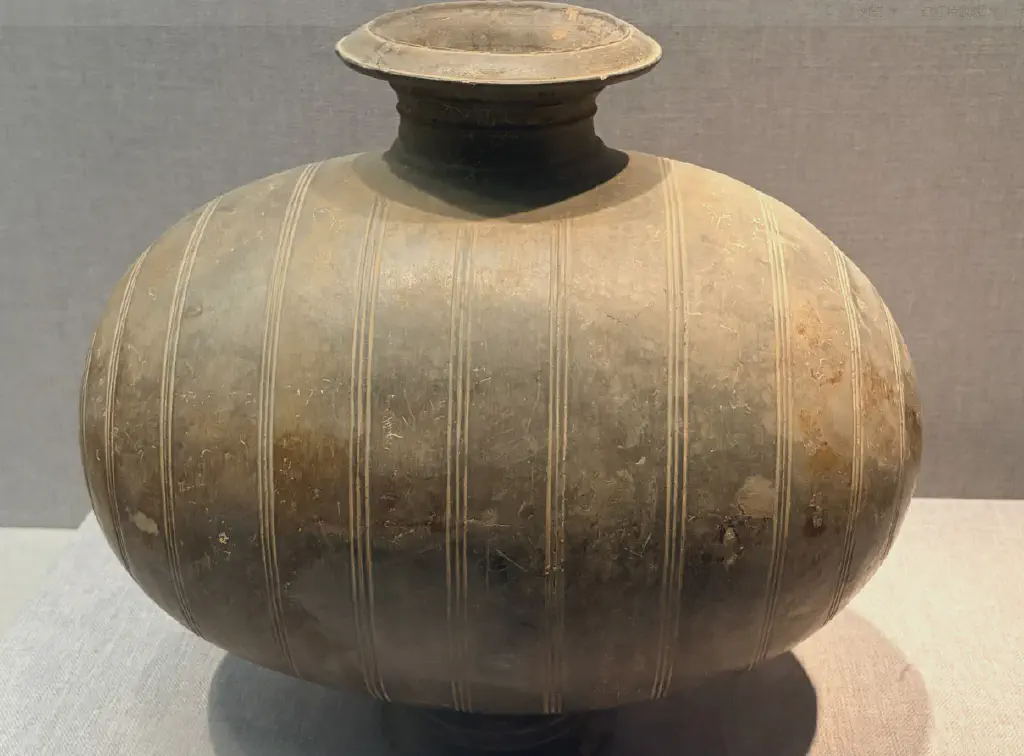 The “ancient mini submarine” is officially an Eastern Han cocoon-shaped hu with bowstring bands, a vessel for storing water or wine and a very distinctive Han pottery form.
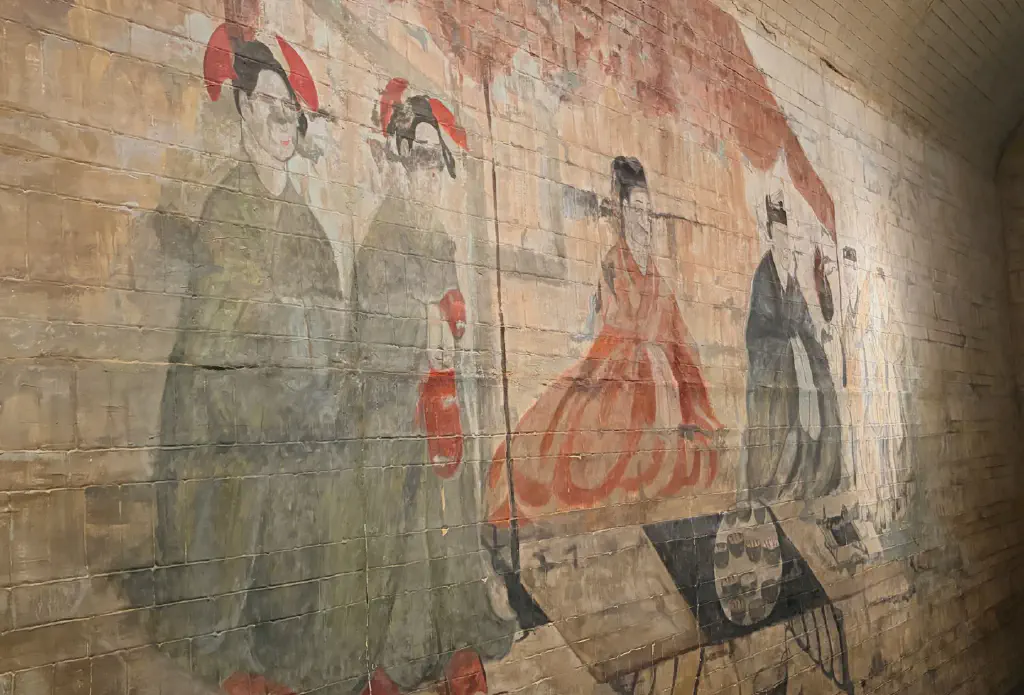 A Cao Wei mural, “A Couple Banqueting”, showing directly the high chignons of noblewomen, the jinxian caps of men and the cut of robes at the turn from Han to Wei.
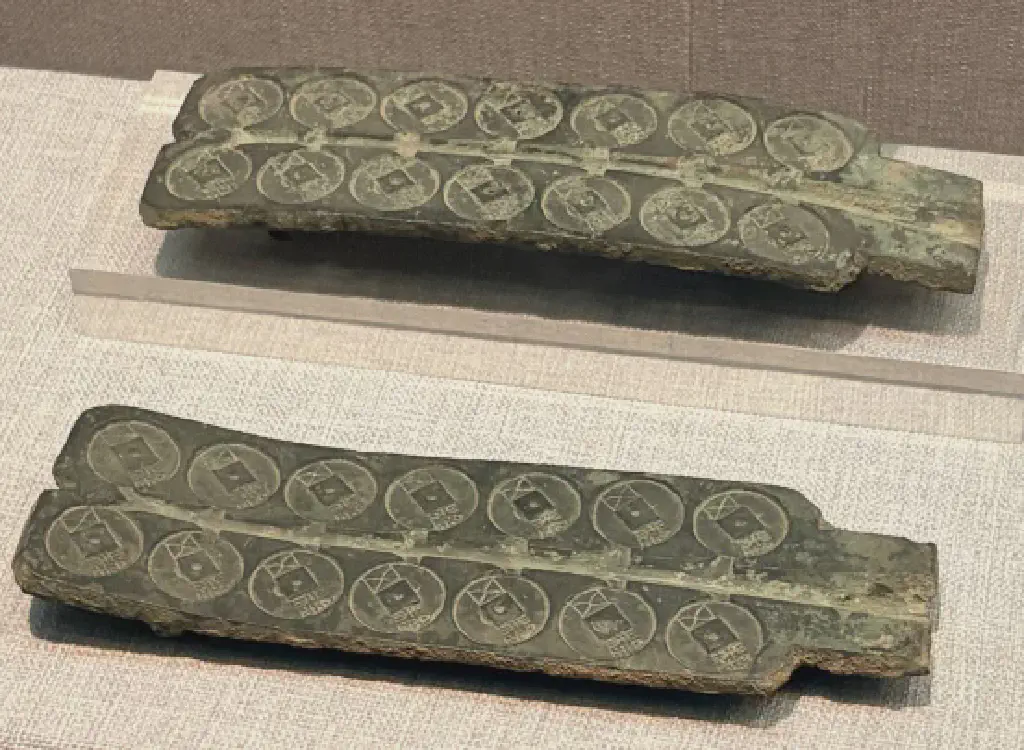 An Eastern Han bronze mold for wuzhu coins from a commandery mint, physical evidence of local coin casting at the time.
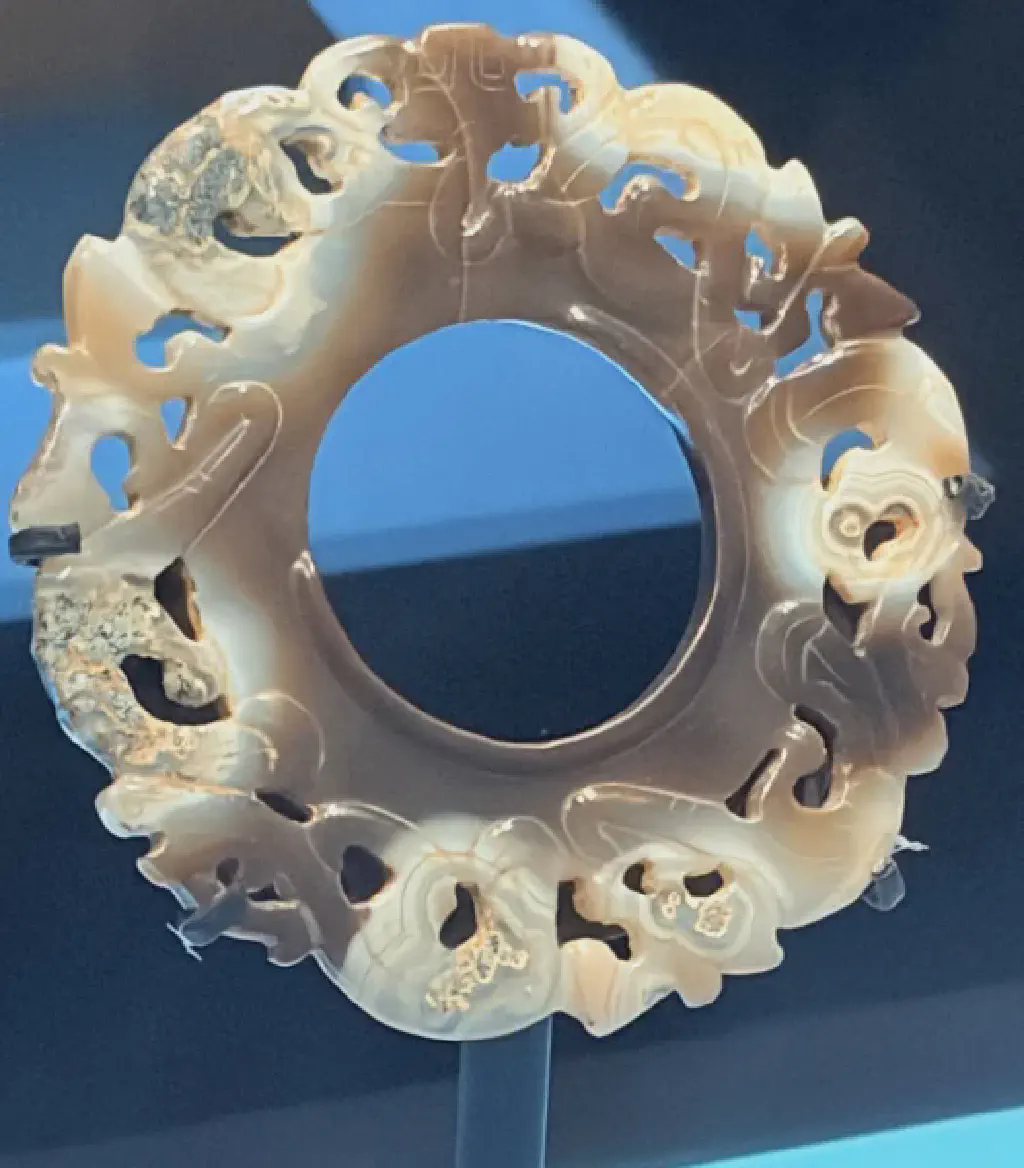 A Western Jin agate bi disc with kui dragons. The carving follows the stone’s natural banding so that ornament and material merge. Most such banded agate came from western Asia, evidence of Silk Road trade.
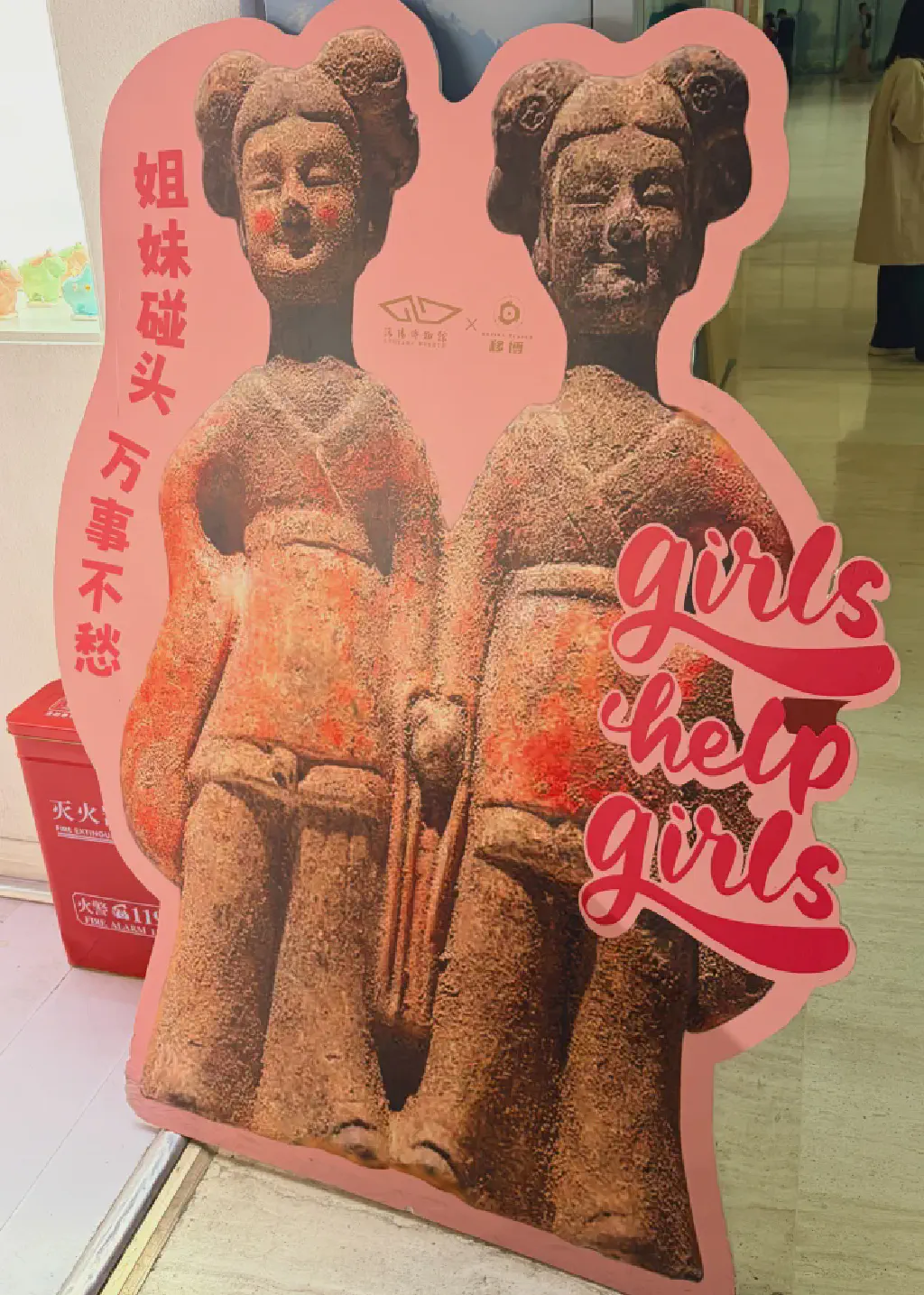
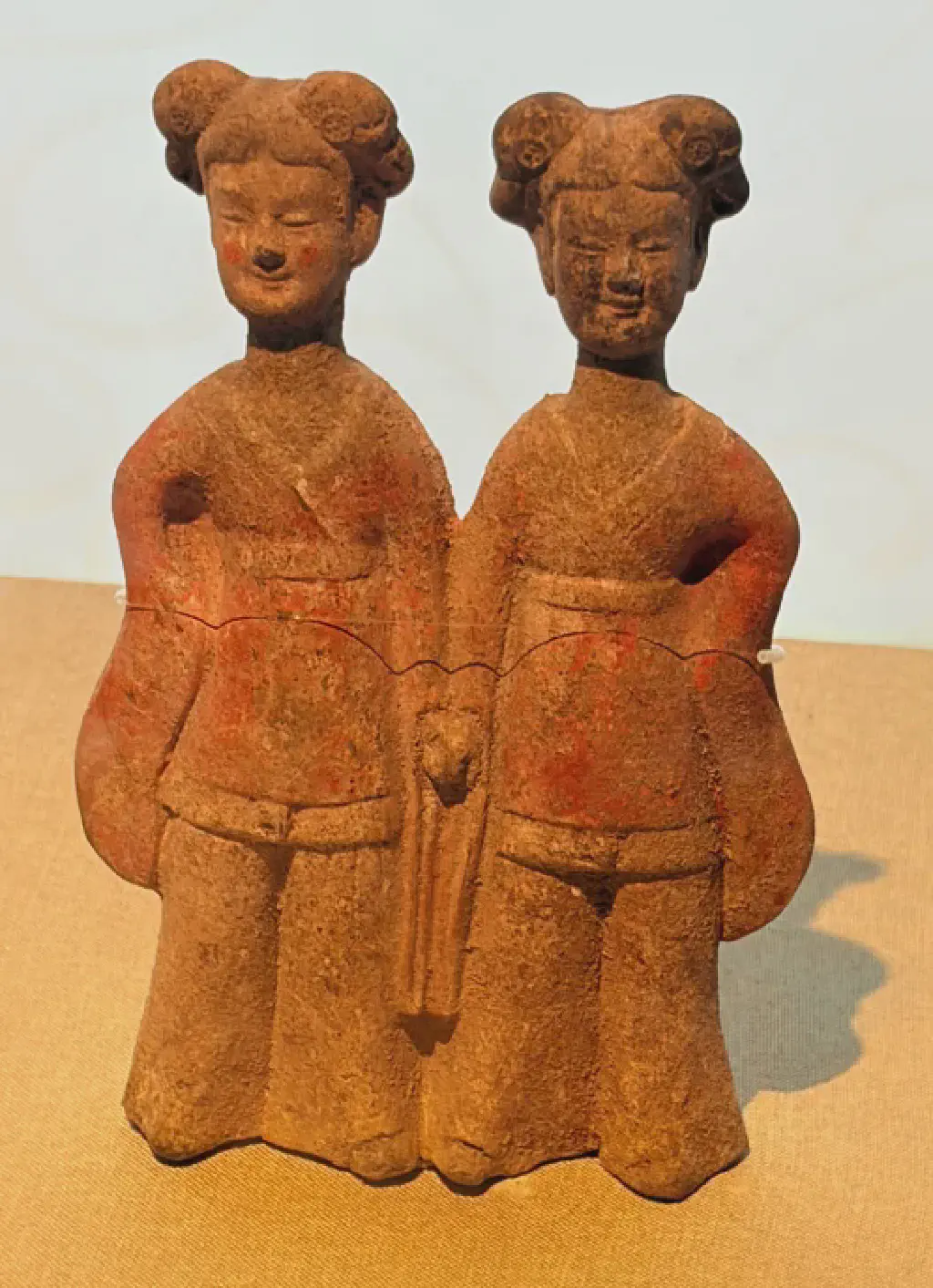 A Northern Wei painted pottery pair of hand-holding female figurines, the museum’s biggest internet star, known as the “thousand-year best friends”. Two young women stand side by side holding hands, hair in cute double buns, floral marks on their foreheads, traces of rouge still on their cheeks, eyes curved and smiles gentle.
The two sisters are the ones displayed at the entrance of the museum gift shop.
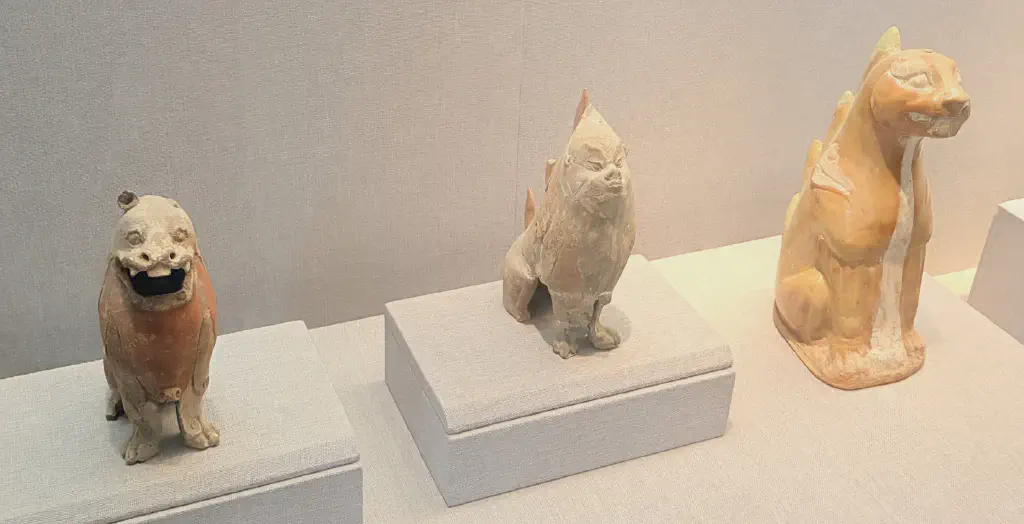 Not far from the pair is another popular exhibit, the “three Northern Wei tomb guardian goofballs: grinny, pouty and buck-tooth”, a rare and thoroughly charming example of Northern Dynasties sculpture.
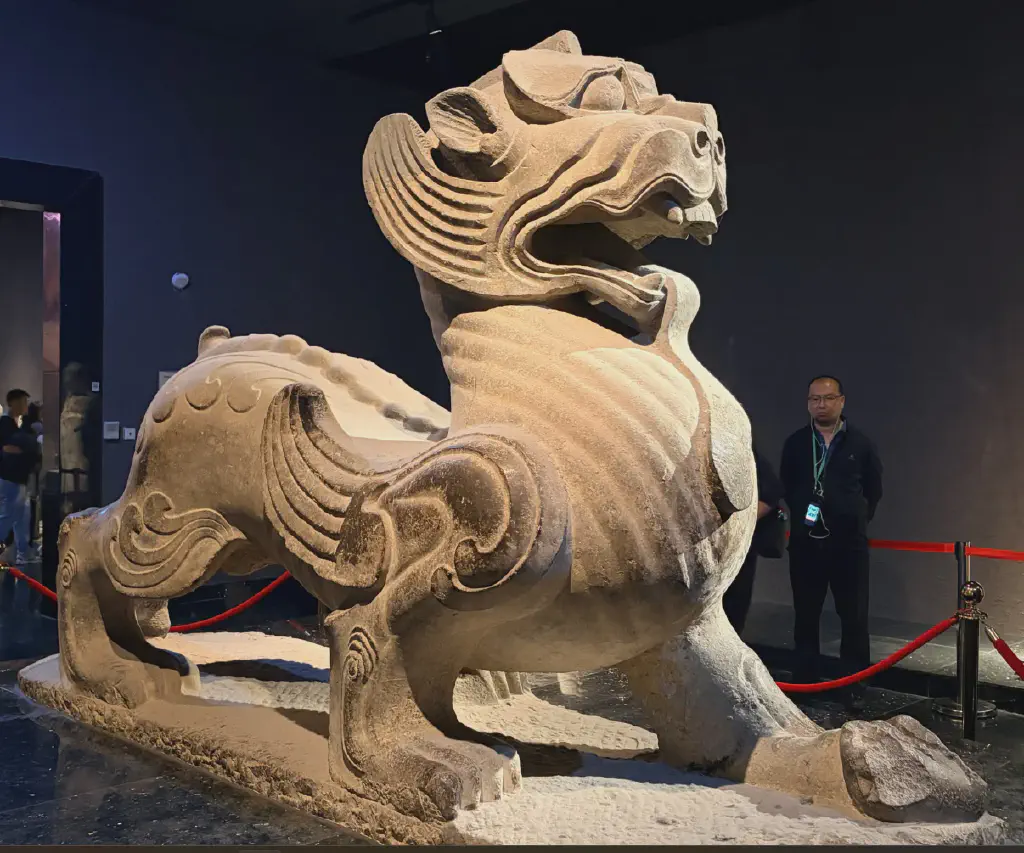 An Eastern Han stone bixie, another signature piece, weighing nearly eight tons — the largest and heaviest Eastern Han stone bixie surviving in China.
Tang and Song Period
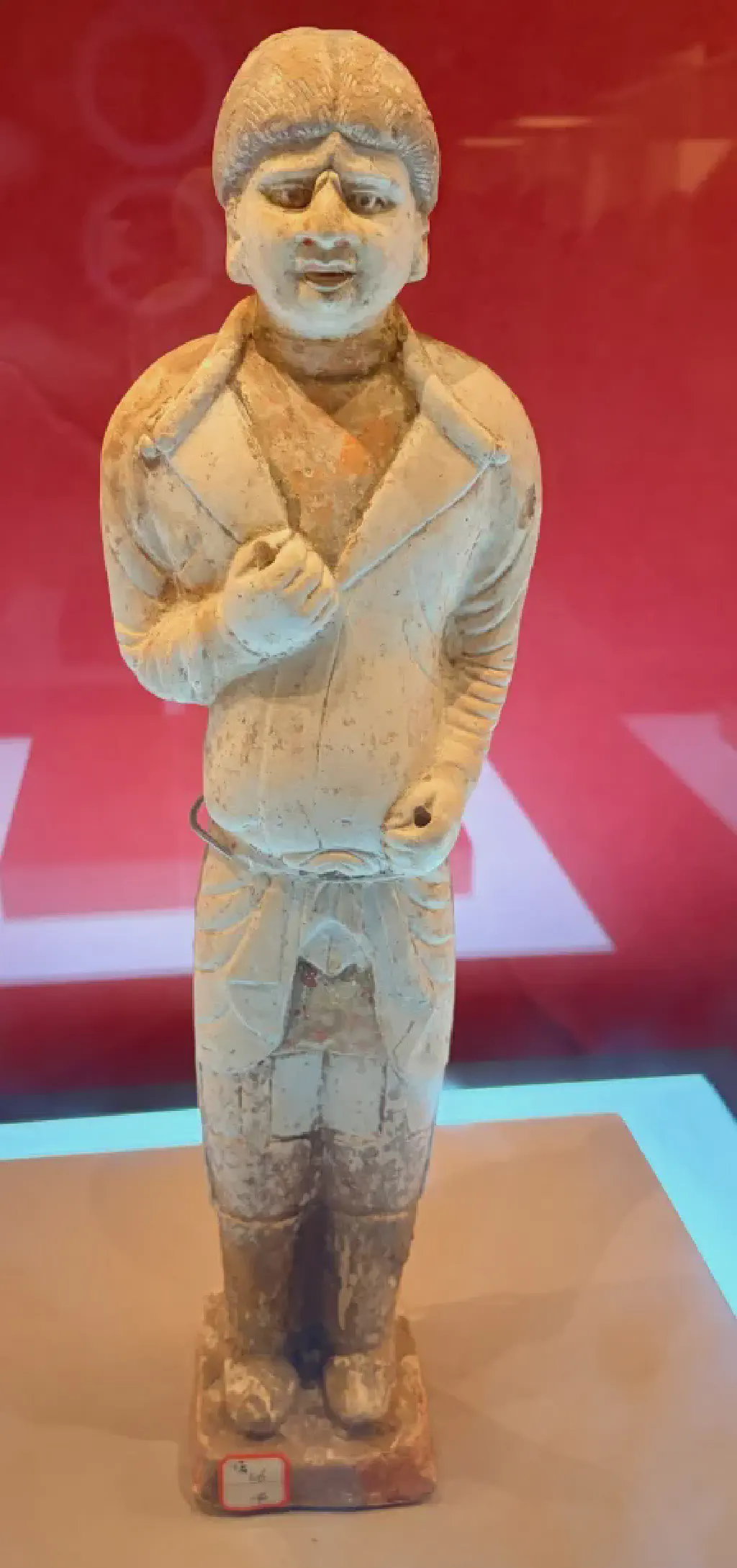 A Tang painted pottery Sogdian merchant figurine — this one looks a little like Mr. Bean — unearthed from the tomb of An Pu and his wife at Longmen. An Pu was a Sogdian noble who moved from Central Asia to Luoyang; these figurines and the Persian gold coins in the tomb testify to the bustle of Silk Road commerce.
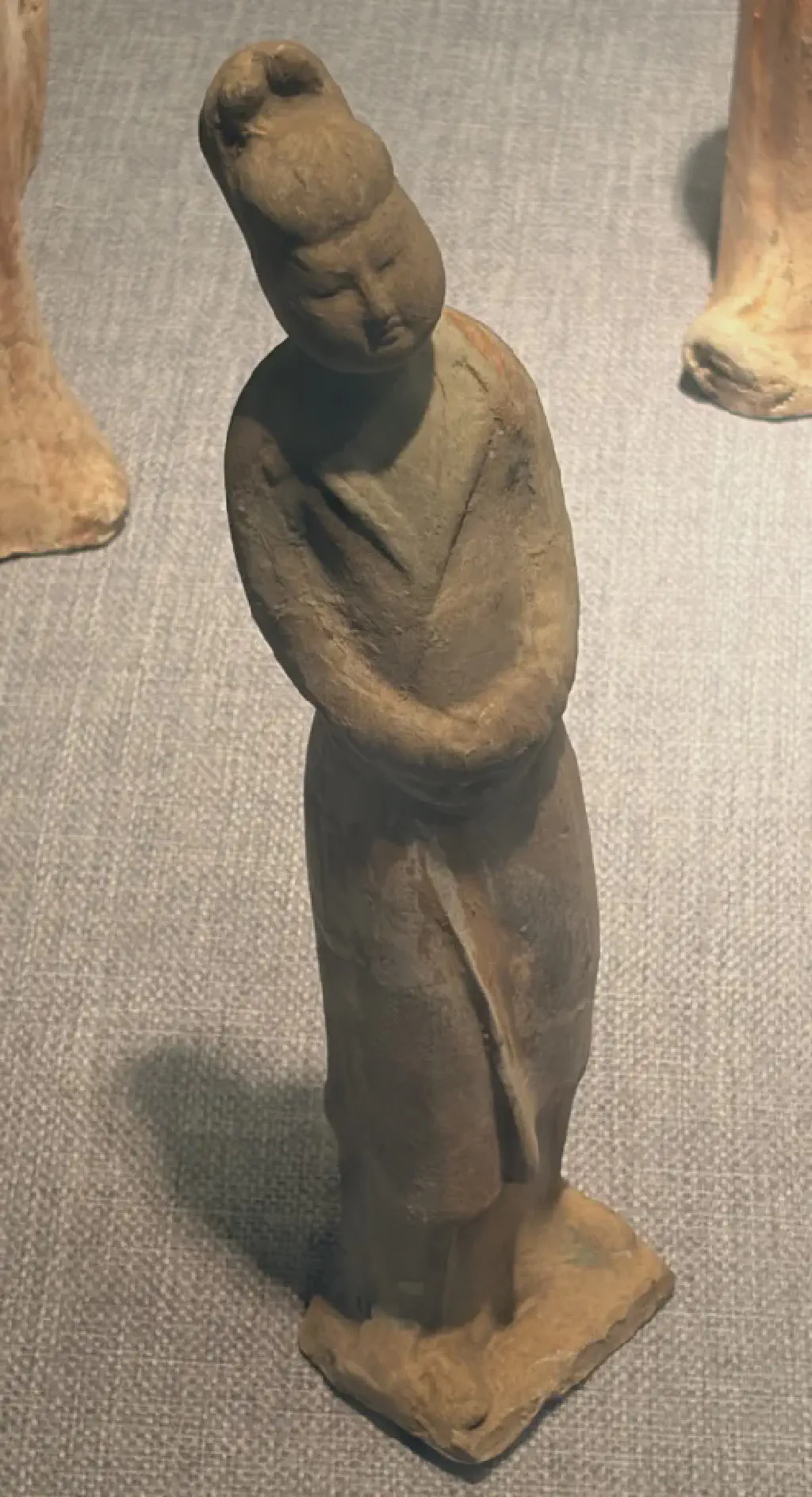 A Tang painted pottery female figurine in male dress, a relatively rare example of a woman shown in men’s clothing.
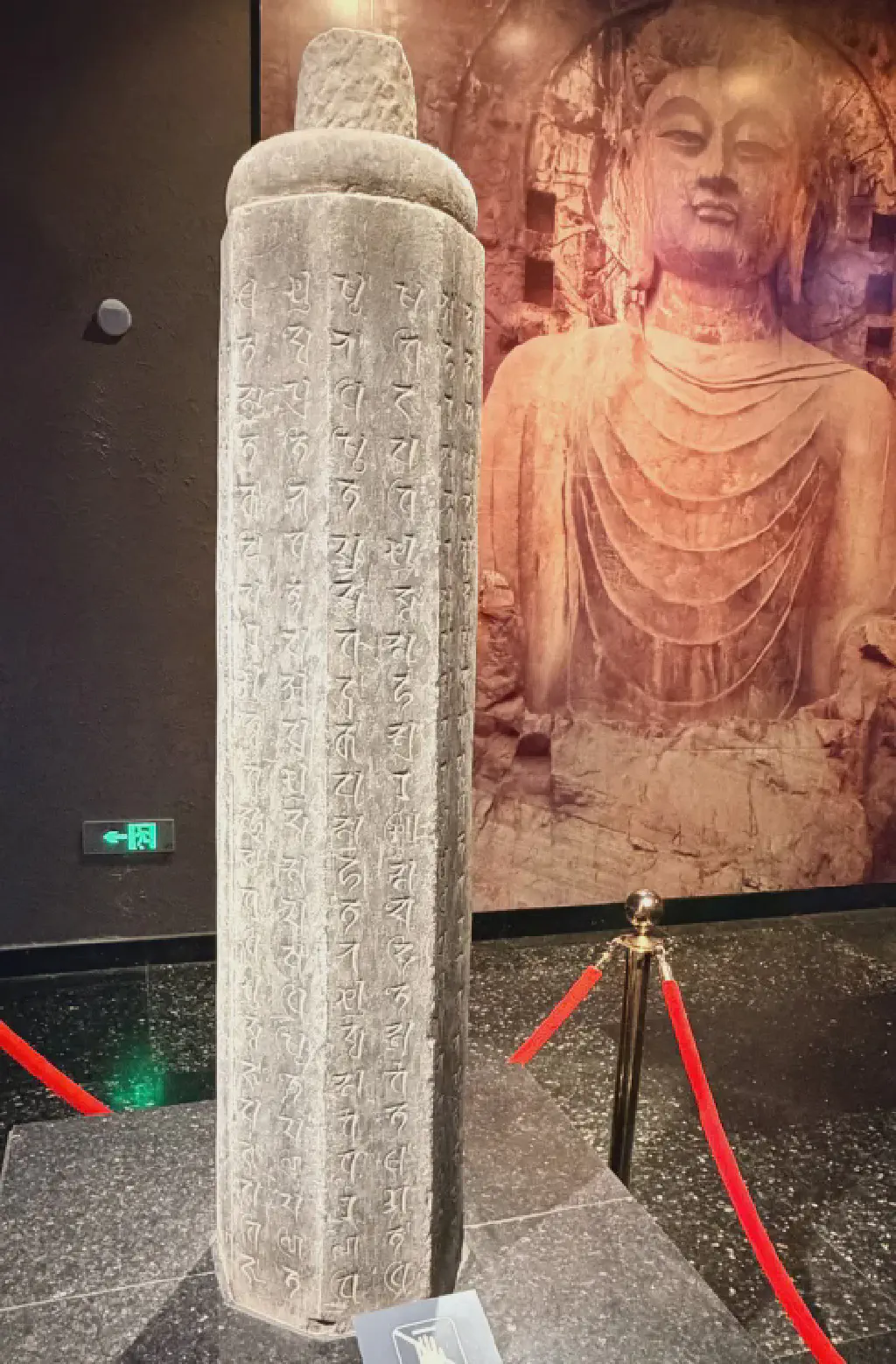 A Song dynasty Sanskrit dharani pillar (octagonal stone pillar), with Sanskrit dharani texts carved on seven faces and a Chinese inscription on the eighth. The script is old Sanskrit in Siddham, much of it still undeciphered, which lends it an air of mystery.
Afterword
I spent a whole morning at the Luoyang Museum taking in the splendor of this ancient capital — from the origins of Chinese civilization, the kingship of Shang and Zhou, the vigor of Han and the grace of the High Tang, to the prosperity of the Silk Road, the flowering of Buddhism and the blending of cultures. For a city-level museum it is firmly in the top tier and well worth repeated visits. I look forward to coming back after its year of renovation — will the Imperial Seal turn up? :)