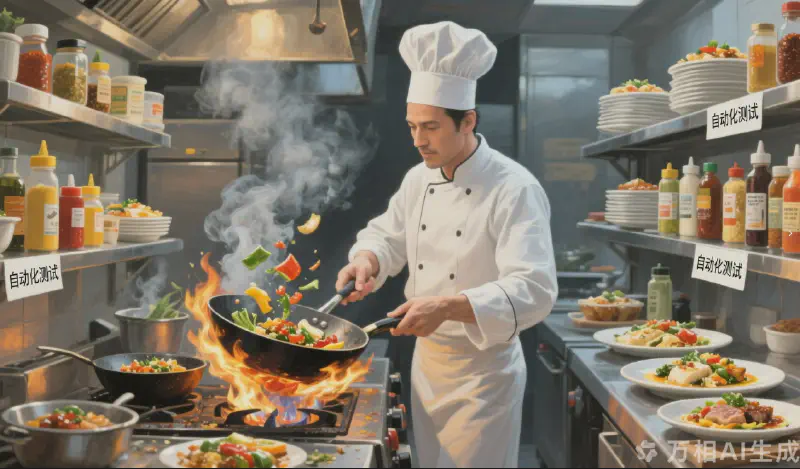
Recently, Xibei and Luo Yonghao set off a heated debate online over pre-made meals, which clearly touched a nerve among netizens.

I do not want to discuss the rights and wrongs of pre-made meals here, but thinking about the quality field, test automation and manual testing seem just like the difference between pre-made meals and chef made to order. This article expands on this thought experiment.
Test Automation and the “Pre-made Meal” Logic
In modern software development, test automation is undoubtedly a powerful tool for improving efficiency and safeguarding basic quality. Like pre-made meals, it has the huge advantage of being standardized and reproducible, helping teams deliver quickly in fast-paced iterations. But it also shares the obvious drawbacks of pre-made meals.
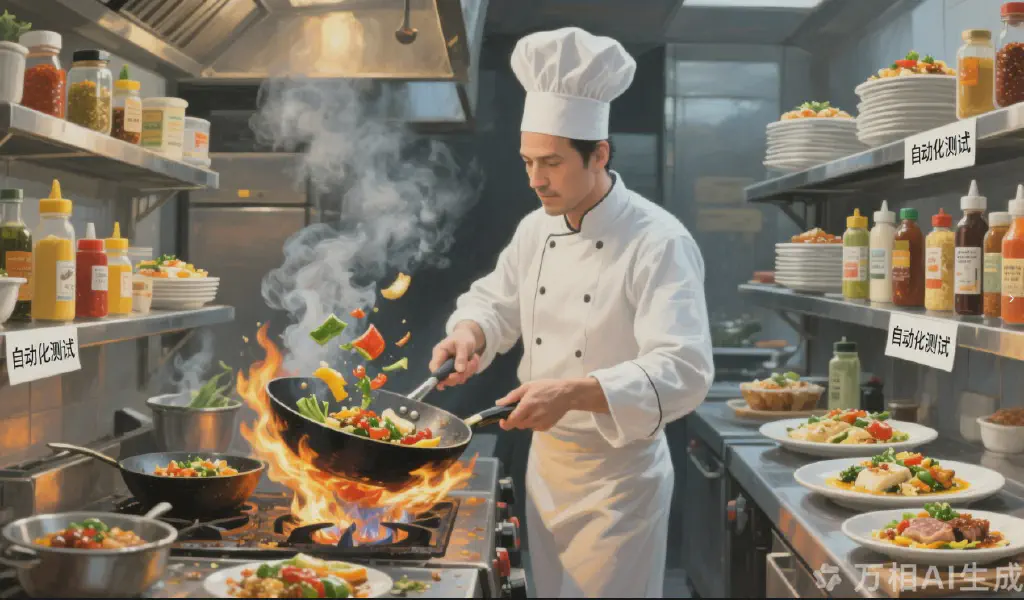
The Advantages of “Pre-made Meals”
Just as efficiency is the main advantage of “pre-made meals”, once automation scripts are written, they can run repeatedly without limit, efficiently avoiding human omissions and execution-efficiency problems in regression testing. They effectively solve the efficiency bottleneck of large-scale, repetitive verification.
The Limitations of Pre-made Meals
Loss of freshness: Just as what people criticize most about pre-made meals is the freshness of the dishes, automation scripts likewise can only target stable business scenarios and flows (ingredients); once the product changes, automation scripts easily become invalid.
Additives: To keep the taste of the dishes, pre-made meals often use various additives or heavy seasoning. Similarly, in automation scripts, to ensure the flow runs smoothly, mocks or workarounds are often needed to bypass certain user scenarios (such as CAPTCHAs).
The missing wok hei: Pre-made meals rarely have the
wok heiof freshly cooked dishes, and automation scripts always verify only known expected results. They are poor at capturing subtle changes in business logic and the humanized design of new features, and even less able to empathize with user experience (UX).
Pre-made meals use a pre-fixed production process, so a dish can be made with minimal effort; test automation uses pre-written test scripts, so test results can be obtained quickly by triggering execution.
But because of the limits of ingredients and production techniques, pre-made meals necessarily cover only a limited range of products and can only meet basic requirements, so they are hard to equate with high-quality products.
Manual Testing - Testing a Product Is Like Cooking a Small Fish
Just as real deliciousness cannot do without the smoke and fire of cooking, manual testing is the “chef made to order” in quality assurance.
Exploratory Testing
What is “wok hei”? It is the deliciousness achieved by the chef adapting to the ingredients amid the shifting smoke and fire.
Testing is the same; many product quality problems only emerge during deep exploration in the testing process.
Experienced test engineers, like chefs, rely more on rich experience and intuition, and during product testing (cooking) discover the traces of product quality problems according to differences in color, aroma, taste, and heat.
In real user scenarios, the user experience is also beyond the reach of test automation: whether a button on a mobile app is easy to tap, whether the swiping feels smooth - these are hard to measure quantitatively with automation scripts.
Automation can only judge whether an element “exists”, not whether it is “usable”.
Complementing Each Other
Pre-made meals are actually an inevitable trend for the catering industry in the context of scale and industrialization, but they will certainly not be the only choice; in the current era they can only serve as a low-end supplement.
And test automation and manual testing, as quality assurance means, are just like the difference between pre-made and made to order.
We can hand repetitive, standardized module verification to automation scripts, and leave deep exploration, complex logic, and verification requiring subjective creativity to the “chefs”!