
Preface
In the traditional waterfall software development process, testing usually sits late in the SDLC, and testers take on the duty of “quality gatekeeper”. As agile development, DevOps, and other delivery models have been adopted, rapid iteration and continuous delivery have become the norm, and accordingly the concept of “shift-left testing” is mentioned frequently; many agile teams treat “shift-left testing” as an important practice.
Many teams encourage testers to get involved in projects as early as possible, involving testers in requirements, design, and development, including requirements reviews, design discussions, pairing during development, unit/integration testing, continuous integration pipelines, test automation, and so on.
In this article we will not discuss these specific practices of shift-left testing, but rather clarify one point: “shift-left testing” is not merely testers moving toward the front end

Software Quality
What is software quality? The definition in IEEE.1061 is as follows:
Software quality is the degree to which a software product satisfies stated requirements as well as implicit needs arising from user needs and expectations.
This definition is quite abstract, and it also shows indirectly that quality is a product attribute that is rather hard to define precisely.
Roles with different perspectives actually see quality differently.
User Perspective
Quality is the degree to which user needs and expectations are met. That is, can the product help users solve specific problems? Is it convenient and fast? Stable and reliable? Good value for money?
“This software is really easy to use!” “This system is very stable and never crashes!” “This app feels so smooth~”
Developer Perspective
From a developer’s perspective, quality is reflected in the code and architecture.
“Is the code standardized, readable, and maintainable?” “Clear architecture, easy to extend” “Technical debt is under control”
Tester Perspective
From a tester’s perspective, beyond bringing in the user’s experience, quality is more about adaptability across multiple scenarios.
The degree to which the software fits various scenarios such as happy path, angry path, scary path, greedy path, and so on.
Management Perspective
From a management perspective, quality is reflected in whether delivery is on time, whether the budget is under control, and whether product metrics are met.
“The product is delivered on time with high quality” “R&D costs are greatly reduced” “The system runs stably with 99.999% availability”
Business Perspective
From a business operations perspective, quality measures the degree to which the product creates value and competitive advantage.
“User downloads”, “user registrations”, “order conversion rate”, “user retention rate”, and so on….

A thousand Hamlets in a thousand people's eyes - so it is with quality too!
In the end, it comes down to what we often stress: quality is not guaranteed by testing, and testing cannot guarantee it either! Quality is closely tied to the whole team and to everyone in the software lifecycle chain; everyone should be an owner!
The Essence of Shift-Left Testing
With the explanation in the previous section, it becomes easy to understand the point of this article’s title: "shift-left testing" is not merely testers moving forward!
Because of the adoption of rapid iteration and continuous delivery, this quality control measure that emerged accordingly moves testers forward. Although testing-related activities are no longer confined to late-stage verification, if quality still depends on testers’ activities, it is still treating the symptoms rather than the root cause.
Shift-left testing is essentially the popularization of an all-hands quality culture. Testers shifting left should, more importantly, bring the testing mindset - uniquely sensitive to quality risks - to the front end, and drive the whole team to build a quality-first cultural atmosphere.
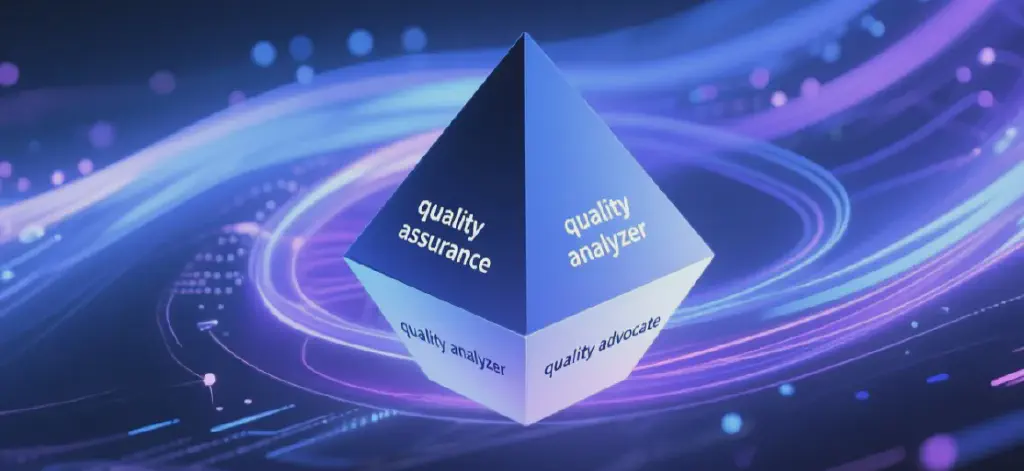
That is, testing should transform toward [QA]! And the QA here is not Quality Assurance in the traditional sense, which focuses on process control and quality assurance work; it should be a new type of QA suited to the agile model.
Testing’s Transformation Toward QA
Quality Assurance
The traditional QA role, Quality Assurance, is a role dedicated to the quality system and is not the same as the testing role. QA’s work is more about formulating and supervising quality standards, with process control across the entire lifecycle; testing, on the other hand, is more of an engineering role based on testing technology.
With the shift-left trend, testing should no longer be confined to the application of testing technology, but should turn its perspective to Quality Assurance, paying attention to quality risks at every link in the entire software development chain.
Quality Analyzer
That is actually not enough! Shift-left testing is not a role switch; more importantly, it also involves introducing the testing mindset. So at this point, testing should also be a Quality Analyzer. For example:
During requirements review:
Find the gray areas: Proactively identify ambiguities in requirements. For example, “the system response should be fast” - how fast is fast? “A friendly user interface” - how is friendly defined?
Raise “What if” questions: Explore various scenarios, including normal flows, exception flows, and boundary cases:
- “What happens if the user enters special characters here?”
- “If the network suddenly drops, how will the data be handled?”
- “If the user has no permission, what prompt should be shown?”
Ensure requirements are testable: Assess whether each requirement can be verified through concrete operations and expected results
During the architecture/design phase:
Start from the user’s perspective: Check whether the design’s flows are smooth and intuitive
Focus on edge cases: Whether loading states, error prompts, empty-state pages, etc. have all been designed
Assess accessibility: Consider whether the design is friendly to all user groups
Assess system testability: Ensure the system is verifiable, including log recording, traceability of operation flows, third-party mocking, and so on
Assess non-functional requirements and test strategy: Ensure that the architecture and design phase has fully considered performance, security, reliability, and other non-functional requirements, and build corresponding test plans
During development:
Drive unit test coverage: Help the development team build unit test frameworks and improve test coverage
Go deep into system integration: Work with the development team to build a continuous integration CI pipeline based on a suitable branch management model, and build the quality gate for test automation
By deeply participating in the front-end links, test thinking and reflection on and keen observation of software quality are integrated into software development activities beyond testing.
Quality Advocator
In addition, a quality culture does not happen overnight. In a fast-moving team, a role that puts quality first, continuously advocates quality awareness to the team, and can promptly raise “objections” when quality is at risk of losing control is even more an important function of testers after “shift-left testing”.
But for this new function to work, it cannot do without the team’s and management’s consistent recognition of quality first, including institutional support for testers’ related work after shifting left. Otherwise, quality first will mostly remain a formality, nothing more than a catchy slogan.
Conclusion
With the continuous development of agile and DevOps technologies, the speed, rhythm, and complexity of software development keep increasing. In this context, for shift-left testing to be truly implemented, building a quality culture is actually fundamental.
And in this process, testing also needs to complete its role transformation, moving toward quality consultant, quality analyst, and quality advocator, and delivering value on a broader scale.
In short, implementing “shift-left testing” requires integrating quality thinking into every link of development, branding the quality culture into the team’s DNA, and ultimately building a quality ecosystem with full participation and continuous improvement.