Someone asked whether people who do testing are really inferior to developers?
Although everyone has their own view, it is still worth thinking about the mainstream view represented behind this question.
Below I share Qiucao’s perspective.
Testing Technology and Development Technology Are Not the Same Track
First of all, to truly do the testing job well, the skill requirements are actually quite high. But testing technology and development technology are technologies of different dimensions. A developer complaining about testers by comparing software development skills is like a basketball player mocking a swimmer for being slow at running.
Testing technology includes many requirements that differ from development technology; for details, see my other earlier article 【】, which I will not repeat here.
Real Reasons Why Testing Is Underrated
But we must also recognize this objective fact — in most enterprises, the say, salary, and so on of the testing position are usually a notch lower than those of developers at the same level.
There are in fact multiple reasons for this situation, mainly the general perception of the role and a rather harsh industry environment. Specifically:
The Mismatch Between Job Requirements and Expected Output
First of all, most current testing job requirements actually revolve around verifying requirements — including test case design and test automation implementation, all of which are based on the verification of existing requirements.
But verifying requirements is actually more checking work than testing work.
Checking, as a subset of testing, actually has lower requirements and does not demand much technical skill. Correspondingly, job requirements centered on requirement verification are in fact requirements for a low-skill position.
The contradiction, however, is that the expectation of the testing position is to guarantee comprehensive quality after the product is released. And the coverage requirements for product quality simply cannot be achieved through requirement verification alone.
Requirement verification is mainly about functional coverage, and usually includes only basic scenarios, lacking all kinds of abnormal scenarios and non-functional scenarios. To achieve quality coverage, it is necessary to rely on full-process quality control during the development phase, including the testing work in the testing phase. Here, testing is not merely basic checking — it must also include proactive discovery supported by a wider range of testing techniques.
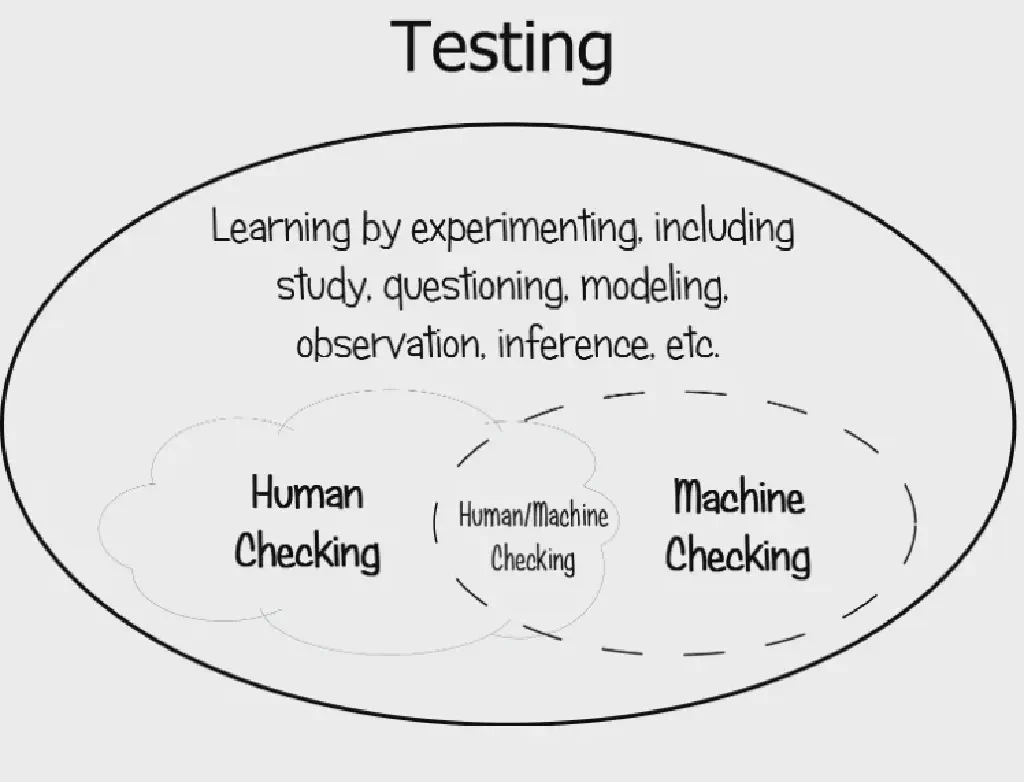
And this mismatch between job requirements and expected output also leads to doubts about the effectiveness of the testing position.
Lower Job Requirements Lead to a Lower Industry Barrier
When the job requirements themselves mainly target low-skill checking work, the entry barrier to the industry is naturally lowered too, and many newcomers with little experience or skill can enter the industry to perform the relevant checking work.
In earlier years there was even a distinction between test design engineers and test execution engineers; here, test execution merely required following the cases to carry out operations and record the results. Such the most basic checking work can hardly be said to require much testing technology.
A relatively low level of skill and job requirements naturally affects the overall evaluation of the position.
The Industry’s Own Misdirection
The rapid development of the IT industry in earlier years and its relatively good compensation made IT a popular career choice. And for the reasons mentioned above, when low-skill checking work is dressed up in the clothes of testing work, such testing positions become the best entry channel for non-IT people to get into the industry.
A large number of non-IT professionals hoping to enter the industry in turn generated a great deal of demand for training.
Then, fueled by all kinds of training institutions — including hype about entering the industry with zero background and newcomers earning high salaries — large numbers of people were indeed delivered into the industry. The performance at work of these short-term, fast-track “talents” naturally affected the overall evaluation of the industry.
The Hardest-Hit Area in the Industry Winter
As the IT winter arrived, enterprises, under cost pressure, cut spending and reduced headcount. Combined with all the factors mentioned above, this made testing the hardest-hit area — a vicious cycle in which the common perception of the testing position drifted even further from the value it deserves.
In Closing
Objectively speaking, it is true that a large number of practitioners in the so-called “testing industry” in China today can hardly be called qualified, so saying it is inferior to development positions is not entirely wrong.
But the “testing” here is in quotation marks — checking and testing are being confused as one.
All in all, the overall environment of the entire testing industry today is rather harsh and misunderstandings run deep, and Qiucao feels quite powerless about it.
There is no need to lose heart, however. If you build your own capability around the true goals of the role and deliver genuine value for comprehensive quality, you will naturally be the one still standing when the tide recedes.