
Although with the spread of Agile and the practice of shift-left testing, many testers have become more integrated into the same teams as developers, most software enterprises still typically set up a dedicated testing department or software quality department independently.
So what aspects do we usually start from when managing such an independent software testing team? Of course, team management has a great deal in common across all types of teams, but the testing function also reflects some characteristics of its own. This article discusses the following aspects.
Establishing Standards
For any team to become effective, the necessary rules, regulations, and processes are indispensable.
These include some management standards and systems, such as:
- Reward and penalty standards
- Attendance standards
- Training standards
- Work reporting systems, and so on…
They also include establishing some technical standards and template requirements related to the testing function itself, such as:
- Test plan
- Test strategy
- Test cases
- Test execution
- Test report
- Defect management
- Environment management
- External testing
- Asset management
- Quality analysis, and so on…
Of course, they also include sorting out testing-related processes, such as:
- Defect handling process
- Test entry and exit criteria (build submission and release processes)
- Quality analysis process, and so on…
Sorting out and establishing standards and processes is the foundation of a department’s work. But standards are not formed and perfected overnight; they are a team consensus that gradually accumulates through daily management and team collaboration, and a tangible guide to behavior.
Building Capability
Whether a team is successful, and how effective it is, depends on the team’s capability.
So for a testing team, how do we build this capability?
The testing industry, drawing on the CMMI model, has proposed the TMMI model:
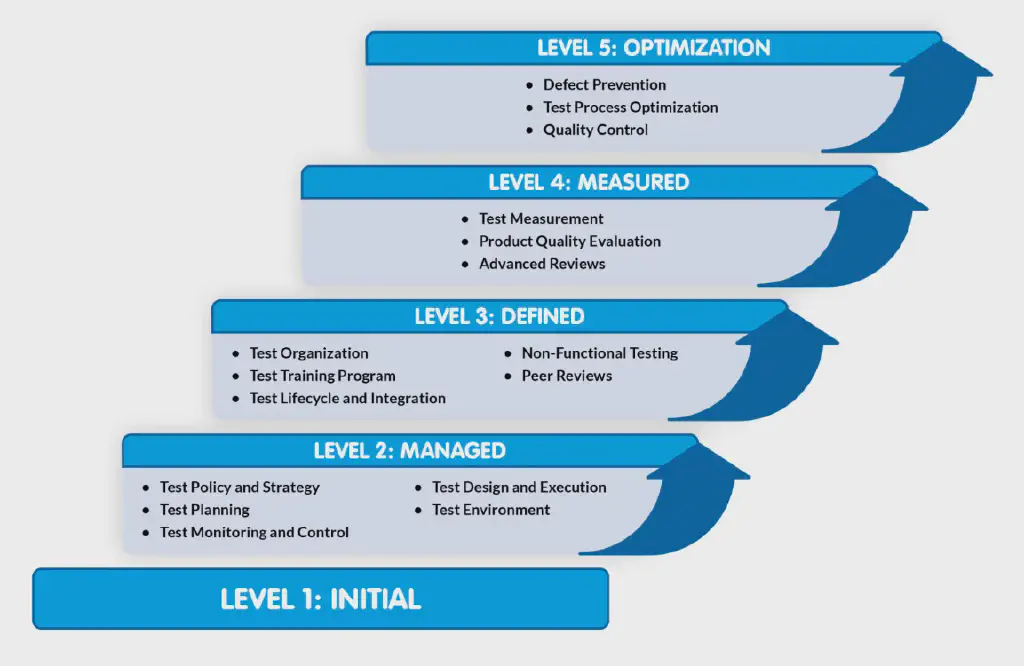
Initial The default starting level. The organization has no relevant testing capability yet; testing work is coarse and casual, with no separate testing phase.
Managed Testing work becomes a specialized function, with basic testing standards such as policies, strategies, plans, schemes, design, execution, and so on. There is also a testing environment — a separate testing environment is used to carry out the testing work rather than performing the relevant verification in the development environment.
Defined Generally it is only at this level that an organization reaches basic maturity in its testing work. Its typical feature is having a dedicated testing organization, with a testing team responsible for organizing and implementing the testing work. In addition to basic functional testing, at this level relevant capabilities are established for various non-functional tests, including performance testing, compatibility testing, usability testing, reliability testing, accessibility testing, and other rich testing types. There is also a strong emphasis on quality-oriented peer review.
Measured The effectiveness of testing work can be quantified from multiple dimensions through relevant metrics and data, reflecting fairly accurately how well the testing work is being done.
Optimized It enables continuous self-renewal and ongoing optimization. Through full-process quality control and up-front analysis techniques, defect prevention is achieved.
Beyond such industry standards, in summary, the capability building of a testing team can also focus on the following four aspects:
- Business testing capability — the foundation on which the team stands, the ability to find problems
- Fast testing capability — improving efficiency, building a cost advantage, and establishing confidence in quality in a timely manner
- Quality assessment capability — accurate measurement and monitoring of quality
- Rapid response capability — quick reaction to quality problems and risks
Doing a good job of building team capability is the foundation of establishing a team’s moat.
Performance Measurement
In the workplace, people work hard ultimately for their own better development and to gain immediate or long-term benefits. Seeking advantage and avoiding harm is only human.
In team management, the measurement of performance is essentially about using performance as an anchor to manage the distribution of benefits well and drive the achievement of the team’s overall goals.
Nowadays there are two main performance management frameworks commonly used in enterprises:
- KPI — Key Performance Indicator
- OKR — Objectives and Key Results

KPI is result-oriented, focusing on some key quantitative indicators that can be measured. OKR is goal-driven and revolves around objectives; although its key results are usually quantitative as well, the emphasis is more on the path to achieving the goals.
Whether it is KPI or OKR, a team’s performance management cannot do without the formulation of various quantitative performance indicators.
For a testing team, the relevant indicators can be viewed from three different dimensions:
Quality Dimension
A testing team is oriented toward quality, so measuring performance cannot do without quality assessment. Some commonly used key indicators include:
- Requirement coverage
- Defect leakage rate
- Build rejection rate
- Release success rate, and so on…
Efficiency Dimension
As a cost center, the efficiency with which the testing department completes quality assessment directly affects the release cadence and is an important component of product cost. Therefore, the management of the testing department necessarily includes indicators related to work efficiency, such as:
- Test cycle
- Automation coverage
- CI success rate
- Release efficiency
- Response efficiency, and so on…
Growth Dimension
Beyond the dimensions above that reflect the department’s own goals, no team can do without the gradual growth and maturation of its members. Therefore, indicators oriented toward individual and team growth are also an important dimension of team management, such as:
- Knowledge sharing, training
- Technical innovation, process improvement, tool development
- Learning summaries, event organization, and so on…
From the different dimensions above, in team management we can break things down into a variety of more detailed sub-indicators based on the team’s current situation, and combine this with techniques for collecting and analyzing performance data to achieve scientific measurement. This can then be directly linked to tangible interests such as salary raises, bonuses, and job levels.
Team Collaboration
As a collective focused primarily on the testing function, and at the same time a team that must cooperate fully with other functions in software product development such as development and operations, another important part of testing team management is management oriented toward team collaboration.
Collaboration cannot do without communication. Here we can make full use of the Johari Window communication model introduced in my earlier article 【】, or the conflict model in 【】, as auxiliary tools for communication and collaboration.
From the perspective of the testing team, we can in fact consider team collaboration from four dimensions:
Internal Collaboration
Here the main thing is to arrange work reasonably according to the different members’ abilities and personality traits, so that everyone is used to their best advantage and all parties benefit mutually.
Peer-Department Collaboration
Collaboration between peer departments includes cooperation with the development team, operations team, product team, and others. The emphasis is on handling cooperation with peer teams in a spirit of win-win mutual benefit — seeking common ground while reserving differences as far as possible, perfecting processes, arranging interfaces well, and safeguarding the team’s interests when disputes and conflicts arise.
Upward Collaboration
Communication and collaboration with senior leadership or higher-level departments is a lesson that any middle manager must master. Likewise, leaders with different personality traits require different communication skills and approaches. Managing upward well wins space for the healthy development of the team.
In short, in an enterprise, an excellent middle manager should be a Leader who can “bear pressure from above, command respect from below, and collaborate (si)(bi) with peers”.
External Collaboration
In addition to these internal collaborations, the testing team is actually a department that fairly often faces external relationships, in scenarios such as outsourcing, after-sales support, and external testing.
In such collaborations, team management must clarify authority and the scope of responsibility. As a representative of the enterprise, it should also safeguard the enterprise’s image and interests, maintain good relations with external organizations, and build trust.
Team Culture
Finally, for any team to remain stable and develop soundly over the long term, it cannot do without the support of team culture.
Processes, standards, and systems are tangible; their emphasis is on telling everyone how to do things correctly, and behavior is passive.
But once team culture has formed, everyone consciously acts according to shared values, and behavior is proactive.

Culture takes a long time to form, and the team manager is the key to its formation. Carry it through consistently — “what you keep constantly in mind will surely find an echo”.
Above is my overall explanation of the five key dimensions of testing team management. Friends interested in the details can also follow the management section of my systematic testing-skills improvement course, which contains a detailed analysis of these five dimensions and their implementation. Reply outline to view the detailed course catalog.