Preface
In my previous article 【】, we explored the central role of communication in team collaboration. Nowadays AI is being applied ever more broadly; in particular, the powerful capabilities of generative AI mean that a great deal of work can actually be accomplished with AI’s help. From AI browsers and coding assistants to workflow engines and integrations with various MCPs, AI is increasingly participating in our daily work.
And completing work with the help of AI is, in essence, another form of team collaboration — except that here the collaborator is AI. So in collaborating with AI, the core is still communication.
From this perspective, this article considers how to communicate and collaborate with AI more effectively.
The Johari Communication Window
In team collaboration, there is an important model and tool — the Johari Communication Window we introduced earlier.
In this window, we divide things into four quadrants according to the level of awareness held by the communication partner and by ourselves. Only by understanding which quadrant each party is in during a conversation can we communicate well.
When we collaborate with AI, we can likewise define such a communication-window model:
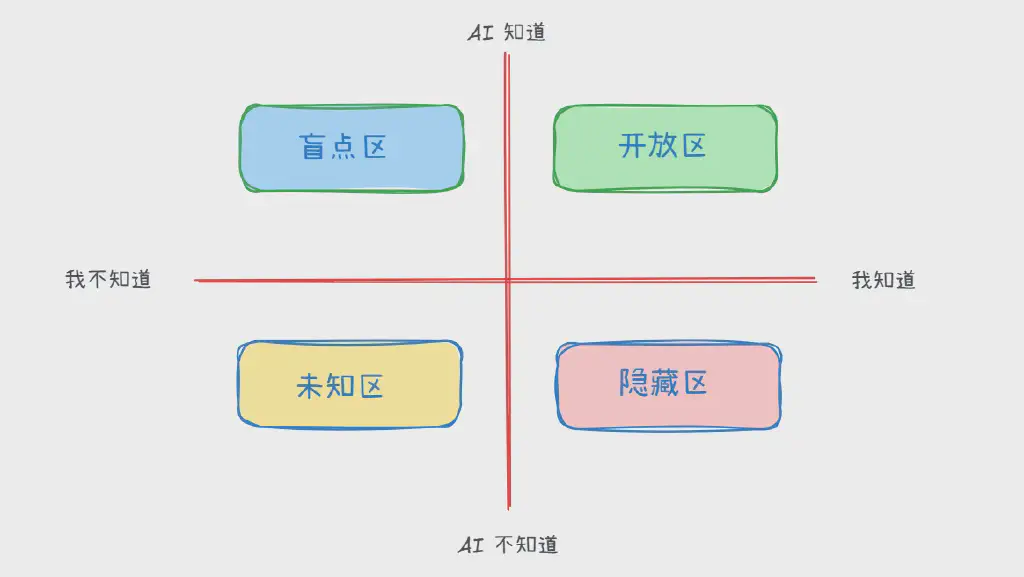
Open Zone — this area corresponds to information that both we and AI already possess and understand; it can be considered the shared ground between the two sides. For example, when communicating with AI we often preset a role or identity for it — such instructions belong to the Open Zone. Or, having already drafted an article, we ask AI to polish it on that basis. Both are typical examples of communicating in the Open Zone.
Blind Spot Zone — here is information we do not possess ourselves, but which AI, with its rich knowledge base, can provide to us. In this area AI is like a teacher — but a passive one, relying on us to ask questions actively to obtain knowledge. The ability to ask good questions is the key to communicating in this zone.
Unknown Zone — this area covers information that we are unclear about and that AI has not yet mastered. Communication in this zone is more like co-creating with AI — brainstorming together to explore information in unknown territory.
Hidden Zone — in this area, the information is mostly our private-domain information that AI cannot access on its own. For instance, if we simply give AI the instruction
please help me output this week's work report, AI has no way to start. So communication in this area means fully providing AI with the contextual information it needs — feeding private-domain information to AI. Things like project background, internal processes, and local data from our work — only once AI has learned and mastered this information can it go on to assist with subsequent tasks.
Communication Techniques for AI in Different Quadrants
Based on the four distinct zones defined by the window model above, we can think about the key points of communication when collaborating with AI — that is, how to use prompts better so that AI delivers results more closely aligned with our needs.
Communicating in the Open Zone
In this zone, because both sides already hold the relevant information, the main thing is to make the boundaries of the Open Zone clear to AI. The clearer and more specific the information you specify, the more closely AI’s results will match our needs. So in this zone, what matters more is issuing clear tasks. You should also avoid gilding the lily — vague prompt instructions can instead cause the results to diverge.
For example:
You are a senior software test engineer, proficient in test automation, familiar with Python, and familiar with various testing tools.
Accurately translate the English document in the attachment and return the translated content in Markdown format, without including any information that is not part of the target content is better than Translate the attached English document in a witty, lively style that rides current internet trends — it preserves the key points of the original content without adding a lot of extra material that may not be appropriate, and the returned content can be generated directly in the format we need.
Communicating in the Blind Spot Zone
The Blind Spot Zone is the area where leveraging AI’s capabilities can most easily help us improve ourselves. Through AI, we fill gaps in our knowledge and eliminate our blind spots.
In this area, the key to communicating efficiently with AI is the ability to ask questions. For relatively complex information, we can proceed step by step, asking progressive questions, so that AI gradually builds a complete knowledge system, identifies our blind spots, and strengthens them. In prompt engineering, there is a dedicated technical term for this — Chain-of-Thought (COT) — which can guide AI to think progressively and step by step to arrive at the knowledge we truly need.
For this, you can also refer to the 5 Whys technique we introduced earlier, gradually focusing on the root cause of a problem.
For example, if we want to master the POM model in test automation and actually solve specific problems in implementation, we can ask questions step by step to focus on solving real problems:
What is the POM model?In which scenarios of test automation is the POM model more suitable?For the login scenario of a web portal site such as www.saucedemo.com, give an example of implementing POM in Python and explain the key pointsIn the above example, what other general approaches are suitable for unified encapsulation, such as element identification and driver definition?
Communicating in the Unknown Zone
The Unknown Zone is content that neither we nor AI has mastered. This is more about innovative scenarios, where through continuous iteration and brainstorming with AI we gradually discover what we truly need.
For example, when using an AI coding assistant to help develop an application, we may only have sketched out the basic functions. AI will help generate the application interface based on the information provided, and we in turn will have further ideas for improvement based on that interface. Through such continuous communication and iteration, we ultimately complete a software product with good usability.
So the emphasis of communication here is co-innovation and continuous iteration.
Communicating in the Hidden Zone
The Hidden Zone is beyond the reach of AI’s current capabilities; it often has to be completed based on internal information and local data. To make good use of AI in such cases, we need to build a sufficiently informative context — feeding our local information and data to AI, letting it digest them, and making up for the part of the information it does not know. Once communication moves from the Hidden Zone to the Open Zone, we can issue clear tasks to have things handled.
The key to communication in this area is actually to give AI the ability to reach knowledge blind spots through approaches such as RAG, model fine-tuning, building a local knowledge base, or exposing local capability calls via MCP.
The focus of communication in this area is to fully provide AI with background and related information it does not yet understand, so that after feeding and digesting information the purpose of normal collaboration can be achieved.
Conclusion
When we want to treat AI as a collaborator that can genuinely help us, we should establish good communication with that collaborator. The Johari Window provides a sound communication model that can offer good guidance in helping us make effective use of AI.