On April 9, Google made a major release of the A2A (Agent to Agent) protocol, adding more fuel to the opening-up and standardization of AI Agent capabilities. So what exactly does this A2A protocol do? What is its relationship with the previously red-hot MCP Server? Will it give rise to a standards war? In this article, let’s get to know this freshly baked A2A protocol and its application scenarios.
A2A and MCP
A2A, namely the Agent to Agent protocol, is an open-source foundational AI protocol just launched by Google, aimed at enabling communication and interoperability between AI Agents. By providing agents with a standardized way to collaborate — that is, regardless of their underlying framework or vendor — different AI Agents can securely exchange information and collaborate, and can work across a variety of enterprise platforms and applications.
This protocol provides a common communication standard between Agent and Agent.
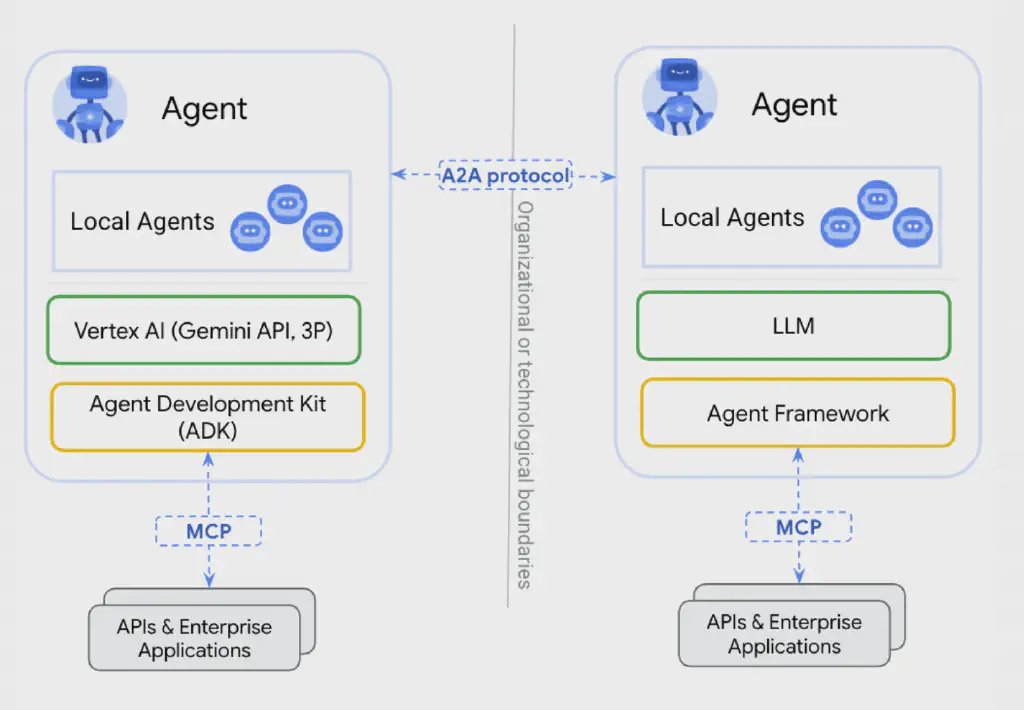
It and the recently red-hot MCP (Model Context Protocol) (introduced in the previous article 【】) are actually not in a competitive relationship. Google’s official release statement also emphasized that this protocol is in fact a complement to the MCP protocol.
MCP is an open protocol launched late last year by the AI company Anthropic (the parent company of Claude), aimed at standardizing the interaction interface between large language models (LLMs) and external data sources and tools.
As mainstream large models such as OpenAI announce support for MCP integration, MCP currently has great potential to become a foundational specification in the AI application field; the recent proliferation of all kinds of MCP Servers springing up like mushrooms after rain also proves that this protocol has gained wide recognition.
As the saying goes, third-rate companies make products, second-rate companies make brands, first-rate companies make standards; Google has keenly captured a very important piece of the puzzle in the AI Agent application standards beyond MCP.
That is, MCP defines the connection between LLMs and Agents, and can use Agents to extend LLM capabilities. In the future there will surely also be Agent stores similar to the App Store, integrating all kinds of different Agents.
But for subsequent large-scale AI applications, many Agents will be integrated to collaborate together, and the interaction between these Agents is precisely the missing piece of the puzzle at present. This is the role A2A plays — very similar to the inter-service communication protocol in a microservices system.
A2A’s Design Principles
The official side has given the design principles of the A2A protocol:
Embrace agentic capabilities — A2A is committed to enabling agents to collaborate in natural, unstructured modes, even when they do not share memory, tools, and context. We are enabling truly multi-agent scenarios, rather than confining agents to being a single “tool”.
Built on existing standards — the protocol is built on top of existing popular standards, including HTTP, SSE, and JSON-RPC, which means it is easier to integrate with the existing IT stacks that enterprises use every day.
Secure by default — A2A is designed to support enterprise-grade authentication and authorization, matching OpenAPI’s authentication schemes at launch.
Support for long-running tasks — A2A was designed with flexibility in mind and supports a variety of scenarios, enabling it to excel at a wide range of tasks, from quick tasks to deep research that may take hours or even days (if humans are involved). Along the way, A2A can provide users with real-time feedback, notifications, and status updates.
Modality agnostic — the world of agents is not limited to text, which is why we designed A2A to support a variety of modalities, including audio and video streaming.
Main Features
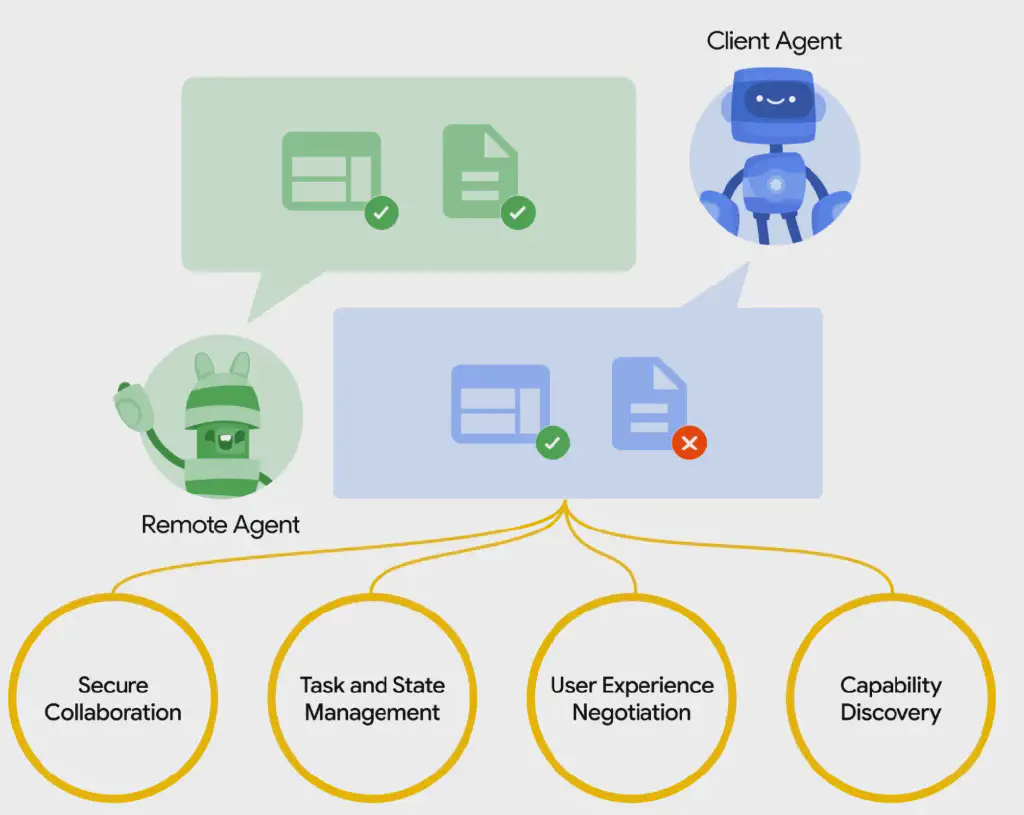
Capability discovery — agents can advertise their capabilities using a JSON-format “Agent Card”, allowing client agents to identify the best agent able to perform a task and use A2A to communicate with remote agents.
Task management — communication between client and remote agents is oriented toward task completion, with the agent responsible for executing the end user’s request. This “task” object is defined by the protocol and has a lifecycle. It can be completed immediately, or, for long-running tasks, each agent can communicate to stay in sync with one another about the task’s latest completion status. The output of a task is called an “artifact”.
Collaboration — agents can send messages to one another to convey context, replies, artifacts, or user instructions.
User experience negotiation — each message contains “parts”, that is, fully formed content fragments such as a generated image. Each part has a specified content type, allowing the client and remote agents to negotiate the correct format needed, and explicitly including negotiation of user UI capabilities (such as iframe, video, Web forms, and so on).
The relationship between A2A, MCP, and LLMs:
Protocol Specification
The protocol is currently open source on GitHub, mainly a format specification file in json schema form (for an introduction to json schema, see 【】); the concrete definitions can be found in the source document.
Here is an explanation of the main parts it contains and their roles:
1. AgentAuthentication
This part defines the supported authentication methods, such as OAuth or API keys.
2. AgentCapabilities
Used to identify the scope of an Agent’s capabilities, such as whether it supports real-time communication.
3. AgentCard
Provides an Agent’s core information, such as its functions and skills, to facilitate discovery.
4. AgentProvider
Identifies the organization or company information of the provider.
5. AgentSkill
Describes an Agent’s skills, such as the tasks or functions it can perform.
6. Error Definitions
Contains some predefined Errors — PushNotificationNotSupportedError, InvalidParamsError, and JSONParseError indicate error types such as notifications not supported, invalid parameters, and JSON parsing, respectively.
7. FileContent & FilePart
Used to pass file-related data, such as upload or download operations.
Case Study
a2aprotocol.net provides a case-scenario description of A2A and MCP collaboration.
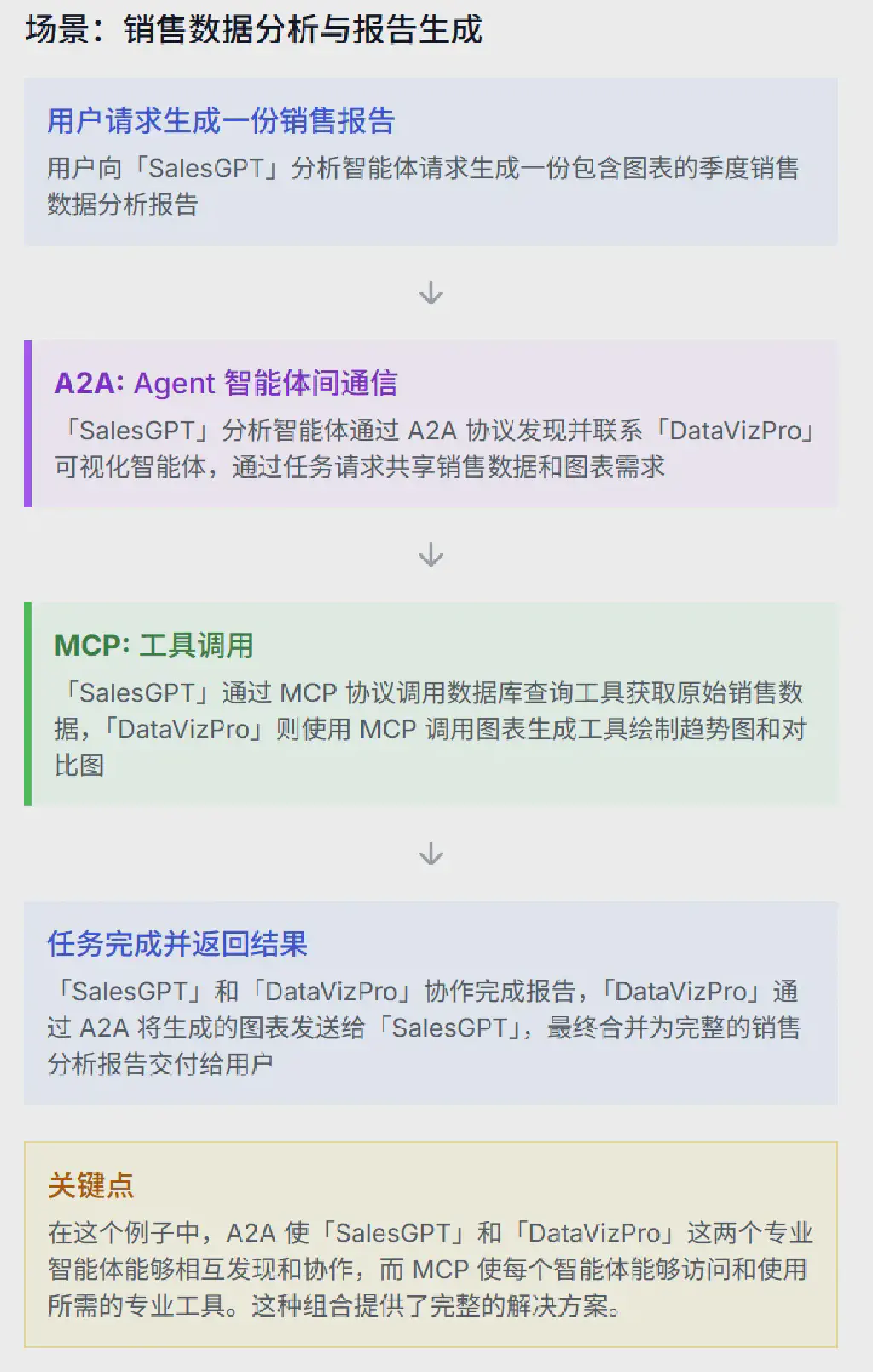
For applications in the testing field, as in the article 【】, some readers mentioned richer scenarios: integrating test-case parsing, Playwright execution, and issue collection and reporting. This can be accomplished by different Agents, respectively responsible for test-case generation, Playwright execution, and submissions to tools such as ZenTao and Jira. Here, besides the workflow between Agents, the transfer of items like test cases and Bugs between different Agents can be implemented using the A2A protocol.
Relevant practices still await the enrichment of the related Agents; this account will continue to follow up going forward!