This article comes from TestGuild’s analysis in January of this year’s testing development trends. So far, its judgments still appear objective and accurate, so I am sharing the translation with everyone.
As we enter 2025, I believe the following test automation trends will profoundly influence the future of software testing.
Table of Contents
- 1. AI Agent - The New Wave of Testing
- 2. Shift-Right AI - Understanding Users
- 3. QA for Everyone - Human-AI Collaboration
- 4. The Evolving Tester Role - Adapting to the Future
- 5. DevOps and SRE Integration - Continuous Quality
- 6. End-to-End (E2E) Autonomous Quality Platforms
- 7. Playwright - The Preferred Automation Tool
- 8. Must-Know Programming Languages for Testers in 2025
- Conclusion - The Path to Test Automation Success in 2025
AI Agent - The New Wave of Testing
I believe 2025 will witness the continued expansion of AI-assisted testing.
Why is that?
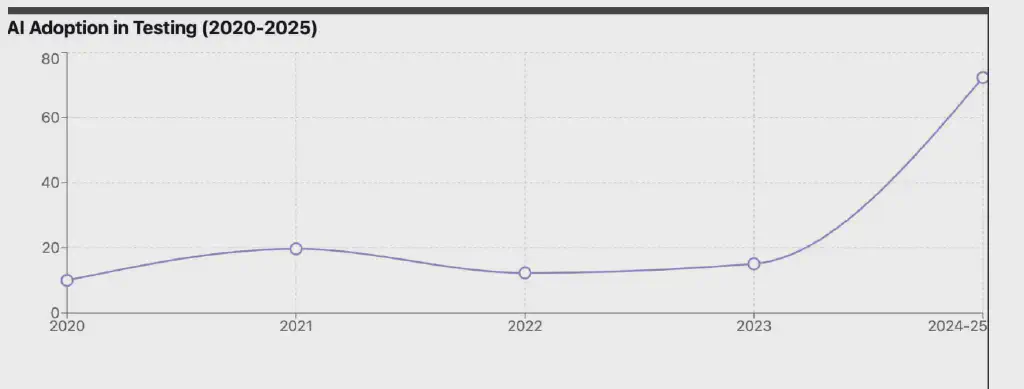
The use of AI in testing is growing exponentially: surveys show that, as of 2024, 72.3% of teams are actively exploring or adopting AI-driven testing workflows, whereas just a few years ago this technology was still in the early-adoption stage. This trend marks the fastest technology adoption curve in the history of our TestGuild test automation survey.
Building on the multimodal AI of 2024 (which processes multiple data types through specialized algorithms), the emerging trend is agentic AI.
First, you may ask: what exactly is agentic AI?
Such systems can operate autonomously, handling tasks that previously required human intervention. They can communicate, maintain long-term state, and make independent decisions based on interactions — essentially acting as a highly efficient team of testing assistants.
Still not clear? Let us illustrate with an example.
Example of an Agentic AI Test Automation Workflow
Imagine a real-world scenario: agentic AI autonomously manages the full regression test suite for a large e-commerce platform.
Rather than relying on pre-set scripts and fixed schedules, this agentic AI system will perform the following operations:
- Priority determination: analyze recent code changes and feature releases, and rank regression tests according to the risk level of the modifications
- Test selection and adaptation: dynamically select appropriate test cases, filtering a subset from the full suite based on risk assessment
- Test execution and environment management: schedule test execution across multiple environments (browser/OS/device). If a test fails, automatically trigger diagnostic tests to collect detailed information, and even attempt to auto-fix simple issues
- Result analysis and reporting: classify the severity of failures, identify patterns, and suggest fixes based on common error patterns
- Feedback loop and continuous improvement: continuously self-optimize through accumulated experience
This vision is no fantasy. Survey data shows that teams are not only pursuing task automation but also relying on AI to make autonomous decisions — which is precisely the core of agentic AI:
- Decision-making capability: AI tools are increasingly trusted to optimize test coverage and maintenance
- Autonomy: interest in AI-driven pipelines and frameworks indicates that teams need solutions that minimize human intervention
- Performance: the focus on AI-powered tools and frameworks signals a shift toward systems that learn and adapt dynamically
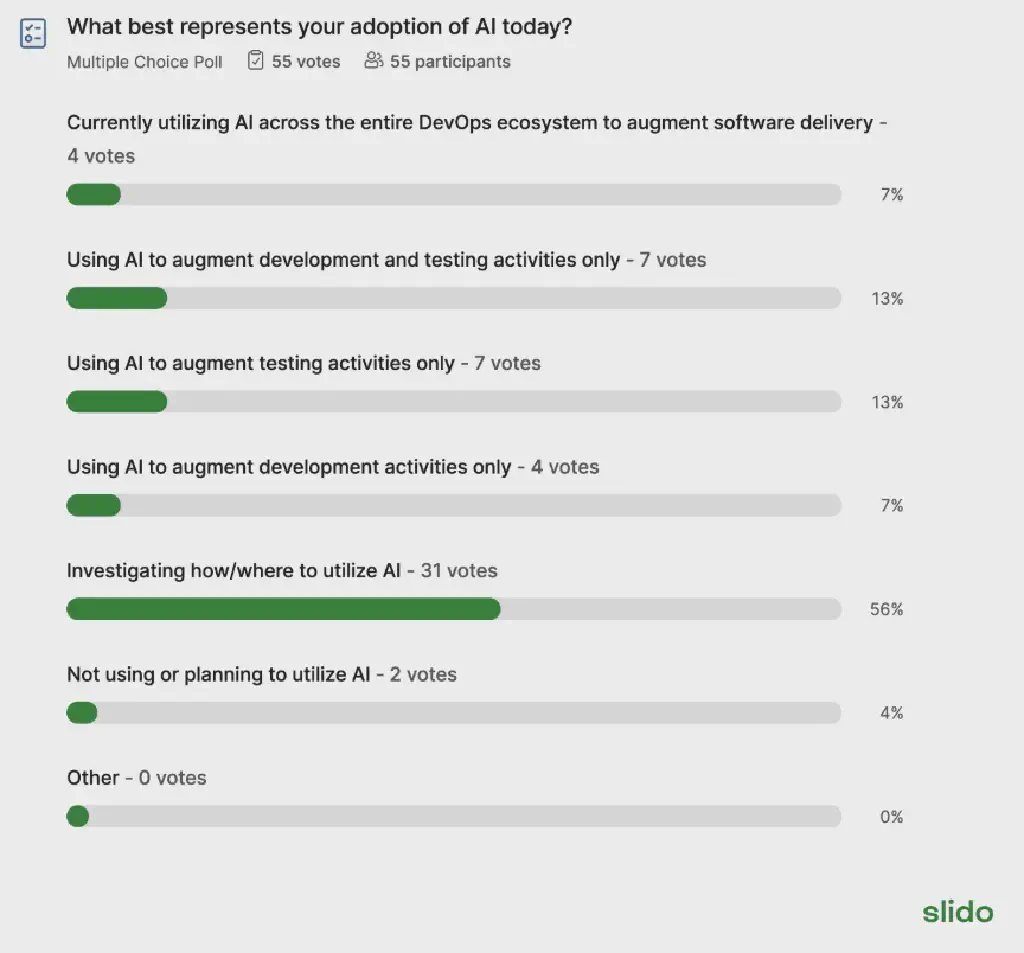
The pace of transformation has exceeded expectations: a webinar poll showed that 56% of teams are in the “research phase” of AI adoption, while 38% of enterprises see AI as a solution to the shortage of testing talent.
The views of industry giants are consistent with this (the author extends them here to the field of test automation):
Microsoft CEO Satya Nadella recently mentioned AI “agents” will transform SaaS, achieving breakthroughs by handling complex tasks, learning continuously, and connecting seamlessly across systems. Experiments by Stanford researchers on AI agents replicating human behavior likewise confirm the potential of agentic AI to change the way we test.
Shift-Right AI - Understanding Users
Understanding real user behavior has become a core element of quality strategy in 2025. By analyzing user interactions in production environments, teams can discover patterns, predict problems, and ensure the software meets user expectations. The integration of AI enables teams to explore new paths for improving quality.
Survey data shows a marked increase in attention to predictive models and user behavior analysis, with teams focusing on using AI to uncover long-tail cases and refine their understanding of the user journey. Gojko Adzic envisions tools integrated directly into platforms, providing experience analytics and predictive models that proactively anticipate problems. This is especially valuable when managing massive volumes of user data (including long-tail cases), where AI plays a key role in identifying data patterns.
This shift-right approach complements traditional shift-left methodologies by emphasizing quality assurance after deployment. Potential benefits include:
- Reduce user-reported defects through proactive monitoring
- Improve feature adoption by optimizing high-value user flows
- Improve test coverage through data-driven decisions based on real usage patterns
QA for Everyone - Human-AI Collaboration
With the adoption of agentic AI and end-to-end autonomous quality platforms (described in detail below), software testing will undergo dramatic changes in 2025. Low-code/no-code tools combined with AI allow testing to break through traditional barriers, enabling business analysts, developers, and even stakeholders without a technical background to participate in quality assurance. A webinar poll showed that 74% of participants considered themselves AI beginners, highlighting the need for tools that lower the barrier to entry.
Intuitive low-code solutions reduce the learning curve and accelerate tool adoption by automating complex tasks such as test creation and defect detection. Surveys show that 32.3% of teams are actively experimenting with no-code testing solutions.
At the same time, human oversight remains indispensable. As Tobias Müller put it: “The point is no longer whether to trust AI, but setting boundaries and trusting the rules you have set.” Teams that combine human experience with AI demonstrate better defect detection and faster testing cycles, proving the importance of human-AI collaboration.
The Evolving Tester Role - Adapting to the Future
Testers are transforming into hybrid roles that blend traditional skills with AI, DevOps, and automation knowledge. Survey data confirms this shift:
- 45% of teams emphasize the need for AI skills
- 51.8% prioritize DevOps knowledge
- 72.3% focus on automation expertise
DevOps and SRE Integration - Continuous Quality
The integration of testing with DevOps and Site Reliability Engineering (SRE) practices is the most significant test automation trend of 2025. As enterprises place growing emphasis on continuous delivery and operational resilience, testing is evolving into a proactive quality assurance activity that runs throughout the software lifecycle.
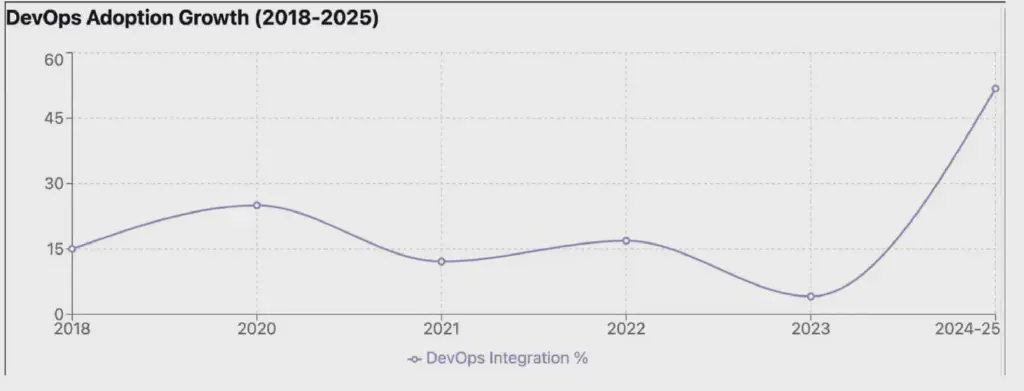
Survey data reveals a significant shift: as of 2024, 51.8% of teams had adopted DevOps practices (only 16.9% in 2022). This growth confirms the deep integration of testing with DevOps/SRE workflows to safeguard software quality under high-speed delivery.
This integration goes beyond traditional QA, turning it into a continuous activity that improves the entire lifecycle and helping enterprises to:
- Accelerate feedback loops: embed testing into CI/CD pipelines to detect issues immediately
- Implement proactive quality assurance: integrate performance testing and monitoring into workflows to identify risks early
- Foster team collaboration: shared quality ownership improves collaboration among QA, development, and operations teams
Survey data clearly supports this trend. From pipeline automation to performance monitoring, teams are adopting continuous quality practices aligned with operational excellence goals. If your organization has not yet integrated testing with DevOps/SRE, 2025 is the perfect time to make the transition.
End-to-End (E2E) Autonomous Quality Platforms
E2E platforms are becoming the core of testing strategy. These platforms integrate testing, usability, performance, accessibility, and security within a unified framework to address a broader range of quality concerns. By using AI to automate the testing lifecycle, teams report significant improvements in defect detection and test coverage.
Survey data shows significant growth:
- Security testing grew from 8.2% in 2021 to 39.5% in 2024
- Performance testing adoption reached 41%
- API testing grew from 13.1% in 2021 to 46.2% in 2024
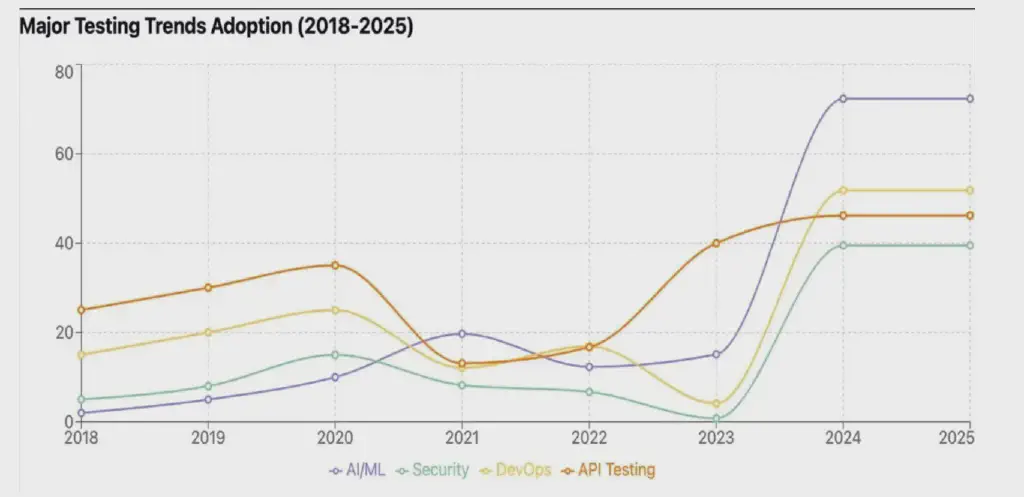 These metrics reflect the growing reliance of enterprises on comprehensive quality platforms to manage all their testing needs.
Playwright - The Preferred Automation Tool
As I predicted last year, Playwright has become the tool of choice for many testers. According to the analysis in Playwright Surpasses Cypress (Future Outlook), this prediction has been validated.
What about current progress? Thanks to outstanding versatility, reliability, and performance, Playwright continues to consolidate its leading position in 2025. The TestGuild 2024 survey and community feedback show its remarkable growth.
Testing tool preferences have undergone a major shift (based on an analysis of 2018-2024 data):
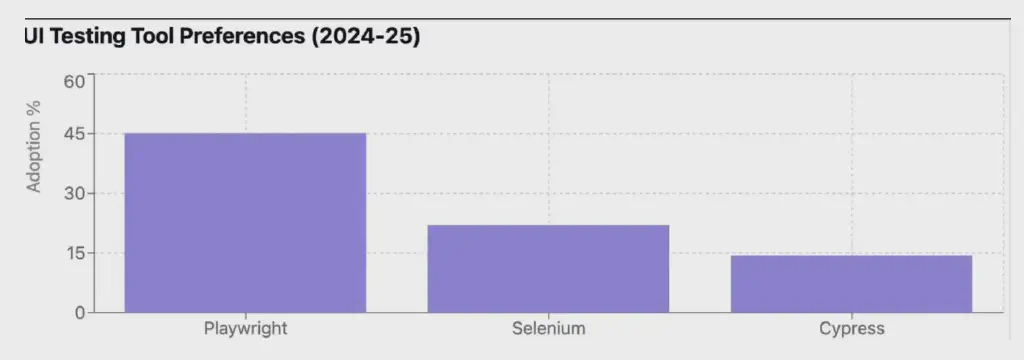
- Playwright: a 45.1% adoption rate makes it the fastest-growing tool, with advantages including cross-browser support, API testing capability, and efficient workflows
- Selenium: once the market leader, its adoption rate has now dropped to 22.1% as teams pursue more efficient and stable solutions
- Cypress: holding its ground in front-end testing, it maintains a stable user base of 14.4%
Playwright users commonly report:
- Faster test execution: accelerating feedback loops and improving the development lifecycle
- Lower test flakiness: producing more stable and reliable test results
Beyond its initial UI browser automation capabilities, Playwright has evolved to support advanced features such as API testing, making it a comprehensive solution for modern testing needs.
Must-Know Programming Languages for Testers in 2025
According to the TIOBE Programming Community Index, Python has topped the list for two consecutive years. This matches my expectation — thanks to its simplicity, strong library support, and dominance in AI/machine learning, Python remains the preferred language for testers in 2025. Whether you are just starting out in automation or are a seasoned testing expert, Python is the bridge connecting today’s challenges with the future possibilities of test automation.
Conclusion - The Path to Test Automation Success in 2025
2025 will be a pivotal turning point for software testing, offering unprecedented opportunities for those who embrace change. The convergence of AI maturity, team collaboration, and tool evolution marks the dawn of a new era in quality assurance.
Success requires not only paying attention to trends but also taking action:
- Embrace agentic AI: explore how autonomous AI agents can optimize workflows and reduce human intervention
- Adopt shift-right testing practices: balance traditional shift-left approaches with post-deployment monitoring to ensure the software meets real user expectations
- Invest in skills development: equip your team with AI, automation, and DevOps knowledge to stay competitive
- Integrate testing with DevOps/SRE: break down silos and embed quality assurance into every stage of delivery
- Make good use of comprehensive tools: from Playwright to Python, choose tools that meet current needs and are future-ready
These trends signal a fundamental shift in how quality assurance is approached. As the boundaries between testing, development, and operations blur, the role of the modern tester is evolving into a strategic one. To gain a deeper grasp of these transformative trends, join the annual Automation Guild conference and help shape the future of testing together with industry leaders.
The road to innovation in 2025 is already laid out — are you ready to lead the change?