
Many people from non-IT backgrounds who want to switch to testing have heard it said that software testing has a low barrier to entry—that you can get into the industry even without knowing how to code. So is that actually the case?
The answer should be stated plainly:
Without coding skills, you actually can work in software testing—and yet, in practice, you actually cannot.
Why you actually can
Software testing is not a discipline built on coding ability, which is why, in principle, you can do it.
Software testing is the act of exposing quality problems in a product through testing; it is, in essence, a skill of discovering the unknown. What matters more, then, are abilities such as experimentation, exploration, observation, reasoning, questioning, and modeling. Having coding skills, on the other hand, mostly helps you understand how the product is implemented, or lets you use code to extend your testing methods and improve testing efficiency. In this sense, coding ability is a supporting capability—one that assists the testing work, but is by no means the decisive factor in whether that work can be accomplished!
In his paper “Testing and Checking”, James Bach elaborated on the relationship between testing and checking
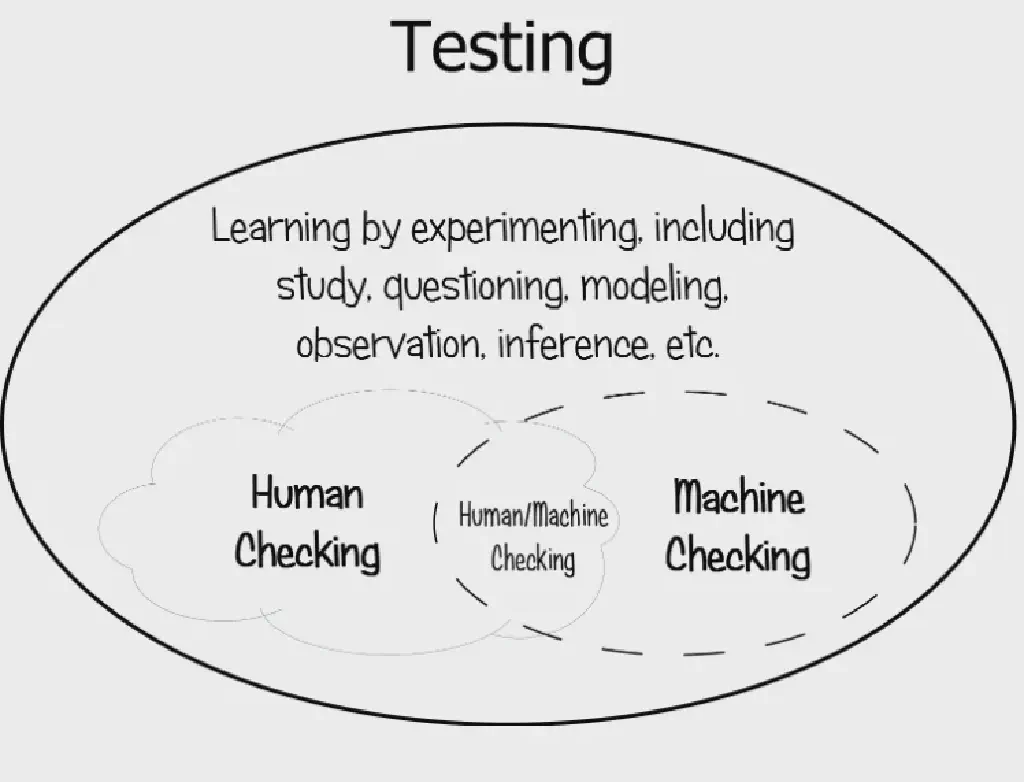
testing is the broader concept, while checking is only a subset of testing—and checking itself is further divided into manual checking and checking performed with the help of machines (tools).
What coding ability affects, then, falls mostly within that tool-assisted checking part.
That is why, in the early days, many testing experts who excelled at the work were not particularly good at coding; more often than not, they were domain experts in the relevant business area, equipped with outstanding testing thinking—that is, the detective-like abilities of observation and reasoning mentioned above.
So, in truth, lacking coding skills does not prevent you from doing testing work exceptionally well.
Why you actually cannot
And yet, we must also say that, without coding skills, in practice you really cannot.
As we noted above, in the early days there were indeed testing experts who could not code. But times have changed, and the reality today is quite different. As the industry has evolved, the direction of the testing profession has arguably departed from its original track. It is rather lamentable, and worthy of a sigh!
There are several reasons:
The rise of development models that emphasize fast delivery, such as Agile
In Agile development models, there is in fact no longer a dedicated testing role; instead, the emphasis is on team members being versatile generalists who can take on a range of development tasks with one specialty and many skills—including both development and testing. As a member of the team, a tester naturally cannot do testing alone; when necessary, they must also be able to pick up development work, at least including tasks originally in the developer’s domain such as unit testing and integration testing. Coding ability is, of course, the hard requirement for meeting this condition.
The mandatory requirement for test automation skills
Also driven by the needs of development models such as Agile and continuous integration, test automation has become an indispensable part of the process. And as the foundational capability for test automation, coding ability is naturally a necessity.
But it must be pointed out here that something like test automation—aimed at “quickly completing testing”—is, according to the relationship between testing and checking shown in the figure above, not really “testing” at all; it is much more “checking”. A single-minded emphasis on coding ability is, in a sense, actually a weakening of the requirements of testing work—that is, it increasingly demands only “checking” rather than “testing”.
The talent market is oversupplied
Finally, there is the industry environment. In the early days of the internet boom, the talent gap was large, and a great deal of “verification” work was done manually by junior staff or complete beginners with zero foundation who did not need coding skills; manual “checking” accounted for a larger share.
But when the industry turns downward, companies cut costs, leading to an oversupplied talent market. The entry barrier naturally rises, job requirements climb accordingly, and expectations for tool-based “verification” grow higher—so coding ability, test automation, tool development, and the like have all but become must-have skills.
Layered on top of that is the current prevalence of development models such as Agile and the resulting demand for test automation. It is fair to say that, without coding skills, in today’s environment it has become very hard to argue that one can still work in testing—there is simply no way in.
Conclusion
So, under present conditions, when it comes to testing work, lacking coding skills does not mean you cannot accomplish the work—but without coding ability it has become very difficult to get on board.
Therefore, as individuals swept along by the tide of the times, what we can do is not to swim against the current, but to steadily build personal capabilities that move with the trend. But we must still understand what the core requirements of this work truly are—accumulate steadily and then burst forth, for gold only appears after all the sand is washed away!