
What Is the Question
Will a boss tolerate an employee with poor conduct? Here, “poor conduct” can be understood as violating discipline or even the law, disregarding public order and good morals, and so on — in other words, the employee has a problem with values.
But there is actually another implicit premise here: this employee is presumably very capable (setting aside things like background — though background, of course, is itself a kind of capability). Otherwise there would be no basis for discussing whether to tolerate them at all.
The Theoretically Correct Approach
Therefore, what we are discussing here is the question of employee evaluation in management. When companies evaluate employees, they usually look at two dimensions in combination: performance and values.
The GE 9-Box Grid
For example, when GE evaluates employees, it combines these two dimensions with three levels — high, medium, and low — to produce a nine-box grid.
Green: excellent evaluation
Blue: competent or improvable
Red: should be eliminated

Moreover, in this nine-box grid, values actually carry more weight than performance: even with excellent performance, an employee still leans toward red, tending toward elimination.
Alibaba’s Five Types of Employees Model
Similarly, it is said that Alibaba also has a classification of employees into five types.
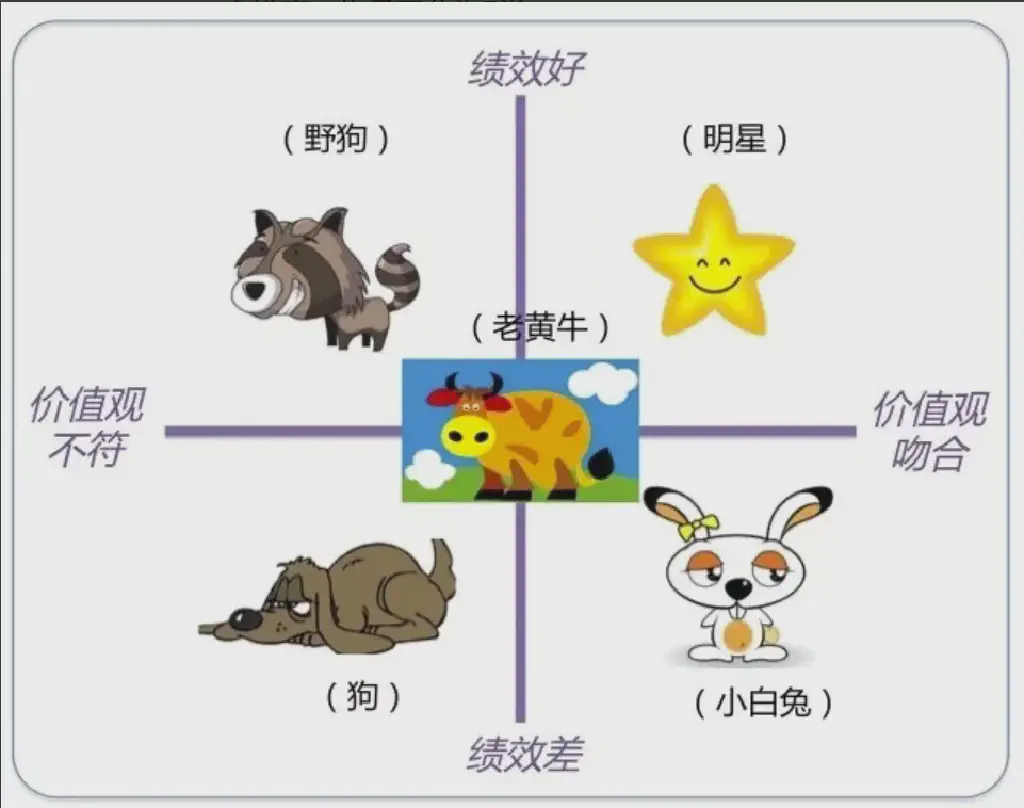
Stars: outstanding performance, prominent contributions, and sound values; performance resources are tilted toward them.
Oxen: diligent and conscientious, fully fulfilling their duties; the bedrock of the team.
Wolves: exceptional ability but problematic values; if they cannot be corrected in time, they must be resolutely replaced.
White Rabbits: appear hardworking and have good values but lack ability; if they cannot improve, they too must be eliminated.
Dogs: neither ability nor values are up to par; eliminate them resolutely.
So from the above we can see that mature companies have a fairly clear stance on employees with values problems: no matter how good your performance, you should still be eliminated — that is, poor conduct will not be tolerated.
Possible Real-World Scenarios
The above is more about the theoretically correct approach.
In reality, however, what choice a boss makes is usually shaped jointly by the stage the company is at and, of course, the boss’s own personal values.
Marx pointed out long ago that “capital comes into the world dripping from head to toe, from every pore, with blood and dirt.” Of course, this refers more to the stage of primitive capital accumulation, where achieving capital growth often means stopping at nothing. In other words, in the early stages of capital accumulation, poor conduct is, with very high probability, unavoidable.

So in reality, the logic behind a boss’s choice is actually quite simple:
If the company’s survival is the top priority, then delivering results and simply staying alive often matters more to the boss; in this case they will mostly be more tolerant of employees who stop at nothing yet deliver excellent performance.
But once the company has grown big and strong, continuing to tolerate misconduct may harm its health and long-term development, so naturally it can no longer be tolerated.
Of course, we should still believe that there really are entrepreneurs with a grand vision and strong character who have upheld those fine values from the very beginning. It is just that when a company faces life and death, the approach it chooses to adopt is the more convincing one.