In the previous installments of this series, we introduced the three main roles in Scrum. When it comes to actually implementing Scrum, there are also specific work objects or deliverables involved, and in Scrum these materials are called artifacts (Artifacts).
Artifacts
In Scrum, “artifacts” generally refers primarily to three core artifacts: the Product Backlog (PBI), the Sprint Backlog (SBI), and the Increment. But beyond these three core artifacts, there are in fact several other artifacts defined in relation to them.
In agile, artifacts serve as our work objects and deliverables. They should be jointly created and maintained by the entire Scrum Team, and they should be transparent to everyone—that is, these artifacts should be visible to everyone on the team. This is also an agile principle: it reinforces a shared understanding and communication across the team, so that everyone works on the same wavelength. Being transparent, visible, and available for reference at any time is extremely important.
Product Backlog (PBI)
The first core artifact is Product Backlog Items (PBI). A PBI is an ordered list containing all the unfinished items remaining for the product, including product requirements, unfixed bugs, technical optimizations, internal improvements, work tasks, and all kinds of product-related matters that the team needs to handle later.
PBIs should have the following important characteristics, otherwise known as the DEEP principles:
- Detailed: detailed descriptions. Backlog items must have clear, unambiguous explanations so that team members can fully understand the necessary information about them. This is also why refinement is necessary in Scrum: the higher the priority, the more thorough the detailed description should be.
- Emergent: emergent. The PBI is a dynamic list that can be inserted into and adjusted at any time as needed.
- Estimated: estimated. Before a backlog item needs to be implemented, both the effort and the value to the product should be estimated. Whether these estimates are accurate is the foundation of the team’s actual productivity.
- Prioritized: prioritized. The backlog items in a PBI should be ordered by priority; within a PBI, no two items have exactly the same priority. This is also an advantage of a list, since a list inherently has an ordering: in a PBI list, items higher up have higher priority. When the team pulls iteration tasks from the PBI, it also extracts them in order of priority.
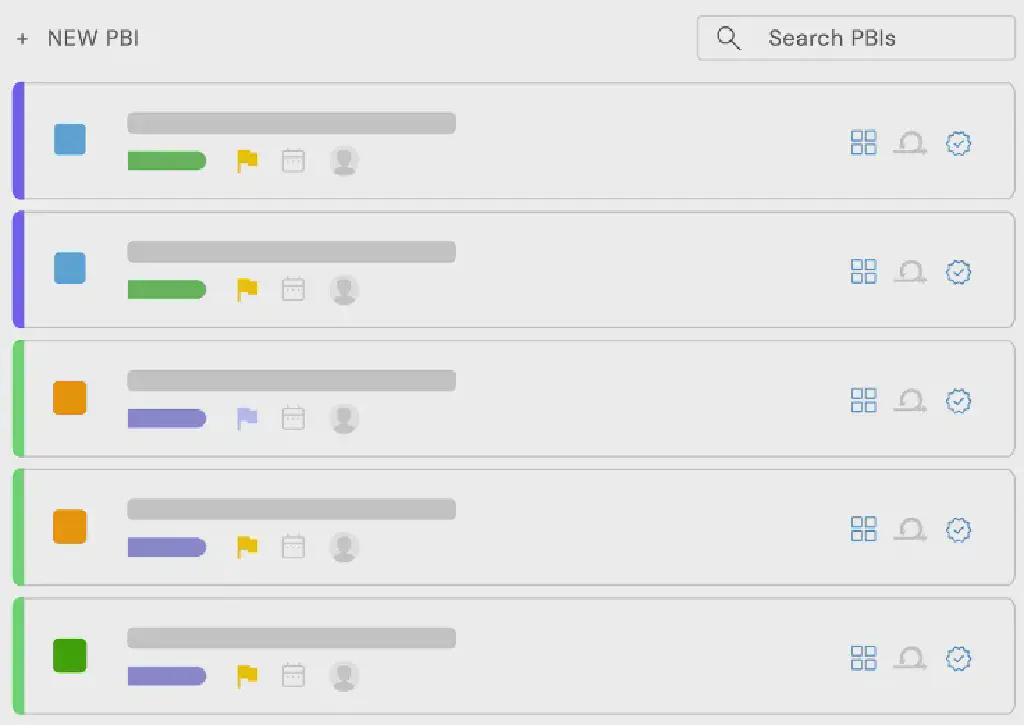
Like other artifacts, although the PBI is also a deliverable that the team maintains together, the owner of the PBI is the PO (Product Owner). Other members do take part in adding details to the PBI, refining solutions, and the effort estimation for the PBI is also provided by the team, but ultimately only the PO is accountable for the PBI. The PO has the final say on interpretation and on prioritization.
During the creation and maintenance of the PBI, the PO usually brings as many relevant Features, Stories, and Enhancements (optimizations) as possible into the PBI as the basis for subsequent work. Then, after thorough communication with the team, typically through a product refinement meeting (grooming), the requirements are elaborated and implementation approaches are discussed. The team also breaks down concrete technical tasks and estimates the effort required.
The PBI is therefore essentially the source of Scrum agile development, playing a role comparable to the PRD, the main deliverable of the requirements breakdown phase in traditional development. The PBI is the foundation for launching a Sprint and also the source of the SBI.
Product Vision
Paired with the PBI, there is actually another supporting artifact, called in the Scrum definition the PBI’s commitment (the committed deliverable). That is the Product Vision.
The Product Vision is something that should be defined early in a product’s life. It mainly summarizes, at a high level, what goals the product aims to achieve, what purpose the thing everyone is building together is meant to serve, and what value it brings to users. In other words, it lets the whole team know what they are working for.
It is a relatively long-term description of the entire product roadmap.
Sprint Backlog (SBI)
Sprint means a short burst. It is a short, time-boxed window defined in Scrum, within which the team can complete some deliverable product features. Based on the completed features, it gathers feedback from relevant stakeholders so that the product’s evolution roadmap can be adjusted in a timely manner. It is a concrete embodiment of the agile idea of “small steps, fast runs.”
The SBI, then, is the list of all backlog items the team needs to complete within a Sprint. The SBI is therefore actually extracted from the PBI, distributed as the work the team needs to complete across different Sprints.
Usually, at the Sprint Planning meeting before a Sprint officially starts, the team jointly completes the extraction of the SBI based on the priorities of the PBI and the team’s capacity.
Once the SBI is settled at the planning meeting, it is generally kept as stable as possible. But unexpected situations always arise in reality, and agile embraces change, so a fixed SBI does not necessarily remain constant throughout the Sprint. Based on priority adjustments, and after reaching agreement with the team, the PO can add, remove, or modify items in the SBI—but the prerequisite is that the team reaches consensus.
SBI adjustments usually mean wasted effort, so within a Sprint it should be kept as stable as possible.
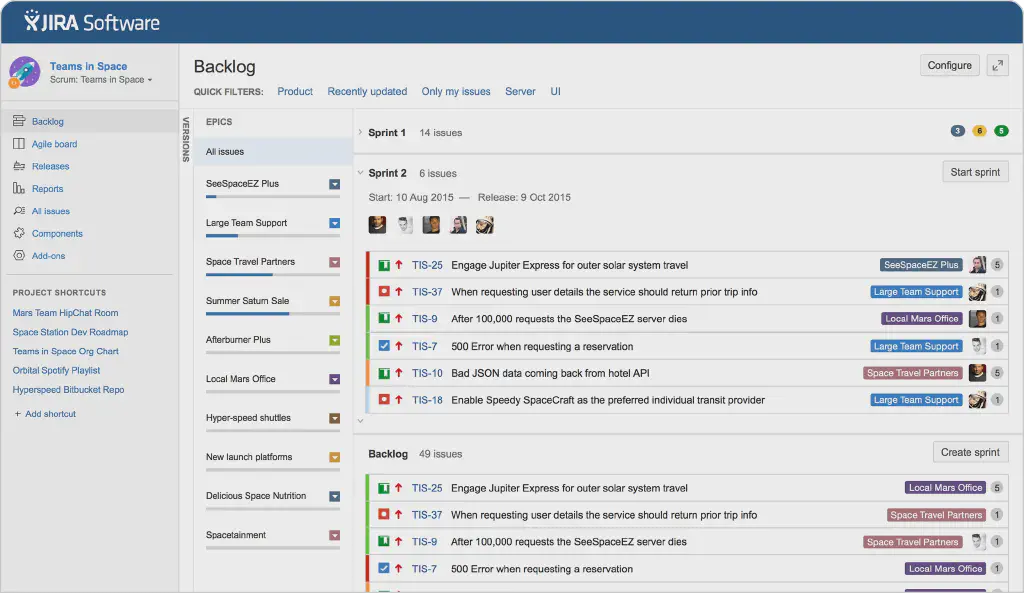
The figure shows the SBI already pulled into a Sprint within Jira, a commonly used agile management tool. Once the Sprint begins, the iteration board in Scrum reflects the Sprint’s progress in real time.
Sprint Goal
Similarly, paired with the SBI there is also a supporting artifact, or commitment—the Sprint Goal. This artifact is usually defined by the PO and outlines, at a high level, the core objective the entire Sprint should achieve. After being confirmed and agreed with the team, the Sprint Goal also represents the output the team as a whole commits to delivering in this cycle.
For the various stakeholders not involved in the iteration, the Sprint Goal is also a way to understand the overall progress of the current product.
Increment
Increment means increment. In agile, because of the emphasis on small steps and fast runs, the work output of each iteration is in fact oriented toward the product vision and is an enhancement on top of the existing foundation. It is not only a process of accumulation but also a process of continuously delivering value to users.
Based on agile principles, the Increment should be working software that can demonstrate the product’s value. In other words, the Increment, combined with the outputs of previous Sprints, should always be a forward-looking, minimal usable piece of software—an MVP (Minimum Viable Product)
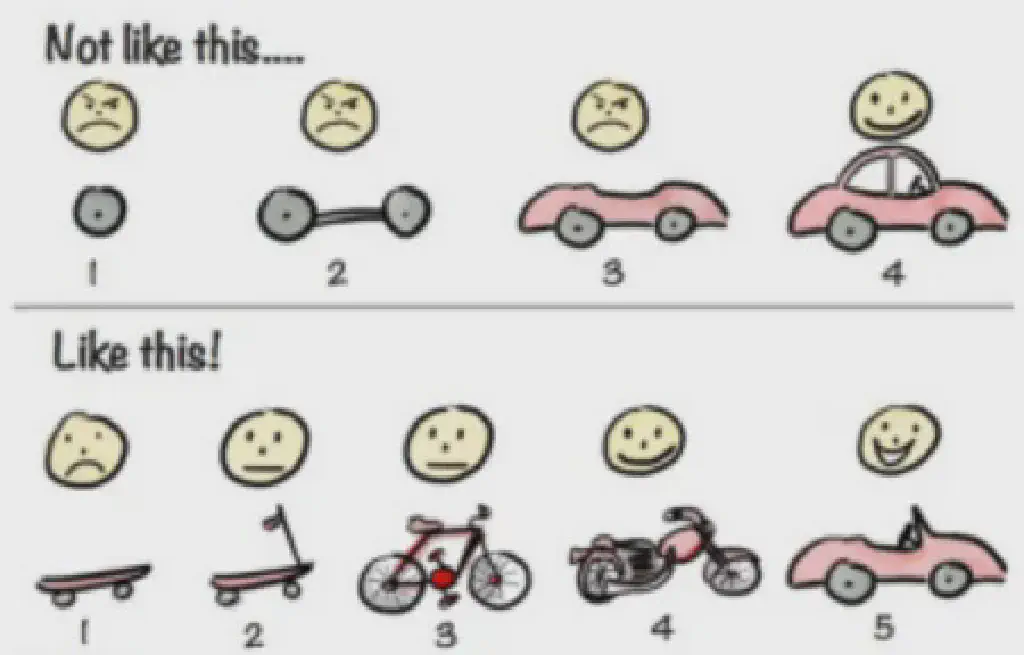
Whether a Sprint has achieved its Sprint Goal is usually demonstrated at the Sprint Review by showing the functional results of the Increment to relevant stakeholders and obtaining their feedback.
Definition of Done (DoD)
The commitment associated with the Increment is actually the completion status of each backlog item in the SBI. So how is this “done” defined? In Scrum, that corresponds to the DoD. The DoD is a set of common definitions for the main types of backlog items.
In fact, besides the DoD there is also the DoR. The DoR defines under what conditions a backlog item can be considered ready. Only ready backlog items should be pulled into the SBI.

Other Artifacts
In addition to the three core artifacts defined in Scrum and the supporting commitment artifacts, there are also artifacts defined to reflect the status of iteration progress.
Burndown Chart
The Burndown Chart is a visual chart that reflects the progress of a Sprint in a timely manner.
X-axis: the elapsed time of the iteration Y-axis: the workload of the iteration, usually represented by the Story Points estimated in the SBI, reflecting the estimated total effort required to complete the iteration.
Based on the relationship between workload and time, first draw an ideal burndown line of Story Points that is linear, and then draw an actual burndown line based on the work actually completed each day during the iteration. How well these two lines match reflects whether the iteration is currently on track. It is a key iteration status chart that the Scrum Master and the team should keep an eye on at the daily standup.
For this reason, the Burndown Chart is usually regarded as an important artifact in Scrum.
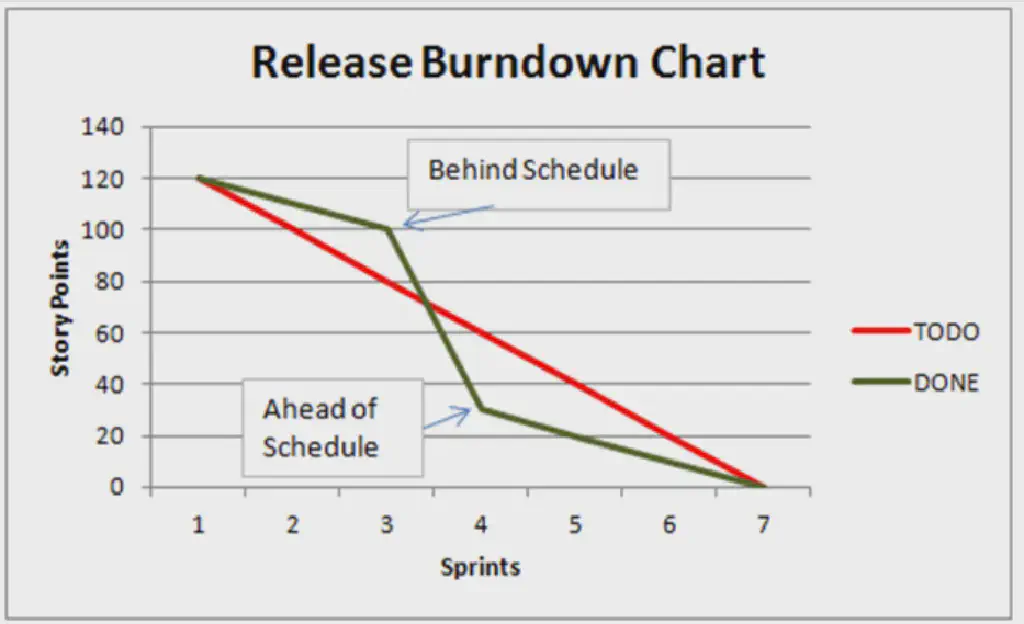
Besides the Burndown Chart, there are in fact many other charts that can be used to analyze current iteration progress. Commonly used ones include:
Cumulative Flow Diagram
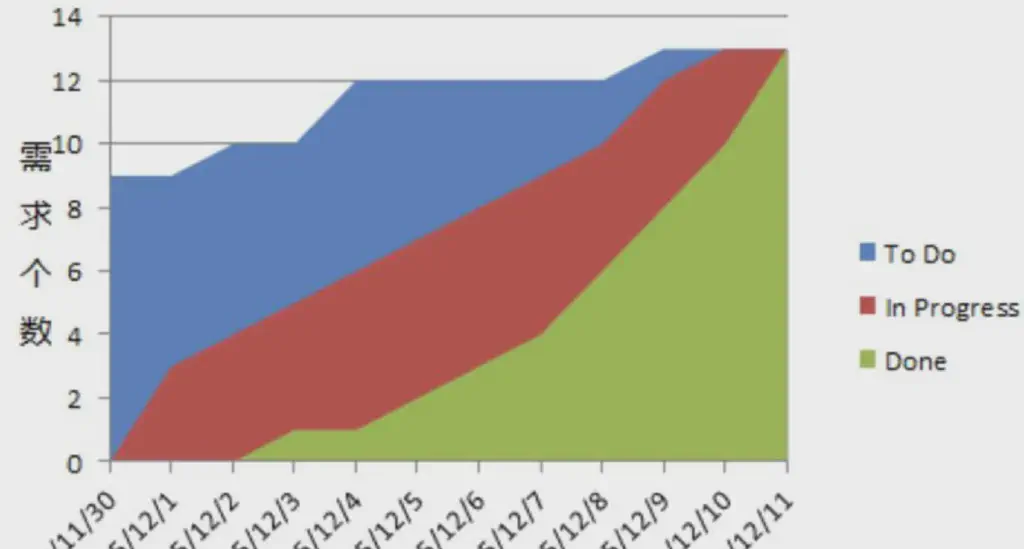
The Cumulative Flow Diagram shows the trend of overall requirements moving between different states within a Sprint, and it often plays an important role in identifying team bottlenecks and balancing the workload among members.
Velocity Chart
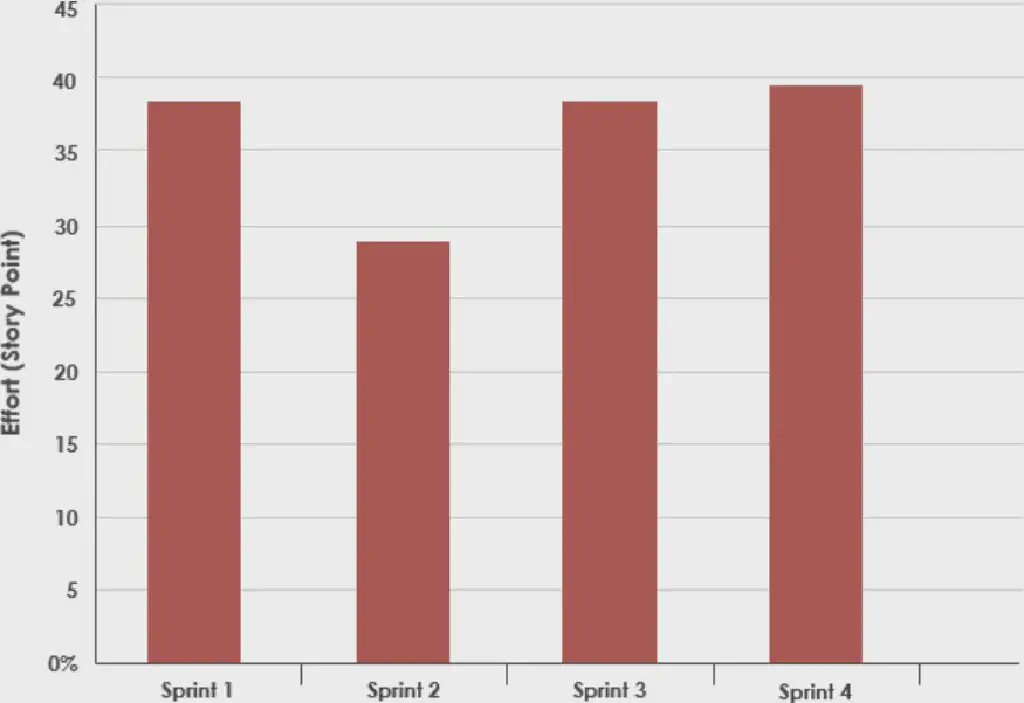
Another commonly used chart is Velocity. This chart tracks the work completed across multiple Sprints to observe whether the team’s productivity is stable, and thereby forms a basic judgment about the team’s maturity.
The more stable an agile team is, the more constant its output per iteration should be. If the variation fluctuates widely, it indicates that the team still has many problems in task balancing, estimation, and handling interruptions. It is an observational metric.
The above is an introduction to the artifacts—the team’s work objects and deliverables—in Scrum agile. Feel free to keep following this series; updates will continue….