In any team, communication is in fact the core work of a manager. What we call management — turning various management methods and ideas into a team’s ability to execute — is actually accomplished through communication.
Managers need to invest a great deal of energy in team communication. Communication is the bridge and the connection, and the inevitable path to holding a team together. But communication is by no means as simple as the two parties just having a chat.
The Communication Funnel
Communication is essentially a process of transmitting information and building consensus, but in communication between people there exists a rule known as the communication funnel.
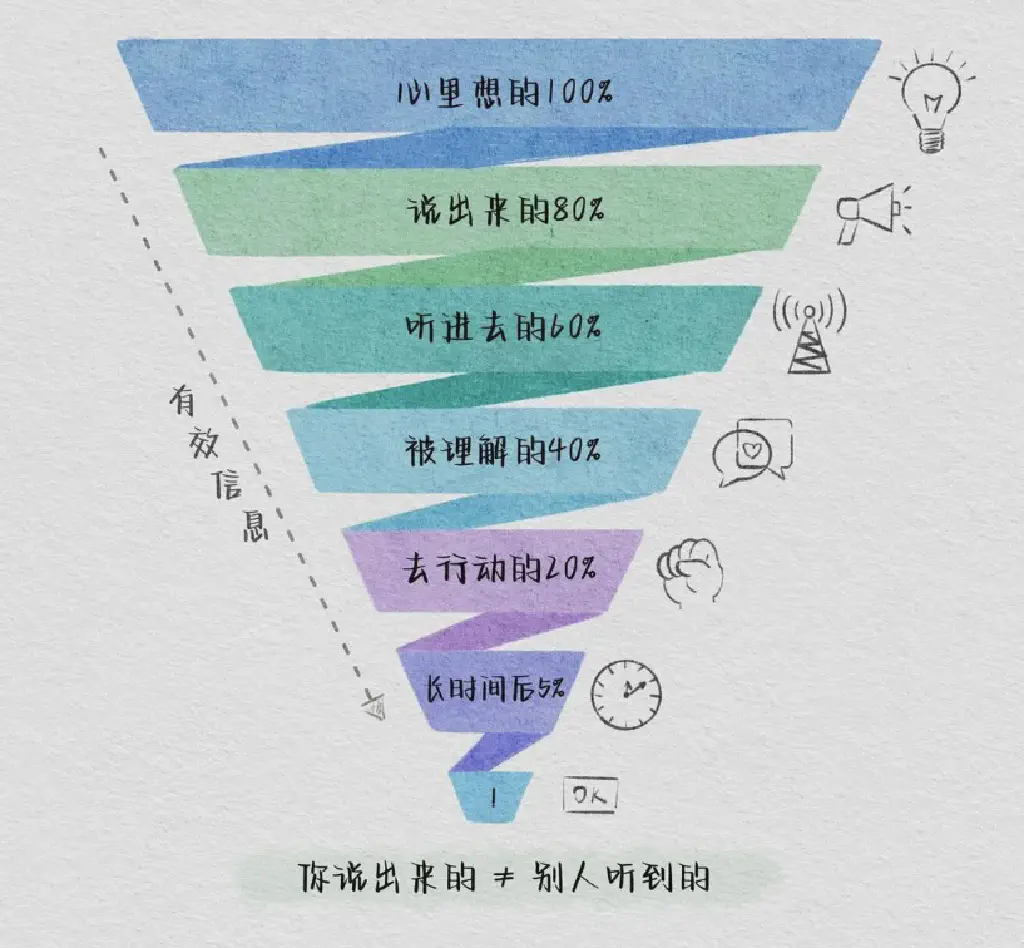
If what you have in mind, about the matter we want to communicate, is originally 100% of the information,
then after it is expressed orally or in writing, the information actually conveyed may be only 80%,
and the information the other party is able to receive drops to 60%,
even within the information received, what can be correctly understood without distortion is estimated to be only 40% left,
and when the relevant information is then translated into concrete action, it drops a further 20%,
as time passes, it may even decay to almost nothing…
So the transmission of information in fact has a marked attenuation effect, and dealing with the attenuation of this communication funnel is the core of communication management in team management.
This includes confirmation at multiple levels; checking for deviations through the definition of processes and the setting of milestones and checkpoints; and regular retrospectives to review lessons learned.
Effective Communication Model - The Johari Window
To counter this attenuation effect in communication, to ensure that both parties in a conversation can fully understand one another and reach consensus, and to improve the effectiveness of communication as much as possible on a shared foundation, there is a well-known model: the Johari Window communication model.
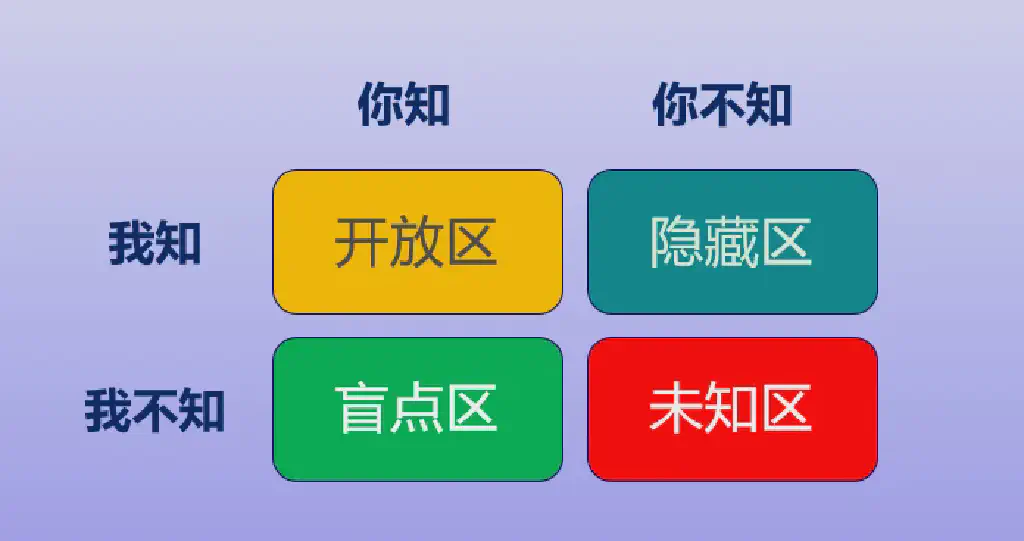
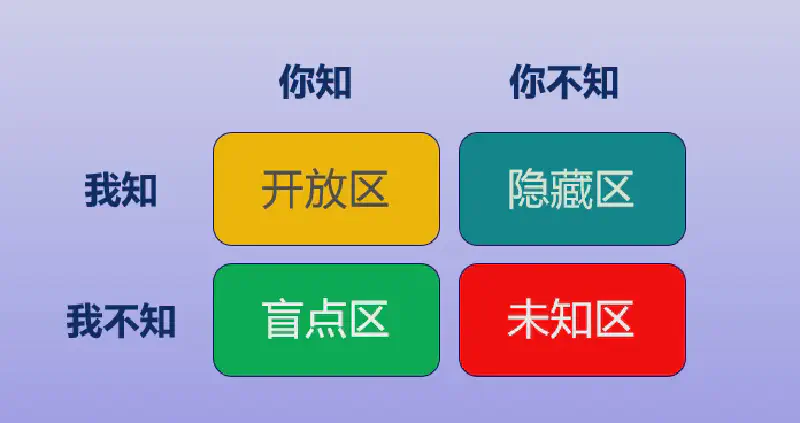
In this model, based on how well the two parties in communication grasp the information, it is divided into four quadrants.
Information that I know and you also know lies in the Open Area. In this region, the two parties share the same foundation of information, which is also the basis for building trust when we communicate; the larger this area, the less likely misunderstandings are to arise, and the more it helps us achieve efficient communication.
Information that I know but you do not know lies in the Hidden Area. Everyone has secrets, a real self concealed beneath the surface. But sometimes, to achieve effective communication, appropriately opening up the Hidden Area is a shortcut to winning others’ trust and building efficient communication.
Information that others know but you do not know — such as others’ true opinions of you, some of your personal weaknesses, or information you simply do not possess — all belongs to the Blind Spot Area of information. The smaller the Blind Spot Area, the closer your judgment of things is to reality, and the greater the chance of making correct decisions. Keep an exploratory spirit and strive to shrink your own Blind Spot Area.
stay foolish, stay hungryThe Unknown Area is information that neither party understands. Information in this region is both a risk and a potential source of growth for the team.
In the Johari Window, achieving efficient communication really comes down to four sentences:
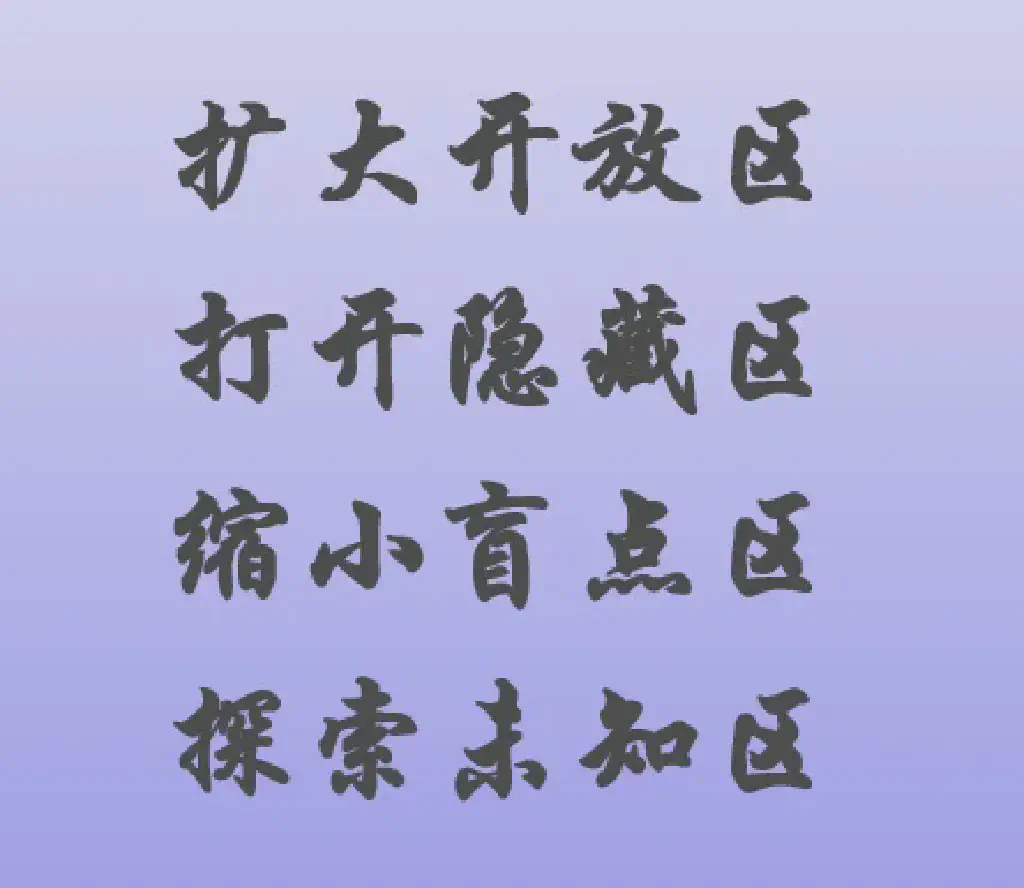
Expand the Open Area: the larger the Open Area, the more consensus everyone shares and the easier it is to reach agreement. It is the foundation of mutual trust.
Open the Hidden Area: an effective means of strengthening mutual trust; opening the Hidden Area can also help us expand the Open Area.
Shrink the Blind Spot Area: it helps us understand the facts better, broaden self-awareness, and improve ourselves.
Explore the Unknown Area: encourage open input and fully grasp information from multiple angles and channels, so as to eliminate unknown risks as much as possible.