In the previous articles of this series, we sorted out the origins of Agile and the main frameworks through which it is put into practice today. Among them, the Scrum framework is the absolute mainstream of Agile practice and is virtually the de facto standard for team-level Agile practice. Most scaled Agile frameworks are also built as extensions on top of Scrum. Therefore, our subsequent summaries will take Scrum as the foundation to explore the main practices and ways of working through which Agile is applied in the software development process.
In this article, we will begin by discussing the composition of roles in the Scrum framework.
The Scrum Team
In Scrum, the Scrum Team exists for one purpose only: every time, it exists to accomplish one valuable goal of the product. As the smallest cohesive unit of productivity in an Agile organization, the Scrum Team has no hierarchy within it. The team is made up of cross-functional professionals, and its members should possess all the skills needed to accomplish the product goal.
In operation, the Scrum Team is responsible for all activities related to the product goal, including collaboration with stakeholders, verification, maintenance, operation, experimentation, research and development, and any other activities that may be needed. The Scrum Team is self-organizing and self-driven, staying focused and continuously delivering value at a sustainable pace.
Although there is no explicit constraint on team size, the ideal size of a Scrum Team should generally be kept to within 10 people. Smaller teams communicate more efficiently and achieve higher productivity per person.
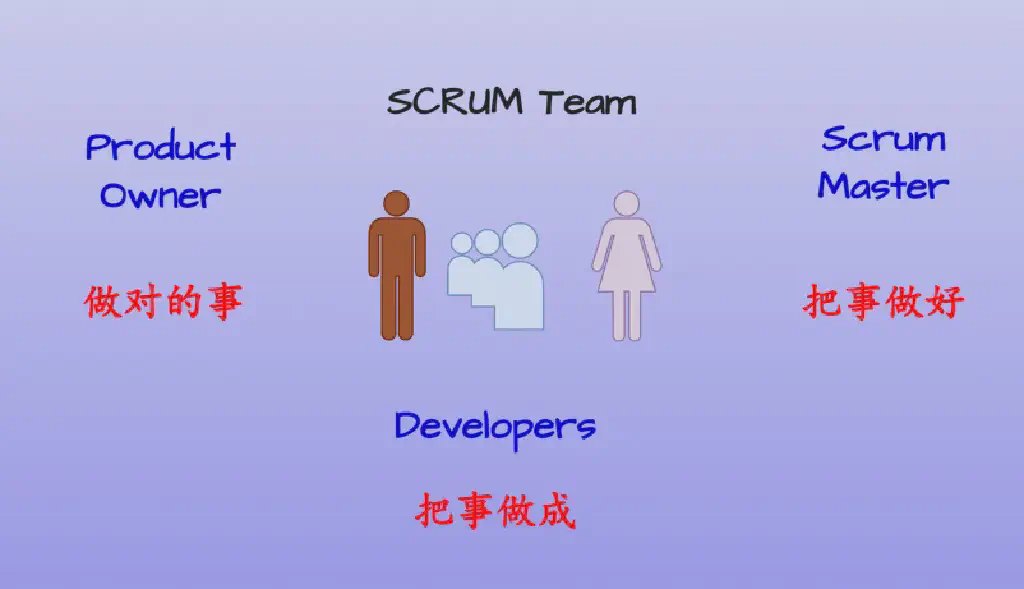
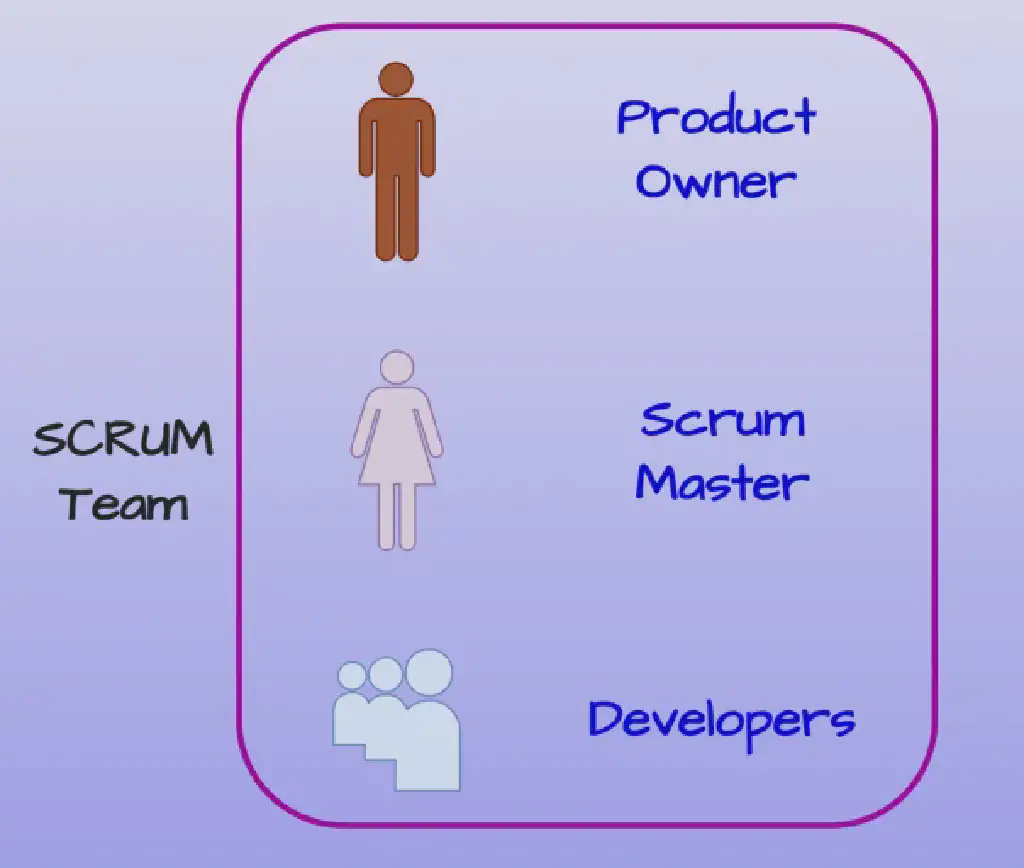
In each iteration (Sprint), delivering a valuable Increment is the responsibility of the entire team. Toward this goal, Scrum defines three different roles within the team: the Developers, the Product Owner, and the Scrum Master.
Product Owner
As the name of the PO role suggests, this person is the owner of the team’s work output — the product. The PO has the final say over what the product should ultimately become. Within the team, the PO is the voice of the end user, and the source, definer, and ultimate decision-maker of requirements.

So the responsibilities of the PO include the following aspects:
1. Defining Requirements and Managing the Product Backlog
The PO’s primary responsibility is, in other words, defining requirements. Requirements are the source of the team’s work and its foundation. Although defining and confirming requirements is not work the PO completes entirely alone — team members also take part in discussing, refining, and improving requirements — the PO is the one who makes the final decision on requirements. The requirements that have been defined constitute the product backlog items, PBI(Product Backlog Item); the PO is the manager and owner of the PBI. Even though the team also participates in maintaining requirement items and refining some technical details, the PO is accountable for every item in the PBI.
The requirements contained in the PBI are a list of all unimplemented requirements, including both near-term and long-term ones. Therefore, when managing the PBI, one of its important attributes is its priority, and defining the priority of PBIs is the PO’s responsibility. Based on the value a requirement brings to the product and on the team’s feedback, the PO weighs risks and benefits to determine the priority order of every requirement.
This is also an inherent advantage of the PBI existing as a list: every requirement has a unique position in the list, and that position represents its priority. The higher up in the list, the higher the priority. An important part of the PO managing the backlog is managing the ordering that corresponds to each requirement. A well-managed PBI is the foundation for starting subsequent iterations.
2. Clarifying Requirements for the Team and Giving Timely Feedback
For an Agile team, since requirements are the input to its work, another important responsibility of the PO is to explain the definition of requirements to the team and to clarify any misunderstandings or descriptions that are not clear or explicit enough.
This process runs continuously throughout development activities. It includes the requirement refinement meeting (grooming meeting) before the Sprint Planning meeting in the early stage, and also the ability to give timely feedback and explanations during the iteration when members have questions about requirements or need a decision. This is also why it is said that a Scrum Team should work together and maintain communication efficiency as an important factor.
3. Maintaining Relationships with Stakeholders
In the course of its work, a Scrum Team inevitably involves a variety of stakeholders, including investors (heads of the various product-related departments), customers, end users, and internal related departments (sales, after-sales, customer service, legal compliance, security, audit, quality, and so on), all of which have some connection to the product. The opinions, voices, and feedback from these different channels may all influence the definition of product-related requirements and their implementation, so the PO is the person responsible for maintaining these channels and communicating and coordinating with these different stakeholders. This is also why the member serving as the PO should be someone with strong communication and collaboration skills.
4. The Confirming Owner of the Work Output (Increment)
As the Owner of the product, whether the team’s work output in each iteration meets the requirements and can achieve the expected product goals is confirmed by the PO.
Although Scrum does not define a separate testing role, the work of testing is in fact included within the Development Team. For the acceptance and confirmation of the product, although the PO makes the final call, that does not mean the PO is responsible for the testing work here. Rather, it is more about judging whether the product goal has been achieved based on the assessment of the testing members or the feedback at the iteration’s demo and review meeting.
All in all, the PO, as a very central role in the Scrum Team, is extremely critical. Having a dedicated person devoted to the role is in fact very necessary. In some Agile projects, the PO may wear several hats and remain detached from the team, which really shows a failure to understand the importance of this role.
Scrum Master
In some dubious Agile projects, people confuse the SM with the traditional project manager (PM), believing that the Scrum Master’s job is the role of a traditional PM. This is a completely wrong understanding.

1. Not the Superior of the Team Members
In traditional projects, the PM is the person in charge of a project and is accountable for its success. At the same time, the PM also holds corresponding project management authority — the authority to assign work to project members and to evaluate their work results — and stands in a different hierarchical relationship from the project members.
But in Scrum, the SM and the team members are peers, with no authority to evaluate or assess them. The SM’s main responsibility is to ensure the smooth progress of the team’s work, acting as a coordinator who, through a professional understanding of Agile and practical experience, guides the team to complete the iteration work as efficiently as possible. The positioning is in fact that of a servant. During the execution of a sprint, by observing and monitoring how the iteration is running, the SM promptly removes impediments, boosts everyone’s morale, and, when necessary, gives the team a shot of adrenaline.
2. Promoting Agile Values and Agile Practices
As the Scurm Master and Agile coach, the SM’s responsibility is to carry through Agile values and convey those values to all members, and through personal practical experience to make the team’s operation conform to Agile principles.
As the facilitator of the Scrum Team, the SM needs to be responsible for organizing some of the main activities in the iteration, most importantly the four ceremonies of Scrum. Of course, this also includes other activities that need coordination and organization, such as discussions of urgent matters, important clarifications, reviews, and so on. In these activities, the SM usually needs to act as the facilitator, ensuring the effectiveness of the activity and keeping it from going off track.
3. The Team’s Firewall
A very critical point in the SM’s responsibilities is that the SM needs to act as the team’s firewall. This is also one of the most challenging aspects of being an SM. For an iteration, achieving the iteration goal is the most important matter for the team during the sprint cycle, and all work in the iteration should revolve around this goal.
But in any organization, it is inevitable that things may arise that interfere with the team members’ work. For example, some leaders may temporarily assign extra tasks, or make temporary transfers of personnel. At such times the SM needs to play the role of a firewall, being able to push these tasks back or, through coordination, seek external support to ensure the current iteration goal is not affected. Everything is aimed at accomplishing the established goals of the sprint and maintaining the team’s fighting capacity, rather than letting team members be directly interfered with by all kinds of external matters that affect the completion of the current iteration’s tasks.
Developers
The main body of the Scrum Team is in fact the Developers Team. But the “developers” here should not be understood as programmers in the traditional sense. The definition of a Scrum Team is that the team should possess all the skills needed to accomplish the product goal, so the Developers Team here is actually a general concept. Besides programmers, it also includes testers, visual designers, and possibly architects, DBAs, configuration management, and many other roles that are distinct in traditional projects — but in Scrum they are all collectively called Developers.
1. Possessing All the Skills Needed to Accomplish the Goal
So for the Developers Team, the primary responsibility is to possess all the skills needed to accomplish the product goal, including design, development, testing, deployment, configuration, and so on. But these tasks are viewed as a whole and are not explicitly mapped to specific individual members. That is to say, the skills of the team members may be comprehensive — specialized in one area yet versatile in many — and the team’s overall capability is not built on dependence on any particular member.
Compared with traditional development, members of a Scrum Development Team should be cross-functional, with each member having the skill requirements and corresponding abilities to take on different types of tasks. Simply put, in this Developers Team, each member’s skills have their own emphasis and they take on corresponding task types, but this is not absolute — they may also need to take on work outside their primary skill area, with everything aimed at accomplishing the iteration’s work goals.
2. Estimating the Backlog and Requirements
Another responsibility of the Development Team is to estimate the backlog items in the PBI.
The implementation of the requirements in the PBI is, after all, the responsibility of the Development Team; the implementation approach, the technology, and the maturity of the team’s capabilities all affect the workload of implementing each requirement.
And the workload of implementing requirements directly affects their completion and delivery, so in Agile, estimating requirements is an important matter.
This estimation is one of the main responsibilities of the Development Team. In Scrum, estimation generally takes place during the requirement clarification meeting or the planning meeting. Methods such as estimation by experience or Planning Poker can be used to assess the implementation complexity and workload of each requirement as objectively as possible.
The accuracy of estimation directly affects the achievement of the iteration goal and the health of the iteration’s operation. It is also an indicator of the maturity of a Development Team.
3. Breaking Down Goals and Claiming Tasks
In the PBI, requirements are mainly business-level demands. But their concrete implementation approach and execution usually still need to be broken down into different tasks, such as front-end tasks, design tasks, back-end tasks, testing tasks, and so on. All of these require the Development Team to complete the task breakdown and, through self-organization, the claiming and assignment of tasks. This work is generally completed collectively by the team during the planning meeting.
4. Fulfilling Commitments and Delivering Value
Finally, there is fulfilling the iteration’s commitment and delivering the product Increment, providing product value. Accomplishing, with both quality and quantity, the established goals committed to during iteration planning is the core of the Development Team’s overall work. The rate at which iteration commitments are met is the most direct indicator for observing whether a Scrum Team is mature and whether Scrum Agile has been successfully implemented.
Summary
The above is a sharing of the three roles in the Scrum framework, along with their respective responsibilities and requirements. Distilled into three sentences:
- The PO makes sure everyone does the right things
- The Development Team makes sure things get done
- The SM makes sure the team does things well