Preface
In the previous article of this series, What Is Agile? An Overview of Agile, we gave a first introduction to what agility is, the background against which Agile emerged, and why it has become so widely adopted today.
But agility itself is, more than anything, a set of values and a guide at the level of ideas. To apply it in a real organization, you still need concrete practice models to put it into action. As Agile has evolved, a great many different practice models have emerged, and organizing our development process around any of these models can be called Agile Development.
Below, we will focus on sorting out the models that are relatively common in Agile development practice, along with their strengths and weaknesses.
Team-Level Agile
When Agile was first proposed, it started largely from the individual developer’s point of view — the collaborative relationships and development philosophy it hoped to establish in the process of building software and working together. This collaboration was usually the development cooperation inside a single team. So the main practice models of early Agile were primarily aimed at the team level.
Scrum
Scrum was actually proposed quite early. In 1995, Jeff Sutherland and Ken Schwaber first introduced the Scrum framework in their paper “Scrum Software Development Process”. Both of them also took part in signing the Agile Manifesto.
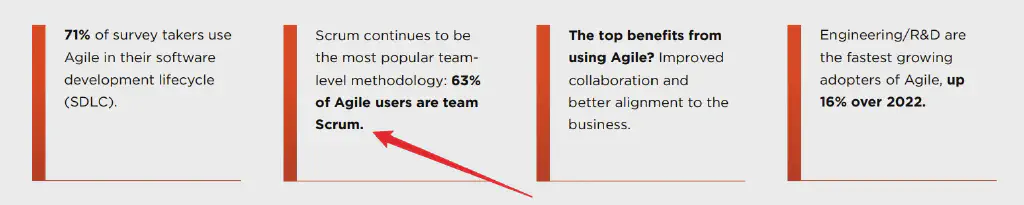
As Agile spread, Scrum came into wide use. According to the latest State of Agile report (17th), Scrum remains the most popular team-level Agile framework today, used by more than 60 percent of the teams surveyed. So it is entirely fair to say that Scrum represents the mainstream practice of Agile.
Our subsequent sharing on Agile practice in this series will also be discussed mainly with Scrum as the reference.
The composition of the Scrum model framework:
- Core process: a fixed development cycle built around the Sprint
- Three role definitions: PO, Scrum Master, Dev Team
- Three artifacts: PBI (Product Backlog), SBI (Sprint Backlog), Increment (product increment)
- Four work ceremonies: planning meeting, daily standup, review meeting, retrospective meeting
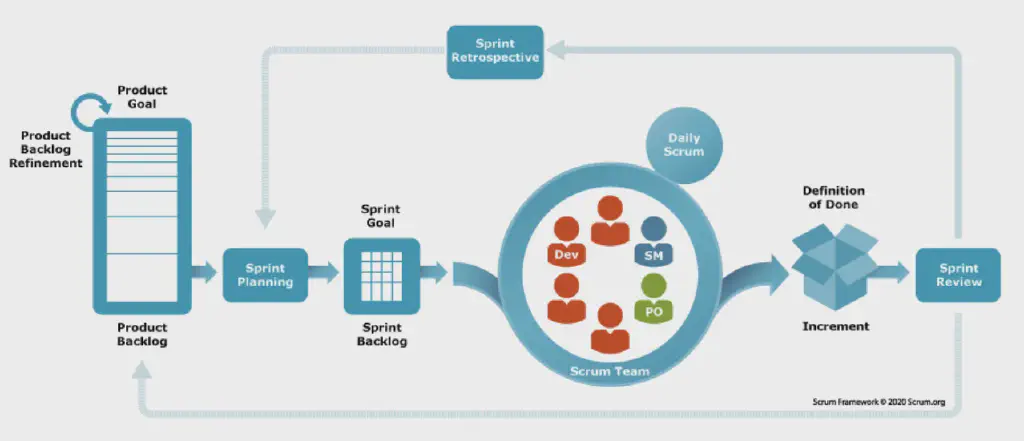
The Scrum framework emphasizes delivering product increments on a regular basis within a fixed, short development cycle (the sprint), using four different work ceremonies to track and coordinate day-to-day work, and it stresses team self-organization and close, flexible collaboration.
Kanban
Kanban actually originated even earlier, growing out of Toyota’s production management theory in the 1940s. It emphasizes using a visual approach to improve efficiency while making the workflow easier to adjust and optimize.
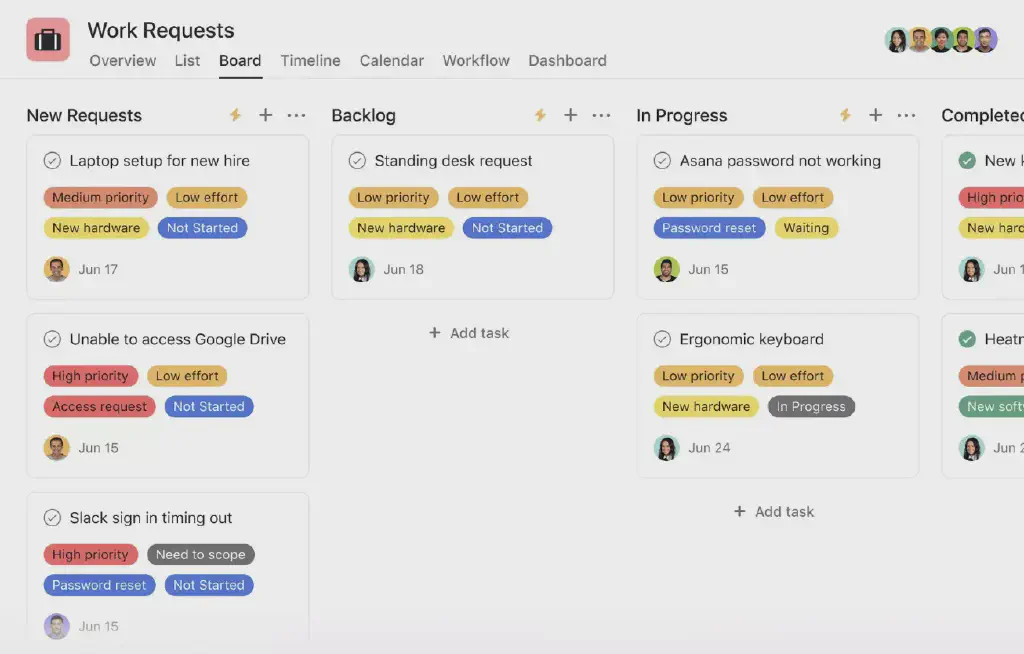
The core principle of Kanban is to clearly display project progress and work allocation to all members through a visual board, to limit the amount of work in progress so as to avoid the waste of resources caused by overload and backlog, and to define and distinguish clear workflows on the board, such as the creation, assignment, execution, testing, and completion of tasks. It emphasizes continuous integration and continuous improvement through regular retrospectives.
Extreme Programming (XP)
Extreame Programming, abbreviated as XP, was proposed by Kent Beck in 1996 and put into practice in the C3 project in which he participated.
The C3 project where Kent Beck practiced XP was a payroll management system for Chrysler. Its participants included several figures who later became important in the Agile movement — for example, two other signatories of the Agile Manifesto, Ron Jeffries and Ward Cunningham, also took part in the project. But the project was in fact not successful: it was delivered several months late, and after running for a while it was shut down completely because of serious performance problems. That is rather ironic.
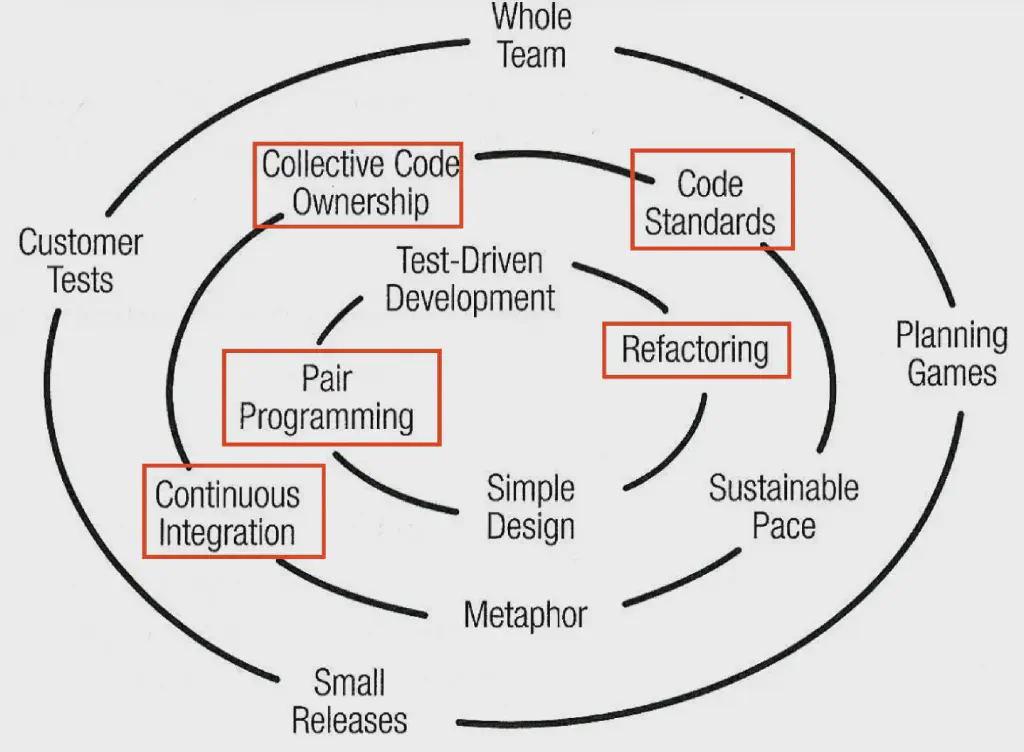
XP defines 13 practice principles mainly across three dimensions — team operation, the development process, and development technical practices — including continuous integration, pair programming, test-driven development, customer acceptance testing, and so on. It had an important influence on the later Agile Manifesto and the 12 principles of Agile.
Lean Development (Lean)
Lean Development, also known as lean development, likewise grew out of Toyota’s lean production management theory.
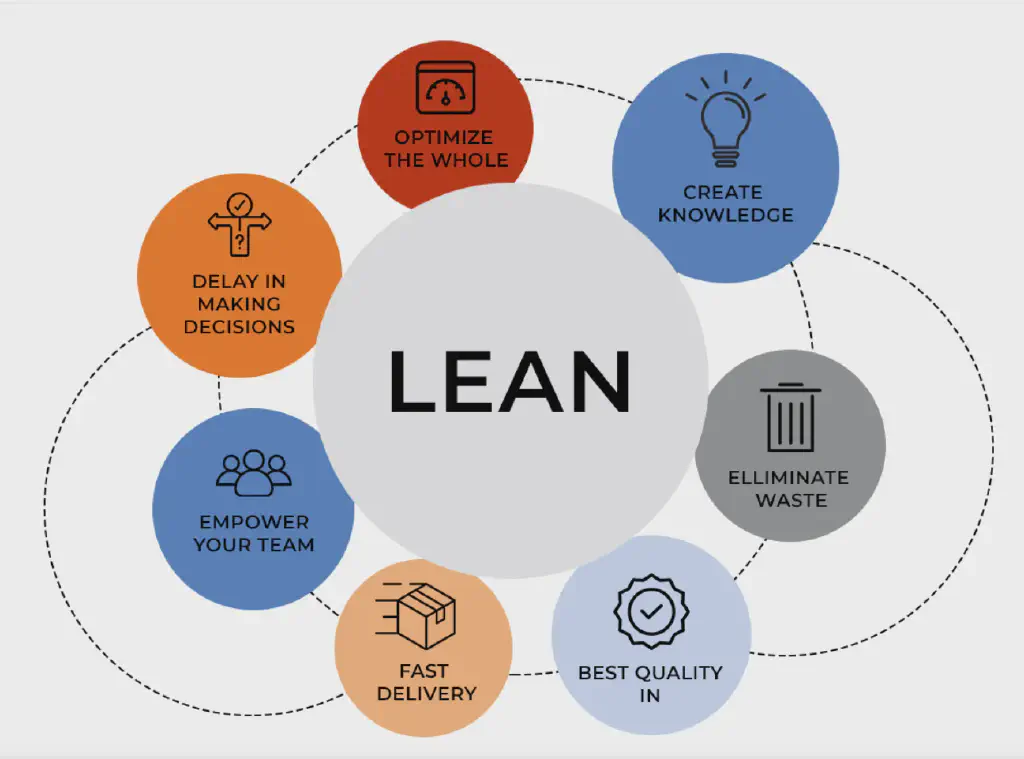
It later developed into the software field and mainly includes the following seven core principles:
Eliminate Waste
Build Quality In
Create Knowledage
Defer Commitment
Deliver Fast
Respect People
Optimize Whole
Lean puts more emphasis on eliminating waste as much as possible while delivering value to users, and on viewing development from the perspective of the broader business environment.
Crystal Methods (Crystal)
The Crystal method was developed by Alistair Cockburn in 1991 for IBM as a set of guidelines for team collaboration and communication. Alistair Cockburn is regarded as an early popularizer of Agile; after the Agile Manifesto was published, methods including Crystal began to come into public view.
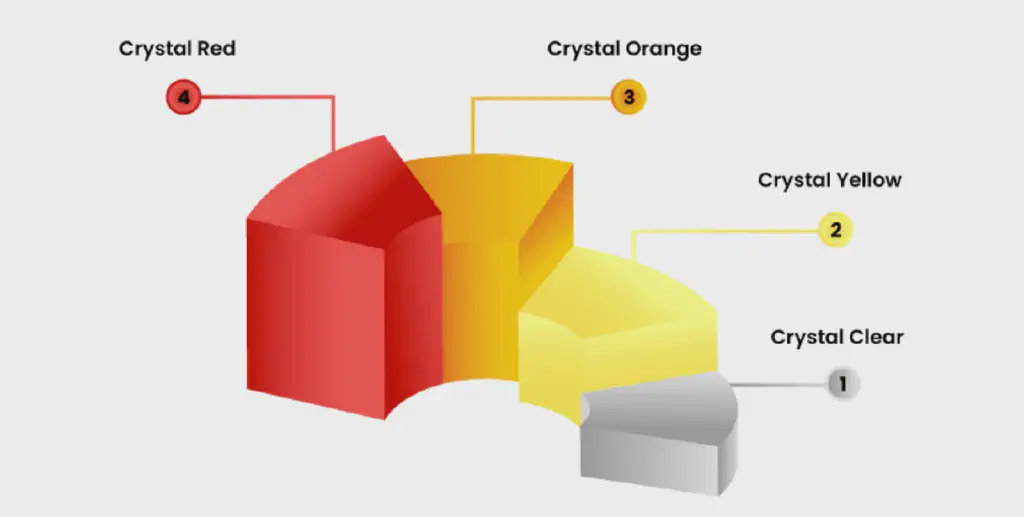
The Crystal methods can be refined into Crystal Clear, Crystal Yellow, Crystal Orange, and Crystal Red. These Crystal methodologies are divided according to the importance of the project and the size of the participating staff.
- Crystal Clear: teams of around 6 people
- Crystal Yellow: around 20 people
- Crystal Orange: around 40 people
- Crystal Red: around 80 people
The Crystal approach likewise emphasizes seven main characteristics:
1. Frequent Delivery
2. Reflective Improvement
3. Osmotic Communication
4. Personal Safety
5. Focus
6. Easy Access to Expert Users
7. A Technical Environment with Automated Tests, Configuration Management, and Frequent Integration
Compared with XP, Scrum, and the like, Crystal is less disciplined, and its main principles change dynamically depending on team size, so in practice it is not widely applied.
Beyond the five common team Agile frameworks above, there are other team-level Agile practice models such as DSM and FDD, but by far the most widely used today is still Scrum.
Although Agile models are many and varied, in actual application they are not mutually exclusive, because they are, more than anything, ways of putting Agile thinking into practice. Understanding the starting points behind the definitions of these models and learning from each other’s strengths is arguably the more pragmatic way to carry out Agile practice.
Of course, the scale of modern software is growing ever larger, and relying on a single small team alone cannot accomplish system-level development of a software product. These team-level Agile frameworks are usually not suited to organization-level agility when applied to large software systems. For agility at this level, large-scale Agile frameworks have emerged, and in the next article we will continue to share an introduction to this part of the Agile framework landscape.
Large-Scale Agile
The Agile models above grew out of some of the ideas from when Agile was first proposed, and are mainly Agile practices aimed at small teams. But the scale of modern software is growing ever larger, and relying on a single small team alone cannot accomplish system-level development of a software product. So in order to integrate multiple such small teams, the Agile community has proposed a number of different large-scale Agile models.
Compared with Scrum’s absolutely dominant mainstream position in team-level Agile, large-scale Agile frameworks present a scene of a hundred flowers blooming, with no single model occupying an absolute mainstream. Below we introduce several of the better-known scaled Agile frameworks.
SAFe
Based on the latest State of Agile report, SAFe is currently the most widely used large-scale Agile framework, but even it holds only around 22 percent of adoption.
SAFe is short for Sacled Agile Framework; it was born in 2011 and has by now been updated to version 6.0.
It provides a complete structured way to scale Agile practices and offers four different configurations to suit different levels, namely:
- Essentail: team level (small to medium projects)
- Large Solution: large solution level (large projects)
- Portfolio: portfolio level (product lines)
- Full: organization level (enterprise level)
Within the SAFe framework, on the basis of the Scrum iteration (Sprint), it introduces the concepts of the PI (Program Increment) and the Agile Release Train (ART). A cycle containing several Sprints forms a PI, through which the cooperation of multiple different Scrum teams works together to complete a fairly large-scale product increment.
Beyond the three roles defined by Scrum — PO, Scrum Master, and Dev Team — SAFe defines new roles such as the Product Manager (PM), Release Train Engineer (RTE), Solution Architect (SA), and Business Owner (BO), in order to manage multiple teams, larger-scale product roadmaps, technical architecture, and cross-departmental coordination.
The four core values emphasized by SAFe:
- Alignment: ensuring everyone in the organization works toward the same direction; clear goals and vision are key.
- Built-in Quality: focusing on quality from the very beginning to avoid late-stage fixes, ensuring the product meets high quality standards at every development stage.
- Transparency: creating an open, transparent working environment that encourages communication and feedback among team members.
- Program Execution: ensuring the smooth delivery of programs and products through a consistent rhythm of development and delivery.
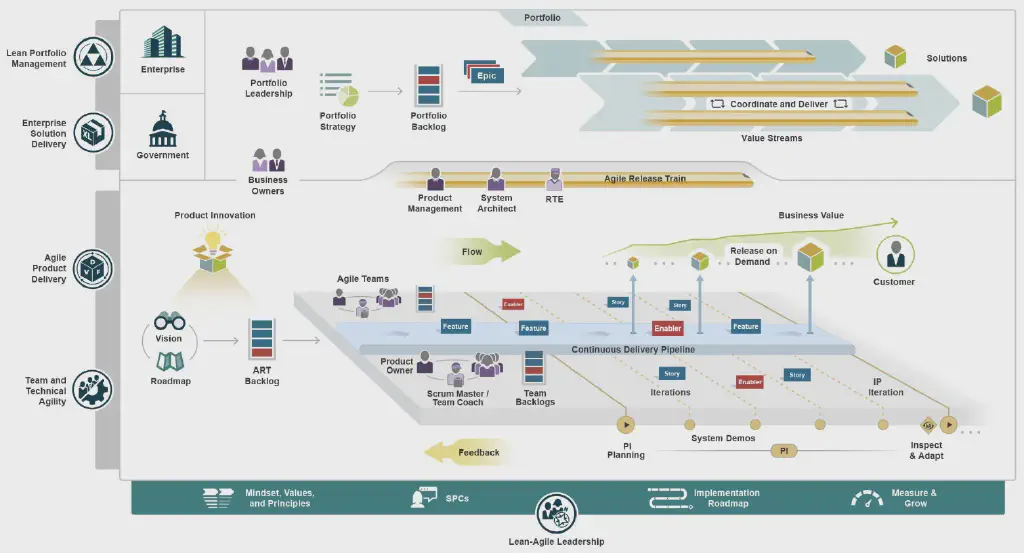
With its fairly complete practice methodology adapted to organizations of different sizes, as well as its broad certification and promotion, SAFe is being applied more and more in the field of scaled Agile today.
SoS
SoS (Scrum of Scrums) is actually a very early scaled Agile model. It was proposed in 2001 — the very year the Agile Manifesto was published — by Scrum co-creator Jeff Sutherland, and was applied in a project practice at GE.
This framework is actually fairly simple to understand.
In essence it is a synchronization mechanism: each Scrum team sends one member, usually called an ambassador, and these people then form a Scurm, that is, the SoS. This team likewise operates according to Scrum principles, with Sprints, standups, a backlog, and so on. But the main concerns of the SoS are cross-team progress, impediments, and coordination.
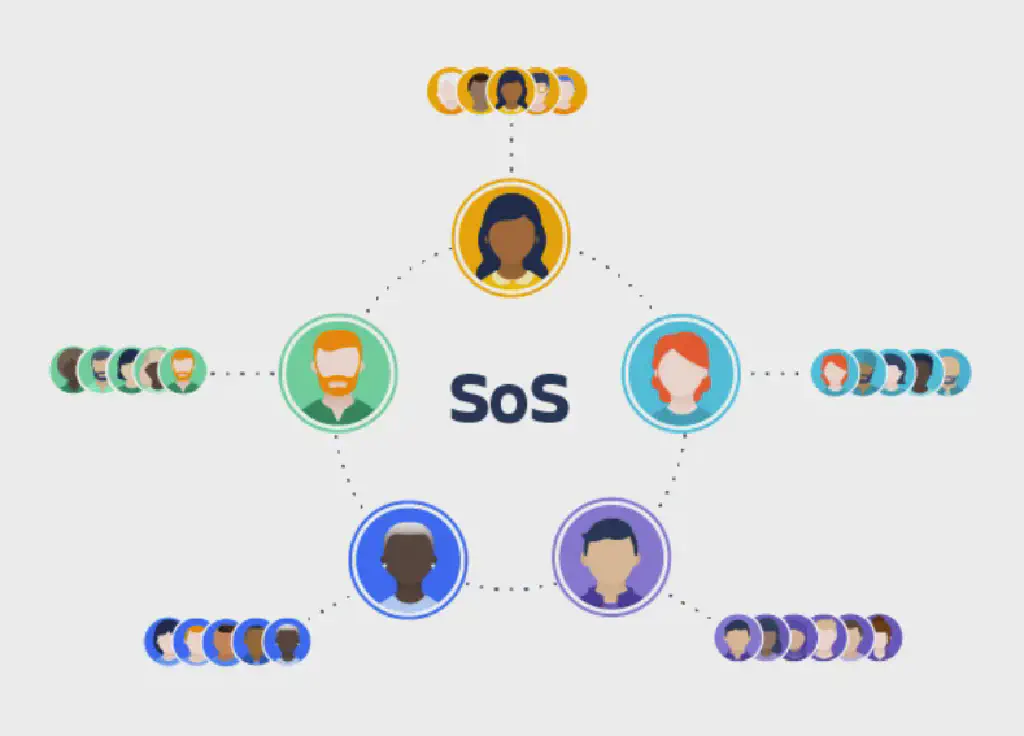
SoS is also a fairly widely adopted approach in scaling Agile today, but its scale is generally not too large — on the order of 5 to 7 Scrum groups. Above it, SoSoS has been extended, but this further increases the complexity and tends to become chaotic in operation.
NEXUS
Another scaling framework, Nexus, was created by the other proposer of Scrum, the father of Scrum Ken Schewaber, and then launched in 2015 through scrum.org , so it can be regarded as a semi-official scaled Agile framework of Scrum. It was proposed relatively late and is currently little used; the State of Agile report shows an adoption rate of only about 1 percent, so its promotion has not gone well.
Nexus mainly makes a small number of improvements on top of Scrum aimed at cooperation across a larger scope. The framework itself does not change much, and there are likewise just a few differences:
Its main work is done at the cross-team level, including sprint planning, review, and retrospective, but the daily standup is held separately by each subgroup.
A Nexus team is composed of 3–9 Scrum teams; a larger scale becomes hard to organize. These different Scrum groups operate within the same iteration cycle.
Nexus introduces a Nexus Integration Team. This integration team has a function similar to the SoS, mainly responsible for work coordination and progress synchronization among the different Scrum teams.
Nexus shares a single product backlog and has only one PO role; before the planning meeting, a cross-team requirement refinement meeting is held. And the work result is also a single increment.
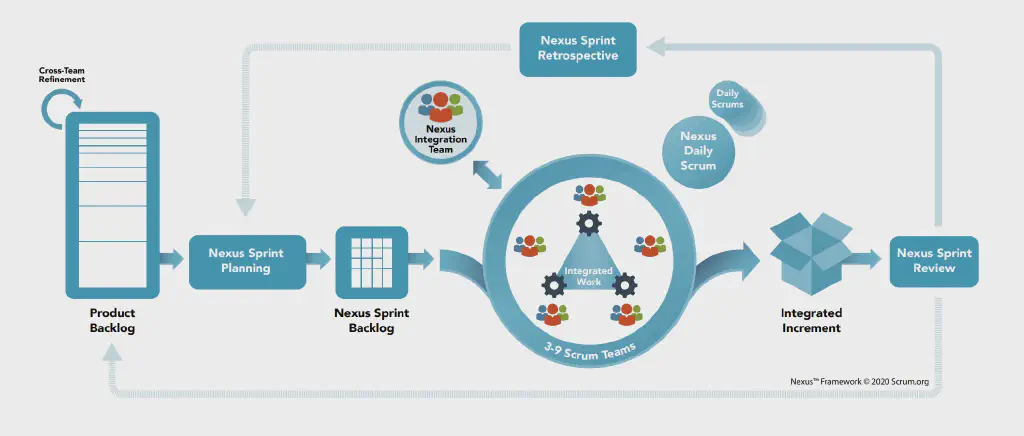
This framework places very high demands on collaboration between teams, and many matters are jointly completed and synchronized by multiple Scrum groups, so efficiency is hard to guarantee. This is probably the main reason the framework has struggled to gain wider adoption.
LeSS
LeSS (Large-Scale Scrum) is a lightweight Agile framework designed to extend Scrum to multiple teams while preserving Scrum’s core principles and simplicity. It was proposed in 2005 and is also a relatively early framework.
Similar to NeXus, the LeSS Agile framework uses a single product backlog, with all Agile teams working within the same Sprint and collaborating to complete that Sprint.
But in LeSS, there are two Sprint Planning meetings at the start of a Sprint: in the first Sprint Planning meeting, representatives from each team take part in discussing and managing dependencies and collaboration between them. The second Sprint Planning is the Scrum teams’ own Sprint planning. At the end of the Sprint, there are likewise two retrospectives: one is the retrospective within the Agile team, and the other is the retrospective for the entire large-scale Agile project.
LeSS is fairly flexible. Compared with Scrum, it retains all of Scrum’s roles and introduces no new roles, relying more heavily on the team’s ability to self-organize.
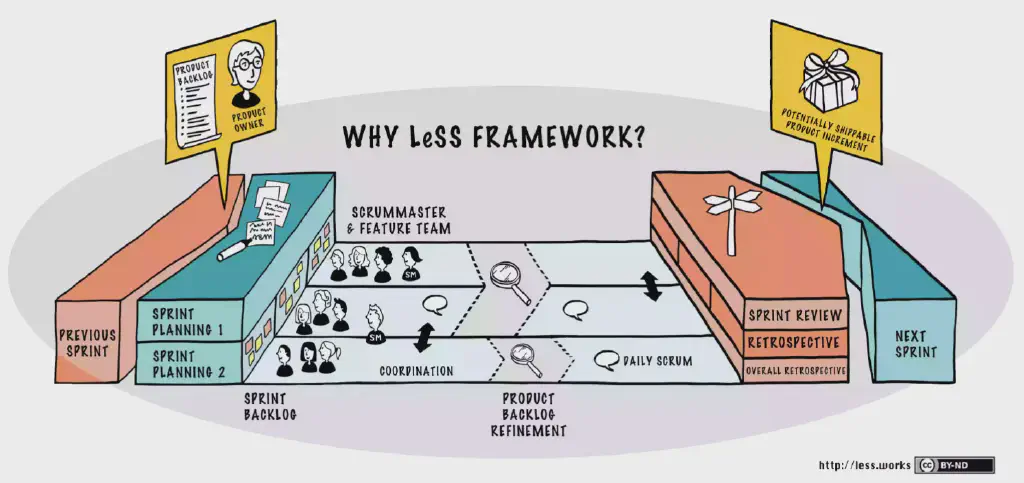
Compared with frameworks such as SAFe, LeSS does not introduce extra roles or too many other processes, but scales Agile by simplifying the structure; this, however, also creates difficulties in practical operability when it is implemented. In the latest State of Agile report, its adoption rate stands at 2 percent.
The above is the sorting-out and summary of the various Agile practice models, intended to help everyone gain an overall understanding of the application of Agile and its current state of development.
Thanks for continuing to follow this series — working hard to keep it updated~