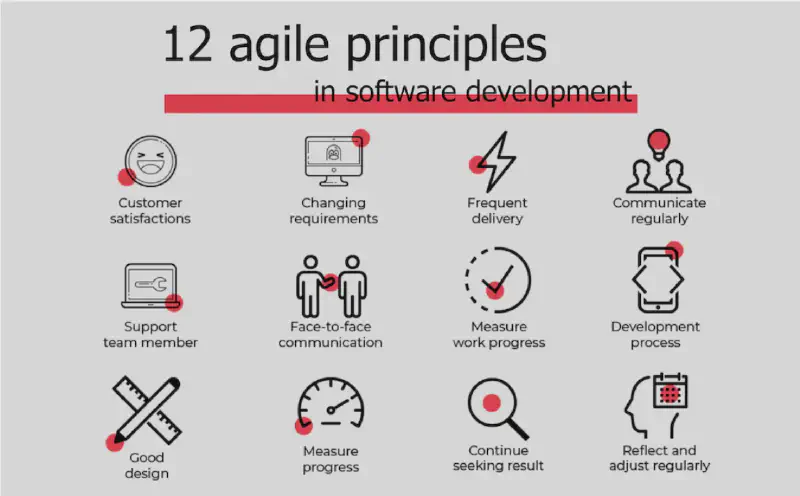
Agile development is probably the most popular and widely applied development model in today’s IT industry. Yet in actual practice, it always seems to deviate quite a bit from expectations. So I am starting a series to sort out, in detail, the knowledge related to Agile development and to share my own understanding of Agile.
The Origins of Agile
To talk about Agile, we first need to look at the background against which it was proposed.
The Software Crisis
As we know, from the 1970s to the 1990s, computers gradually began to become ordinary consumer goods and started entering households. Taking this as an opportunity, the computer software industry also began to boom and develop rapidly. But at the same time, as the scale of software applications grew, their complexity increased sharply, and a large number of problems caused by software occurred during this period—what is now known as the “software crisis” era.
The software crisis mainly manifested as:
- Over budget
- Over schedule
- Low efficiency
- Low quality
- Not meeting requirements
- Unmanageable, hard-to-maintain code
- Never able to deliver
To address the problems arising from the software crisis above, software engineering began to develop rapidly as a discipline, and various theories and papers on software development began to emerge. Among them, the Waterfall Model, converted from engineering management in manufacturing, along with its derived V Model and W Model, occupied the mainstream, and their influence continues to this day
The Waterfall Model
But the Waterfall Model also has obvious shortcomings, namely that it is a linear development process, and problems that affect a release often only surface in the later stages. Moreover, this model places very high demands on risk control and values plans and processes, so documentation and standards requirements are extremely strict, and all the red tape also creates big efficiency problems. Cases of software projects failing even while using the Waterfall Model have also remained numerous.
The Rise of the Internet
Another part of the background is the rise of the Internet in the 1990s. Unlike traditional desktop applications, Internet-based applications are delivered the moment they are released, and their user base is enormous. In addition, the free strategy of the Internet makes the cost for users to switch to similar products extremely low, so Internet applications are inherently an industry with extremely frequent requirement changes and very high demands on product iteration and updates. The traditional, process-heavy Waterfall Model had already become very poorly suited to this high-speed demand of Internet products.
It was against exactly the above background that the Agile model emerged.
The History of Agile
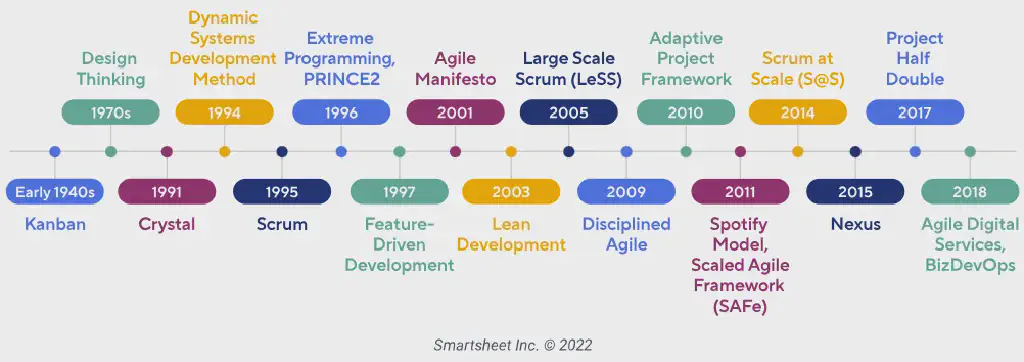
As early as the 1940s, Toyota had already adopted quite a few ideas now esteemed in Agile development in its automobile production management. The most typical is Kanban. The main function of this Kanban is to manage the production process and materials through visualization, letting production be driven by demand rather than by early plans.
By the 1990s, the Internet began to rise. In 1991, the Crystal methods were proposed; in 1994, Dynamic Systems Development Method (dynamic system develop methodology) DSDM was proposed.
In 1995, Scrum was formally proposed as a development model, jointly published by the father of Scrum, Ken Schwaber, and Jeff Sutherland. This is also the most widely applied model in Agile development today, almost synonymous with Agile.
In 1996, XP (Extreme Programming) was published, by Kent Beck. He is also the top-ranked luminary among the later signatories of the Agile Manifesto. Many principles in Agile in fact originate from Extreme Programming. As an aside, Kent is also the author of the famous test automation framework
Junit. It is fair to say that many later automation frameworks were significantly influenced by Junit.In 2001, the Agile Manifesto was published, jointly signed and released by 17 experts in software development—including Ken, Jeff, Kent, and Martin Fowler—at the Snowbird ski resort in Utah, USA. From then on, Agile gradually moved into the mainstream.
2005, the large-scale Agile framework LeSS (Large Scale Scrum) was proposed
In 2006, the first Agile China Conference was held, led by the well-known consulting firm ThoughtWorks.
In 2009, the Agile certification system DA (Disciplined Agile) was established
In 2011, the large-scale Agile framework SAFe (Scaled Agile Framework) was proposed.
In 2018, BizDevOps was proposed, aiming to open up the path from business to R&D.
Developing to the present day, Agile is still spreading widely around the globe, but at the same time, Agile has also exposed some of its own problems, so Agile 2.0 has already begun to be mentioned and discussed.
The Agile Manifesto
In the development of Agile, the publication of the Agile Manifesto was a milestone event. From then on, Agile began to gradually enter the realm of practice and became widely applied
Agile Manifesto Official Website
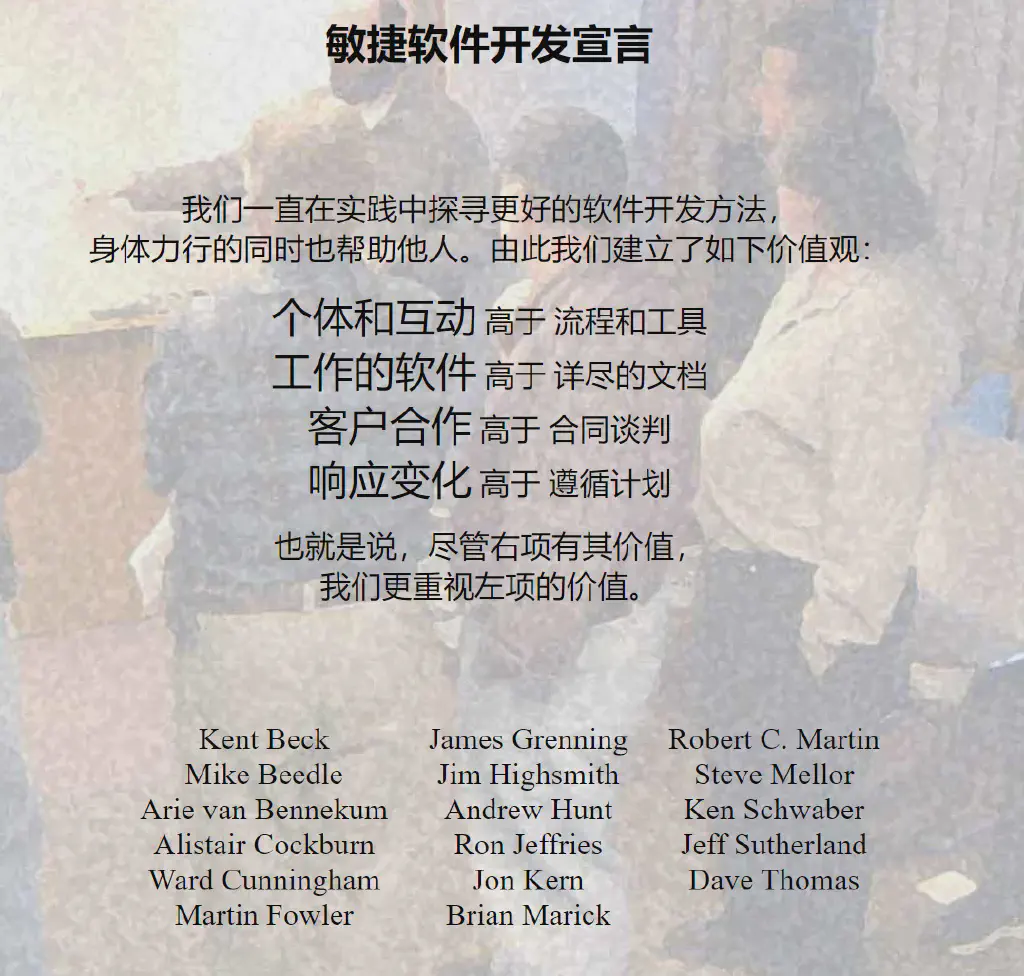
Individuals and interactions over processes and tools: Agile places more emphasis on the role of the individual, holding that an individual’s subjective initiative is more efficient and useful than relying on processes and tools
Working software over comprehensive documentation: The comprehensive documentation here refers to heavy, rigid documents—red tape that few people actually read once written. Working software, by contrast, means software that can actually run, “seeing once is better than hearing a hundred times”
Customer collaboration over contract negotiation: It emphasizes communication. Developers are the producers of software and customers are the users; more direct communication between the two can better confirm whether what is being built is the same as what you want, rather than agreeing in advance through a so-called contract
Responding to change over following a plan means that change certainly exists, and a good software development process should adapt to that change rather than following a set course to the very end.
The 17 signatories of the Agile Manifesto were all experts with high achievement and prestige in their fields, which also laid a solid foundation for the wide spread of Agile. But these 17 people were mainly experts in the software development field; for the entire software product lifecycle, the absence of other roles also planted limitations in the adaptability of Agile itself.
The 12 Principles of Agile
Besides the Agile Manifesto, Agile also put forward 12 basic principles for practical application
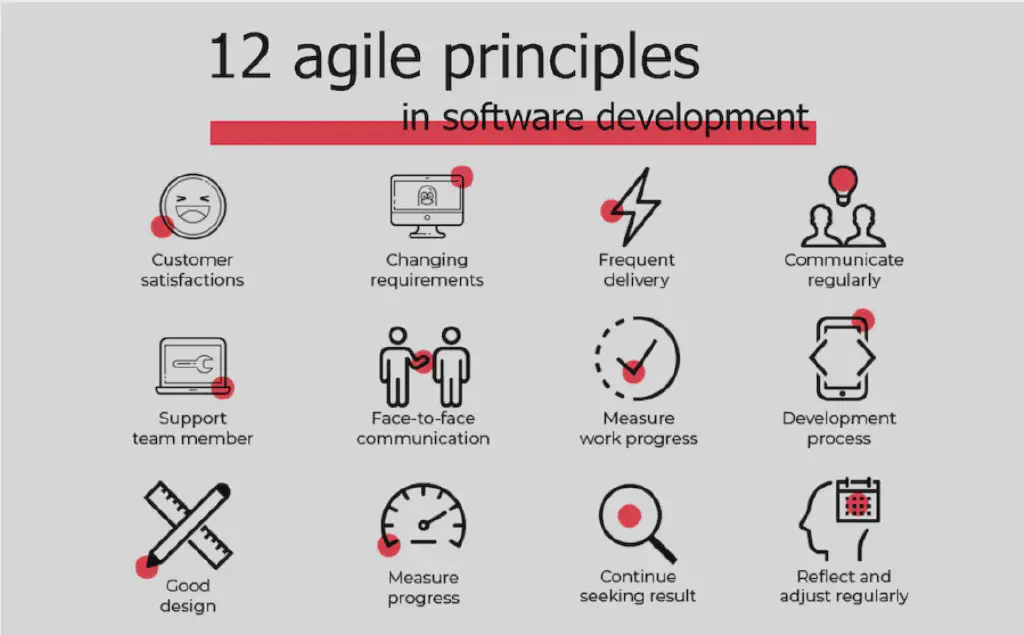
Customer satisfaction : Oriented by user value. Customer satisfaction means the value of the software is realized, and software realizing value is the ultimate goal of our developing software.
Embrace change: Change certainly exists; rather than controlling change, it is better to accept change.
Frequent delivery: Small steps, fast running, rapid delivery, fast feedback, making it easy to correct course in time
Mutual cooperation (business and R&D): The business requirement side, user representatives, producers, and the development team should work together. Confirm in time
Motivated teams: Self-motivated teams; the team itself is proactive, with no internal friction
Face-to-face: Timely communication, seeing once is better than hearing a hundred times
Working software: What you see is what you get
Sustainable pace: A fixed rhythm better forms tacit understanding
Good design (technical excellence): Emphasizing the internal foundation of software development, solving problems through better design, and reducing risk. Emphasizing technical excellence
Simplicity is beauty: Software should not be over-engineered; gradually satisfy user needs
Self-organizing: Control of the development process should be in the developers’ own hands, without various administrative orders. The father of Scrum, Ken, once clearly stated that the purpose of Agile is to eliminate the manager position.😂😂
Reflection and adjustment: This one is a supplement to self-organization. In the course of Agile operation, various failures or rough spots will inevitably occur; at such times it is necessary to review and reflect in time and make timely adjustments and remedies.
The Author’s Views on Agile
Although Agile is widely applied in the industry today, it is not a silver bullet; we still need to view Agile dialectically, for there is no theory or method under heaven that applies everywhere.
The ideas it proposed and some of the principles and practices it developed start from an excellent point, but not all situations are applicable; applying Agile still requires determining the approach based on the actual circumstances of the product and project.
From the Agile Manifesto and principles, it can in fact also be seen that what Agile itself conveys is more a set of values—an ideal direction for software development—rather than a methodology. It is not an execution-level method that guides how a project should operate.
The proposal of Agile was thought through more from the software development angle; it is the conclusions these development gurus reached from a software development perspective. But when Agile is applied in the product domain, many practices are overly idealistic, such as working with customers and self-organizing teams, and especially in traditional enterprises they will face great resistance. It is impossible to advance without a fundamental transformation at the organizational level.
So Agile itself is not a silver bullet, nor is it a methodology. Rather, it is a cultural-level way of thinking; to be applied truly ideally requires organizational-level change to advance, and it is not a practice that can be successfully applied simply by being pushed bottom-up from a small team of a dozen or so people.
On the practical application of Agile, more sharing on the Scurm framework will follow. Stay tuned.
Qiucao “Testing” Observatory, observing the testing industry. (WeChat official account: Qiucao on Testing)