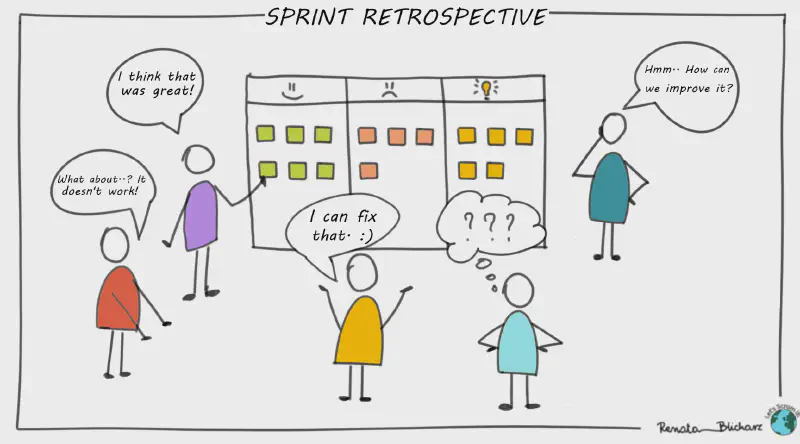
In the earlier articles, we have already gone over the key points of holding the planning meeting, the daily standup, and the review meeting. In this article, we take a look at the last meeting ceremony among Scrum’s four major Agile ceremonies — the Sprint Retrospective.
The Purpose and Role of the Retrospective
Because the retrospective and the review meeting are both usually placed on the last day of the iteration and are typically scheduled back to back, many people mistakenly think the two meetings are the same Agile ceremony and treat them as one and the same.
This is in fact a misunderstanding of two distinct ceremonies — the review and the retrospective. The two meetings differ markedly in their function, purpose, and even participants, so one should not assume they are the same meeting simply because the two ceremonies are consecutive in time.
The review meeting’s main purpose is, through a demonstration of the iteration’s deliverables, to collect feedback and opinions from product stakeholders in time, so as to confirm that the phased delivery meets expectations and to make timely adjustments to subsequent iterations. Its focus is externally oriented feedback collection, aimed at the product itself.
The retrospective’s focus, by contrast, is on internal team review and summary, aimed at process and team collaboration.
So the purpose of the retrospective is, after an iteration ends, to look back and inspect how the iteration ran, drawing out experience and lessons from it.
Holding a retrospective produces the following benefits:
- While working across multiple iterations toward the product vision, the team also regularly inspects how the iterations run, discovering problems, summarizing experience, improving in time, and steadily getting better.
- Through the retrospective as a window, team members have a relatively formal and open platform where anyone can raise suggestions about how the team works or point out possible problems.
- The retrospective is also an important ceremony for strengthening team cohesion, and a channel for team members to affirm one another or exchange views frankly and openly.
In short, the retrospective can be seen as a closed-door meeting within the team, a ceremony of the team’s self-renewal and self-optimization.
The Different Roles in the Retrospective
So, given the purpose above, this meeting should not be held as the same meeting as the review meeting either.
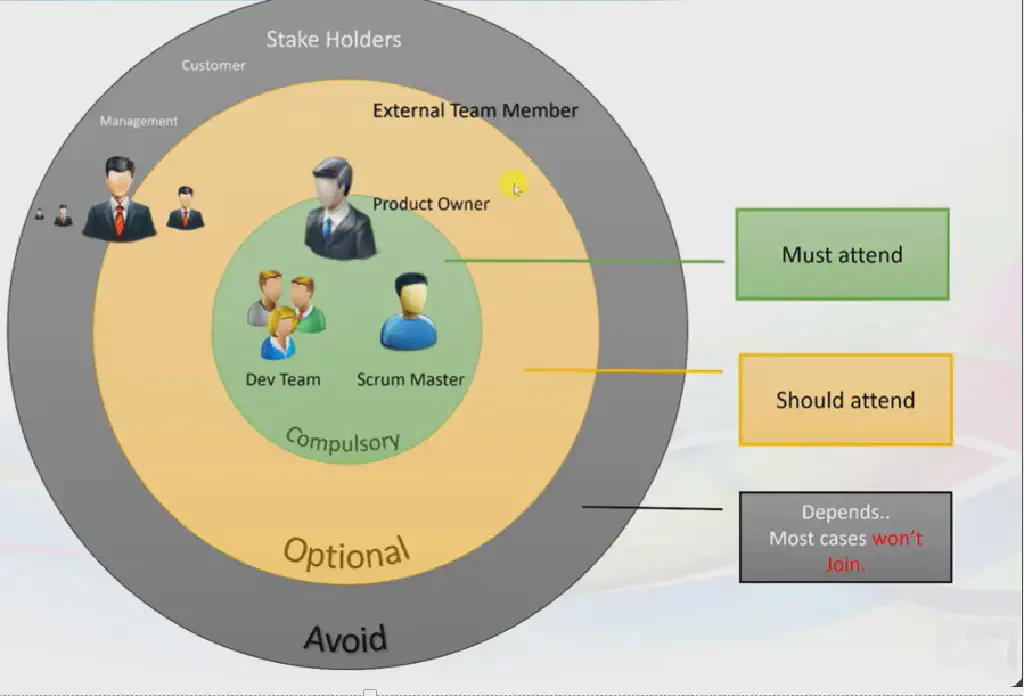
The roles that different people play in the meeting also differ:
Must attend: As an internal team summary meeting aimed at the team’s own improvement, the Dev Team and Scrum Master must take part.
Attend if possible: Although the PO is also part of the team, the PO’s responsibilities are oriented more toward the product itself, and they are basically not directly involved in product development. So when it comes to the team retrospective, the PO is not required to attend; but as an important member of the team, in many cases some opinions and improvement actions do need to be raised or joined by the PO, so the PO attends whenever possible.
Avoid attending: One important reason for separating the retrospective from the review meeting is precisely that, as an internal improvement meeting, some stakeholders who attend the review meeting — such as users and management — had best avoid attending, so that team members can express their views more directly. Of course, in certain special circumstances, such as major disagreements or serious risks to product goals, key stakeholders may also be invited to the retrospective. (And of course, if the boss insists on attending, it is generally hard to refuse.)
Meeting Process
The retrospective is generally recommended to be held in person as much as possible. And because the team members all know one another well and the iteration has just ended, the atmosphere should be made as relaxed as possible; preparing some small snacks and little gifts helps the meeting achieve a better effect.
The general flow of the meeting is as follows:

First of all, of course, the Scrum Master facilitates the meeting. Before the retrospective begins, some preparation is usually needed. For example, collect relevant data from the iteration, such as the burn-down chart and the team’s velocity chart, as well as the current status of follow-up items from previous iterations’ retrospectives; all of this is reviewed by the team as a whole at the start of the meeting. And for relatively new teams, the rules of the retrospective also need to be explained, along with the supporting tools to be used, such as cards and voting stickers.
The next segment is to collect the team’s suggestions about how the iteration ran. That is, each team member writes down their own observations of the current iteration — which aspects went well and should be kept, which aspects were not good enough and could be improved, including anyone they would like to thank individually — on stickers of different colors. Once everyone has finished writing, the stickers are placed in the corresponding areas of a prepared whiteboard. After the opinions are collected, everyone gathers in front of the whiteboard, and the SM or any member of the team reads aloud the content of each sticker card. This process is effectively the team reliving together how the iteration ran.
After all the opinions have been read out, the meeting moves into the voting segment. For example, everyone may be given 3 votes, and then, among these opinions, each person votes for the 3 they think most worth taking action on in the next iteration.
Once voting is done, tally the opinions with the most votes. For example, with three votes per person, the three opinions with the most votes are finally selected as the to-do items to take action on in the next iteration.
After the to-do items are set, the team also jointly discusses the concrete measures for each item and decides how to carry out the improvement and enhancement.
The results produced by the discussion above must be made concrete down to implementable actions, with a designated owner for each. These are to be arranged as tasks for the next iteration and added to the iteration board for task tracking.
Through the meeting process above, the goal of the team’s continuous self-renewal and improvement is achieved. A very important core here is that members should be frank and open, and that everyone truly conducts the retrospective from the starting point of improving the team itself.
Common Retrospective Tools
The main content of a retrospective is, in fact, collecting everyone’s observations of how the iteration ran and their suggested improvements. In an in-person setting this is usually represented on a whiteboard using stickers of different colors.
But nowadays many teams may be working in different locations or from home; for such online retrospectives, some online supporting tools can also be used.
The more commonly used ones include:
IdeaBoardZ
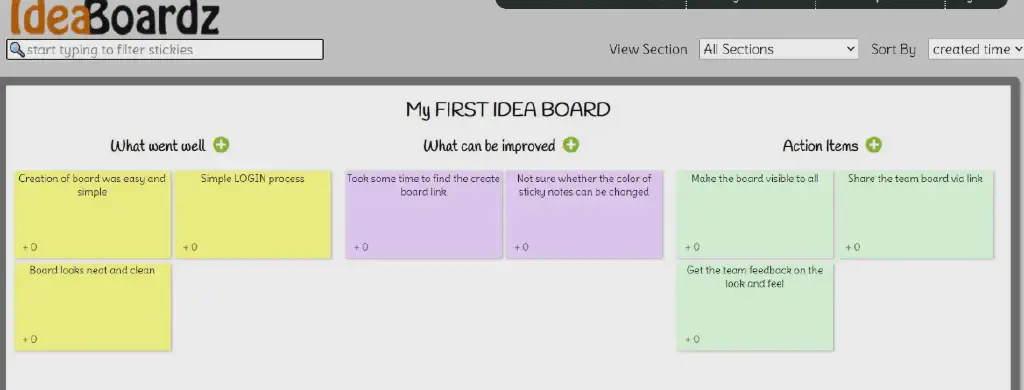
A retrospective template can be conveniently created through https://ideaboardz.com/.
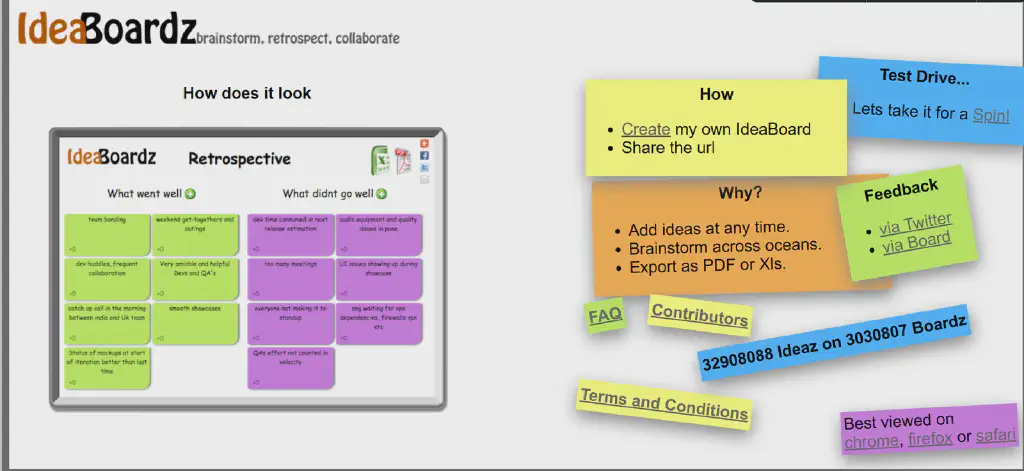
Following the most basic
- Things the team did well
- Things worth improving
- Actions to be taken
Collect everyone’s opinions from these aspects
Starfish
Besides the basic model above, some teams also use the Starfish to break down the observations into five different areas.
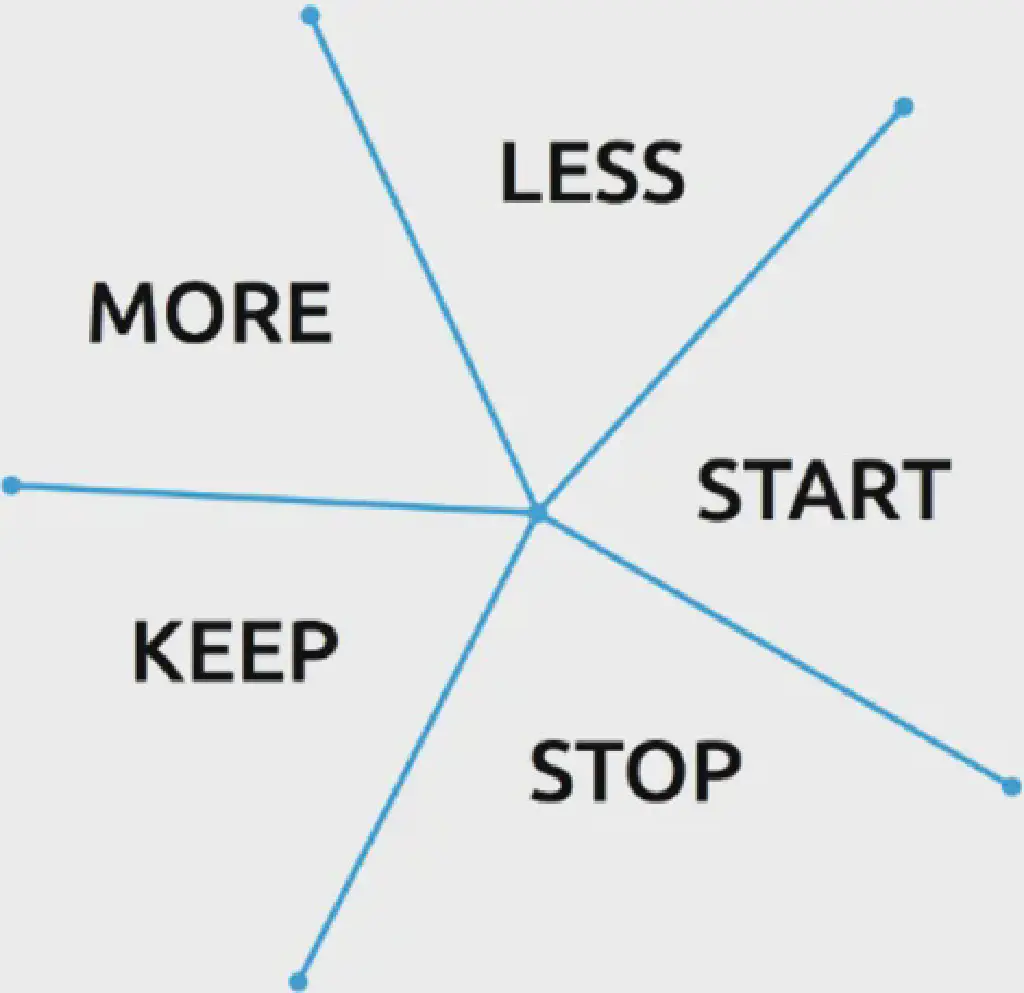
- KEEP: Behaviors that should be kept going
- MORE: Behaviors that should be done more
- LESS: Behaviors that should be reduced in later iterations
- START: Behaviors that should be started in later iterations
- STOP: Behaviors that should be stopped in later iterations
Sailboat
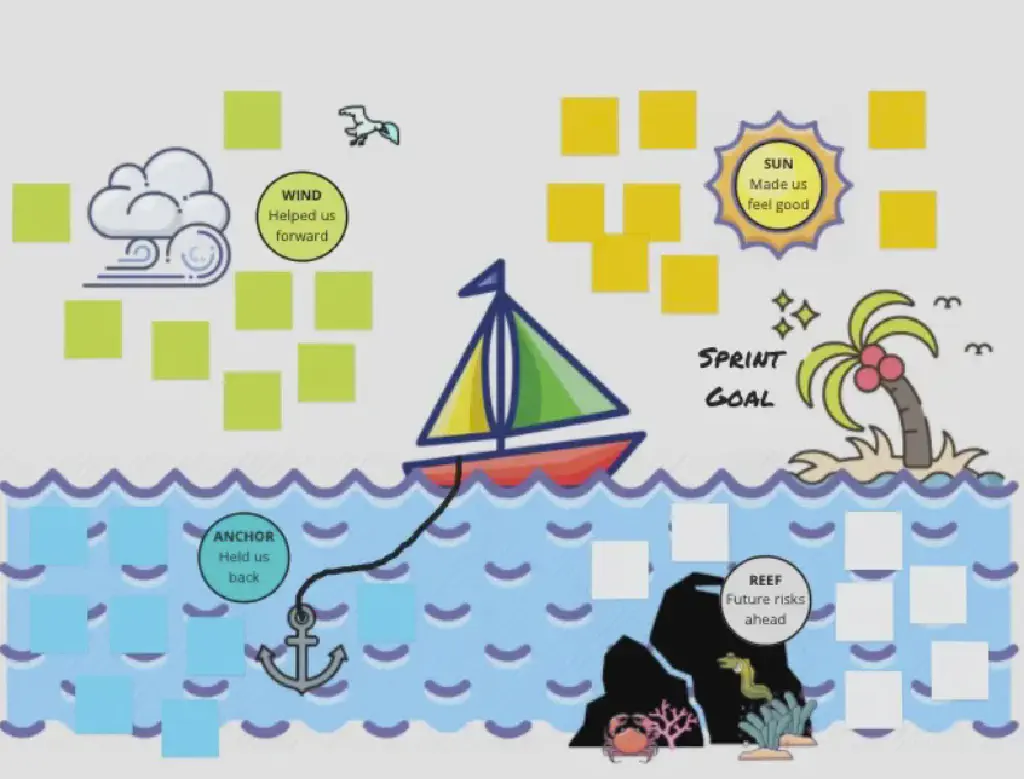
Similarly, there are also models like the Sailboat, whose purpose is basically the same — all serving the goal of reviewing and inspecting, and learning from past experience for the future.
Summary
The above is a rundown of the Sprint Retrospective. In actual practice, never let the retrospective turn into a session of complaining, griping, or mutual blame. No matter how serious the problems discovered during the process are, everyone should ultimately stay grounded in the team’s development — the real purpose is for both the members and the team to improve together.