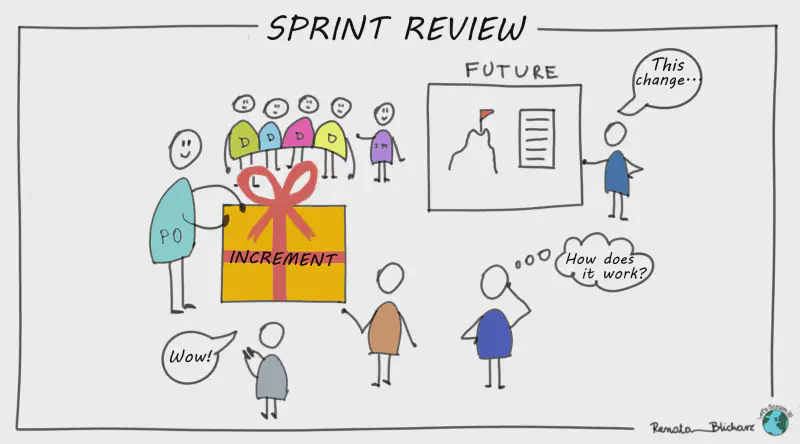
In the previous two articles, we shared the planning meeting and the daily standup among the four Agile ceremonies. In this article, we continue by introducing the Agile Sprint Review meeting, held after an Agile Sprint ends.
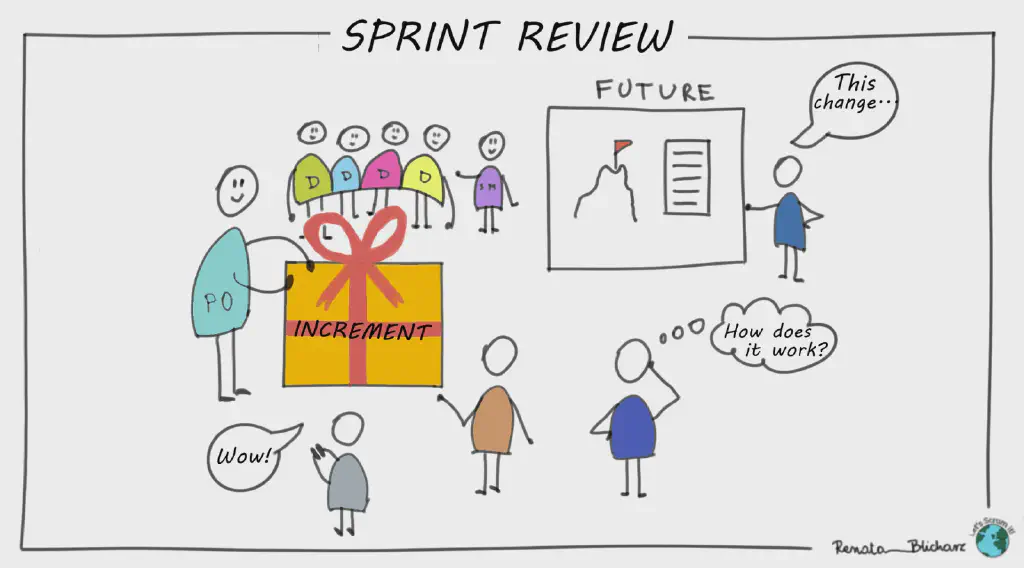
Purpose and Role
As a meeting held at the end of a Sprint iteration, the Sprint Review Meeting mainly embodies the Agile ideas of “customer collaboration” and “fast feedback,” and is an important expression of the Agile principle of moving in small, fast steps.
To be specific, the purpose of this meeting is to demonstrate the current Sprint’s work results to the product’s business team, users, and stakeholders, to hear their feedback on the product, and to confirm whether the current product output — the Increment — meets expectations and whether there are new opinions, so that later Sprints can be adjusted in time.
This is also a notable difference between Agile and traditional development models: within a short Sprint cycle, progress is confirmed in time with the ultimate requester through the demonstration at this meeting, rather than — as in traditional processes — waiting until a long, complete development cycle has passed before delivering the final product to users for confirmation.
So, beyond the team’s delivery of results, the more important role of this meeting is to obtain feedback from external business parties and other stakeholders through the demonstration of the product Increment, so as to allow timely adjustment.
Misconceptions
Many people regard this meeting as a delivery-confirmation meeting held inside the Sprint team with the PO, but that is actually incorrect.
It is based more on the purpose of communicating with parties outside the team.
For the same reason, under some special circumstances this meeting may be skipped for certain Sprints. For example:
When the Sprint’s Increment produces no obvious, directly demonstrable business change, and consists more of technical adjustments or architecture-level changes, there is little that needs confirmation from the business side.
When key business parties or stakeholders cannot attend and cannot match the current Sprint’s cadence. A Sprint’s end time is fairly fixed, but if key stakeholders’ schedules cannot align, the meeting may be cancelled. In that case, a later Sprint’s review meeting will include a demonstration of the current sprint’s relevant output.
When the team itself assesses that the Sprint Goal was not achieved and the key output falls short of expectations, it is naturally not suitable to give a product demonstration to external parties.
Attendees
Given this meeting’s purpose, a review meeting may in fact involve quite a lot of people, generally including the following roles:
- The Scrum Team should of course all attend, including the PO, SM, and Dev Team.
- Key stakeholders, usually the product’s sponsors (roles such as the product director / R&D director).
- The reporting lines of team members — development manager, testing manager, UE manager, and so on.
- Other key roles from teams associated with the Sprint’s output, such as key members of other collaborating Scrum teams (PO, SM), or functions like security, legal, quality, after-sales, pre-sales, and customer service.
The review meeting is generally held on the last day of the Sprint. Within the Scrum Team, the PO — as the communication channel with the various external stakeholders — sends out the meeting invitation before the meeting (usually 1–2 days in advance). This both informs the relevant people of the current Sprint’s main input content and scope, and helps confirm the attendees, while leaving the team some necessary preparation time for the review demonstration.

Meeting Process
On the last day of the iteration, everyone finishes the iteration work and, following the PO’s meeting invitation, takes part in the Review Meeting.
The meeting process is roughly as follows:

The Scrum Master facilitates the meeting. Usually at the start they welcome the attending stakeholders and briefly introduce the participants. If a new member has joined the Scrum Team, they may also ask the new member to give a brief self-introduction. If everyone is already familiar with one another, it is just a short opening remark.
Next, the PO explains the main content of the current Sprint increment, which is also the main functional scope to be demonstrated. If the Review is held only after several sprints have passed, this part usually covers the content of multiple Sprints.
Then comes the demonstration segment. Generally the PO gives the demonstration and explanation themselves, because the PO is involved in the Sprint throughout and is fairly familiar with the relevant content. In practice, a team member who knows the relevant features well can also give the demonstration, and it is often the people responsible for testing who perform it. It is best not to switch frequently between different people during the demonstration.
The following segment usually runs throughout the demonstration as well: feedback and communication from stakeholders on the product implementation. Based on the product’s goals and value, and including expectations for the next Sprint, they may have questions or suggestions for improvement about the product, and the team can communicate and discuss these issues directly with the stakeholders. This part actually takes up the largest share of the meeting’s time; the atmosphere may be harmonious or heated, but in the end it leads to some revisions or additions to the original requirements.
So the output of the previous segment actually produces an updated PBI list, which will also be the main input for subsequent Sprints and the material the PO needs to further organize and refine after the meeting.
Finally, the SM summarizes the meeting, usually recapping the discussion results, including confirming the requirements and other matters to be tracked and implemented afterwards, such as research and tackling of related technologies. Of course, this summary also serves to signal to stakeholders that the meeting is over, but for the team it is also a reminder that the retrospective will follow (the retrospective is usually held right after the review meeting).
The review meeting is generally kept within two hours (for a two-week Sprint). During the meeting the SM must control the pace and, depending on how much is being demonstrated, keep discussions that become too divergent or too deep within the time budget — for example by scheduling a separate dedicated meeting to discuss them.
Summary
So, to summarize the key points of the review meeting:
First, this is a meeting held after an iteration ends to obtain feedback on the iteration’s output. It is a major expression of the Agile idea of moving in small, fast steps. But in actual practice, it is not a meeting that must be held every single Sprint. The only requirement is to avoid leaving the gap too long, so that the team retains the flexibility to make timely adjustments based on stakeholder feedback.
This meeting is not an acceptance meeting; it is not used to confirm with the PO whether the Sprint Goal was achieved. Communication and feedback are the main purposes.
The meeting’s process and output are an important part of Agile iteration and product evolution, and an important process for determining PBIs and correcting course in time, ensuring that the team’s work matches users’ expectations.
Finally, this meeting is also the only formal window in the Sprint for the Dev Team to communicate directly with relevant stakeholders, to feel the pressure, and to face the real thoughts of users or bosses. It is of great significance for preventing the team from working in isolation, taking things for granted, or slipping into an engineer-only mindset.
The above is a rundown and summary of the key points for holding the Sprint Review Meeting. Feel free to follow Qiucao for more in-depth reviews and reflections on software development, testing, and technology.