 In the previous article, we discussed the key points of running Sprint Planning, one of the four Agile ceremonies. In this article, we continue with the second of the four ceremonies — the one held most frequently, the one teams find easiest to adopt, and yet the one most likely to go off the rails: the Daily Standup.
Misconceptions about the Daily Standup
The standup is a fairly emblematic ceremony. Most teams that claim to be Agile also adopt this practice, yet when it comes to understanding the standup, there are in fact quite a few misconceptions.
- Many people assume the standup is a meeting owned by the Scrum Master. They understand it as a meeting like those in a traditional project, where the PM listens to the team report on their work.
But in Scrum, the SM is actually a supporting role; the team itself is the one accountable for all the concrete work. So the real Owner of the standup is the team. Although the SM usually facilitates it, the SM’s main function is to coordinate and keep the pace, while the meeting itself exists primarily to enable the team’s own internal collaboration.
The second misconception is that this meeting is not a status-update meeting either. It is used neither to report progress to the SM nor to the PO. Updating status is not the purpose of the meeting; rather, the point is to give every team member a clear understanding of everyone else’s work, so as to support further collaboration during the day.
There is another misconception, one that many people slip into without noticing: this meeting is not meant for solving problems either. It is simply a very brief synchronization meeting among team members. To keep the meeting efficient, avoid long discussions that dive into details. Reflecting the team’s current progress and identifying obstacles to the work is enough to achieve its purpose.
The Purpose of the Daily Standup
So, with these misconceptions cleared up, the purpose of the standup becomes fairly clear:
The team itself owns the meeting. A very mature Scrum team may not even need the SM to organize and facilitate the standup.
The main purpose of the meeting is to synchronize the team’s progress. Members learn about one another’s progress so that everyone knows where the team currently stands in terms of achieving the sprint goal, and what still needs to be adjusted.
Finally, the standup also surfaces the main difficulties and impediments at present, making it easier to take timely action.
What Happens in the Standup
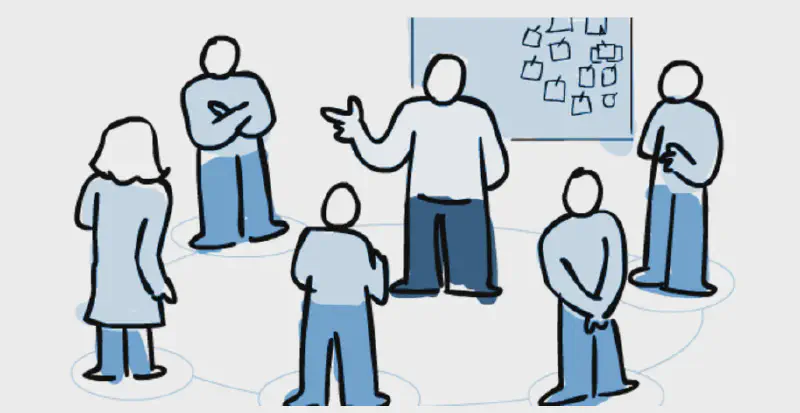
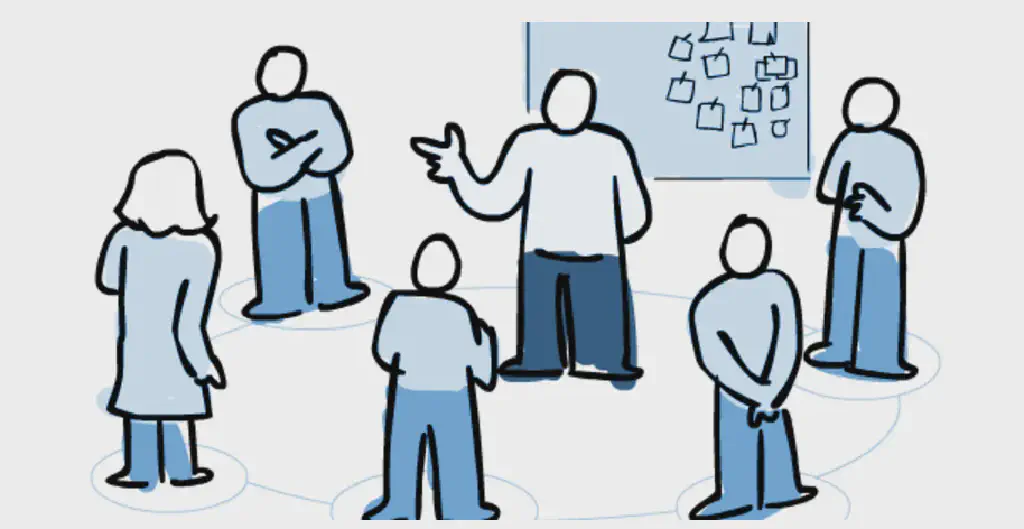
Because the standup’s main function is synchronization and collaboration, it is usually held at the start of the working day — the standup is the starting point of the team’s work for that day. The meeting typically follows a routine in which everyone gathers in front of the kanban board, and each team member takes turns answering three questions:
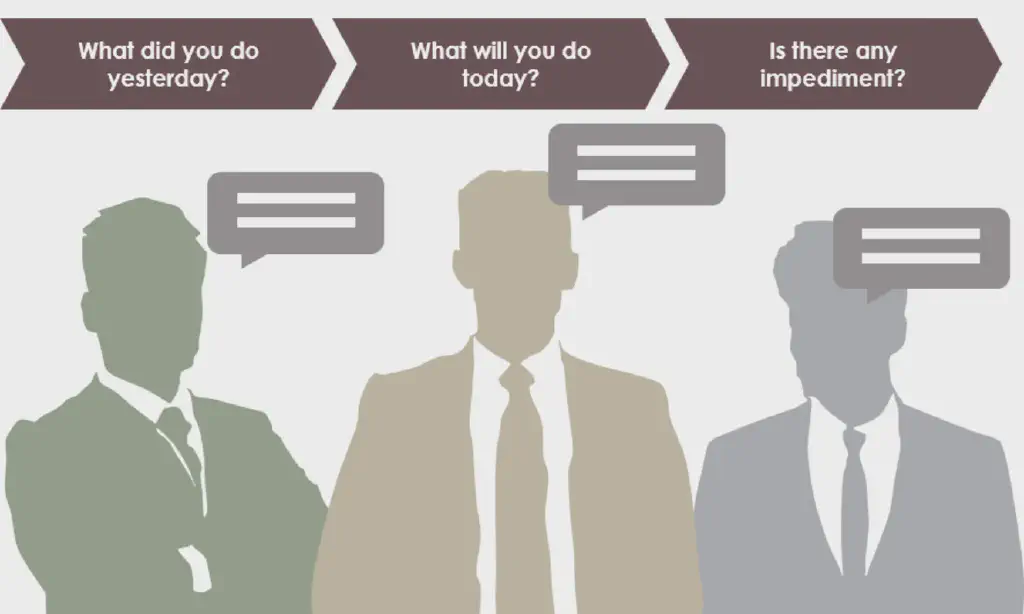
- What did I accomplish yesterday?
- What is my plan for today?
- What difficulties have I run into, or what do I need others to collaborate with me on?
By answering these three questions, each member lets everyone else know their current progress, then works out whom they need to collaborate with that day and which issues need to be discussed as soon as possible. They state the support they need, or offer assistance when others need it.
Precisely because the standup’s function is to synchronize information, and because it is held every day, its duration should be strictly controlled and normally should not exceed 15 minutes. Everyone gives a quick update on their progress, and any issues requiring further discussion should be taken offline — discussed separately afterwards with the relevant people, going into the details or the solution in depth.
The Different Roles in the Standup
As for the three different roles in Scrum, what should each of them do when taking part in the standup, and what role should each play?
Scrum Master
As the team’s organizer and supporter, the SM’s main role in the standup is really to maintain the discipline of the standup, ensure the meeting runs efficiently, and keep it aligned with the Agile spirit.
When an issue arises that may need in-depth discussion, interrupt in time and move the issue into the
parking lotsection of the board, arranging to continue the discussion after the standup.Based on the progress and work reported by team members, judge the risk to achieving the sprint goal, remind the team of any progress that may be falling behind, and coordinate other members to join in collaboration as appropriate.
If an impediment raised by a member cannot be resolved immediately within the team during the meeting, record it and follow up on its progress that same day.
Before the meeting ends, the SM can also quickly share the sprint’s current burndown chart and the status of the main items on the board with the team, so that everyone has an overall picture of the current progress.
Finally, the SM should keep the meeting within its time limit and end it in no more than 15 minutes.
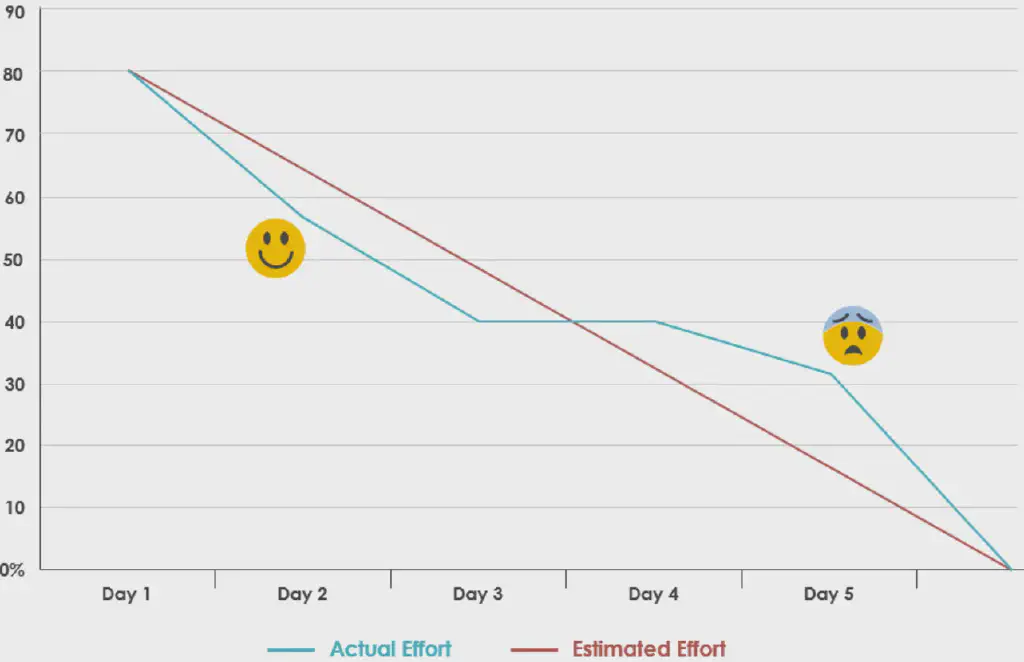
A burndown chart is a fitted chart of the work actually completed against the ideal progress, and it intuitively shows whether the team’s current progress is on track.
Dev Team
Attend on time; do not be late.
Most important of all, of course, is synchronizing progress by clearly answering the three questions above.
Before the meeting, update the status of the tasks you own in time, so that the task status information on the board is accurate.
Any impediments, or issues that need coordination or clarification, should be raised promptly at the standup — this is, after all, the main purpose of the meeting.
PO
During the sprint, the PO’s main responsibility is to clarify and confirm requirements. But since the standup’s function is mainly to synchronize the team’s work progress, the PO is not necessarily required to attend. That said, attending is not off the table either — the PO’s participation has its value.
For the PO personally, taking part in the standup reveals the team’s current progress and allows a more timely and clearer judgment about whether the Sprint Goal will be met.
If there are questions about requirements or points needing clarification at the standup, ones that can be explained in a sentence or two can be resolved right in the meeting. For more complex ones, the PO can stay informed in time and follow up with a separate one-on-one conversation immediately afterwards.
Also, during the sprint, if requirements currently in progress are adjusted or their priorities change, this needs to be explained to the team at the standup in time, so the team can make the corresponding adjustments and responses.
Sometimes the difficulties or impediments the team identifies are related to the PO; in that case the PO can follow up promptly, including updating the team on the resolution progress of impediments that were reported earlier.
Overall, the requirements for the three roles in Scrum to attend the standup are:
- SM - Not mandatory, but attendance is recommended.
- Dev Team - All members must attend (including joining remotely by phone); if a member temporarily cannot attend, it is best to ask another member to speak on their behalf.
- PO - Not required, but may attend.
Points to Note When Running It
Finally, whether the standup achieves its effect also depends on a number of points where many Agile teams’ practice tends to go off track. They are summarized below:
The meeting should be held at a fixed time and place. The standup runs every day, so everyone should form the habit of attending at the same fixed time and in the same fixed place each day, avoiding the time wasted on gathering people because of frequent changes.
Be brief. When speaking, every member should keep in mind that the meeting’s purpose is to synchronize progress, and simply explain the three related questions clearly. This is not the place to explore and solve problems. Keep each person’s speaking time to around one minute.
Be punctual. The standup requires all Dev Team members to take part, so that everyone clearly understands the others’ progress and can collaborate promptly on matters that need it. And because the standup is quite simple, attending on time matters all the more — no one should waste the team’s time for personal reasons.
When a member really is late, the meeting usually does not wait for everyone to arrive; the fixed start time must be strictly honored. (For team members working in different locations or remotely, they can dial in via video conference or phone, but attendance must still be ensured. If a team member goes on leave mid-sprint, they should normally entrust another member to report their progress on their behalf.)
Stay focused. This is a point that is easy to overlook. The reasoning is the same as above: because the standup’s function is collaboration, every member should stay focused on the meeting and make sure they clearly understand everyone’s progress. No one should be handling other work, taking phone calls, playing with their phone, or holding side conversations during the meeting.
Parking lot. This is a dedicated area on the board. When issues that need in-depth discussion inevitably come up at the standup, they are temporarily noted and placed in this separate area to keep the meeting efficient. The parking lot’s purpose is to prevent the meeting from slipping into deep discussion, while the relevant members can continue digging into those issues afterwards.
Stand-up meeting. As the name suggests, a standup is meant to be held with everyone standing. Especially for teams sharing one office, standing effectively keeps the meeting from dragging on too long; and for teams with a physical board, moving items on the board is more convenient while standing, while speaking while standing also makes it easier for everyone to hear clearly.
Summary
The standup is a routine information-synchronization ceremony during the sprint that every member attends. Efficiency therefore matters a great deal — it is an important expression of the team’s self-organization and effective collaboration. Grasping the standup’s purpose, along with the key points and considerations for each role’s participation, helps us run the standup better and truly carry forward the Agile spirit.
Follow Qiucao’s official account to stay up to date with new posts.