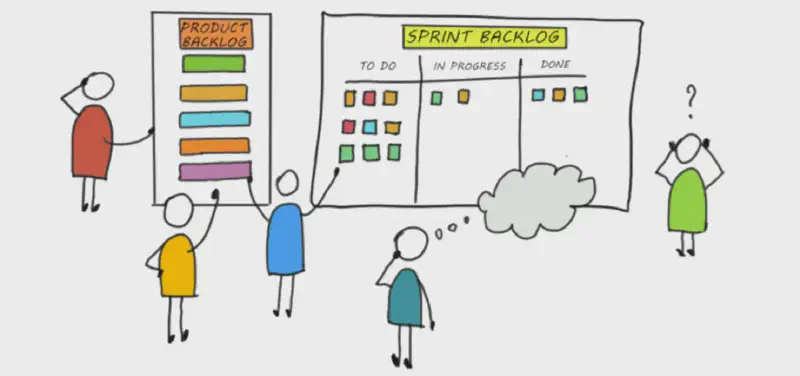
In the Scrum agile model, the practical implementation of agility is actually accomplished mainly through the four main ceremonies defined by Scrum, that is, what we usually call the four agile ceremonies. In this article, we explore the role of the Sprint Planning meeting among the four ceremonies, as well as the key points of its practice.
The Role of the Planning Meeting
At the start of every Sprint, this Sprint Planning meeting is held first, and this meeting also marks the beginning of the Sprint.
The main role of this meeting, as its name suggests, is to formulate the plan for the current Sprint’s operation, to determine the team’s work content and work direction in the current Sprint, and to form the Sprint backlog, SBI.
Inputs to the Meeting
PBI
The most important input to the Planning meeting is the Product Backlog, PBI.
The main discussion in the meeting actually revolves mainly around the PBI, that is, extracting the backlog items jointly confirmed by the team from the PBI, bringing them into the current iteration, and forming the SBI
And the PBI used as an input to the meeting should be requirements that have already been refined and distilled together with the team. Team members should also have a full understanding of the requirements themselves and have completed estimates of the workload for the backlog items. All backlog items should also have defined priorities.
This is also the main reason why, before the Planning meeting is held, the PBI should preferably have already gone through requirement clarification and estimation in a grooming meeting, so as to improve the efficiency of the Planning meeting. Of course, during the Planning meeting there will also be further clarification and confirmation of requirements, but just to keep time under control, this part should be given as solid a foundation as possible in advance.
DOR/DOD
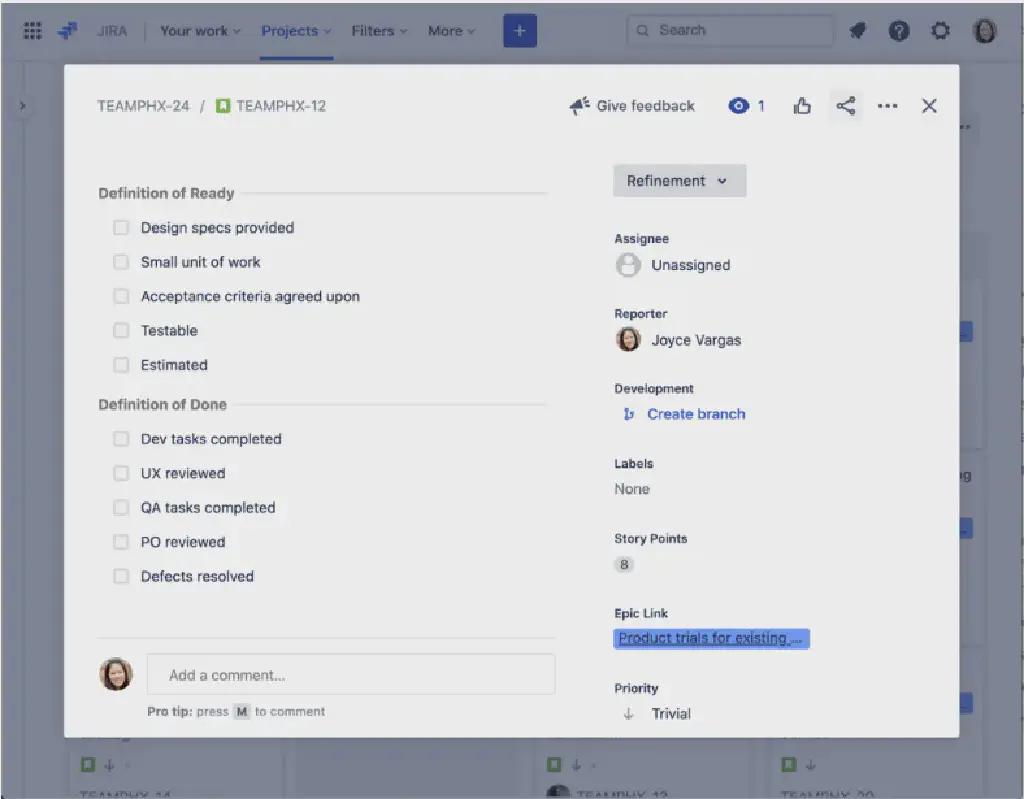
Another important input is the team’s collective definition of DOR and DOD, which is usually confirmed in Sprint 0. Subsequent Sprints can reuse it, and if there are revisions it is confirmed again.
Regarding DOR and DOD, we already explained them when introducing Sprint artifacts, so we will not go into detail again.
DOR is in fact the standard for pending requirements that can enter a Sprint; only requirements that meet DOR should enter the Planning discussion. DOD, on the other hand, is the standard by which each backlog item can be considered complete during the Sprint.
The Planning meeting should confirm that everyone has a shared understanding of this.
Capacity
This reflects the team’s production capacity. The capacity of team members in each Sprint is not fixed, because there may be members on leave, temporarily reassigned, or not fully dedicated to the project in the first place. Therefore, before the Planning meeting is held, the Scrum Master should gather and understand the overall Capacity of the team for the current Sprint in advance.
The Questions the Meeting Needs to Answer
In the Planning meeting, there are actually mainly three questions to answer: Why? What? How?
- Why?
Why are we running this Sprint? The team needs to understand what value the work in this Sprint brings to the product. The PO needs to explain to everyone the value goal he hopes to achieve and be able to answer the team’s questions: why are we doing these requirements? Why should these requirements be placed in the current Sprint?
What? What exactly is to be done in the Sprint? If the requirements have already been refined and distilled through grooming, a lot of time will be saved here. But if the requirements have not been fully clarified, or if some new ideas arise during the meeting, the PO and the team need to work through the requirement details here, identify the relevant risks and dependencies, and reach a shared understanding.
How? This part is more a discussion for the development team members, namely determining exactly how the requirements brought into the Sprint will be implemented, and further breaking the requirement Stories down into different work tasks and matching them to people. The Scrum Master will work with the team to complete task assignment and balance the team’s Capacity.
Outputs of the Meeting
The most important output of the Planning meeting is, of course, the SBI, which contains all the task items that need to be completed in the current iteration.
In addition, there is another artifact we introduced earlier, the Sprint Goal. This sets out a summary of the goal that the team and the PO have jointly agreed the iteration should strive to accomplish.
Meeting Duration
Empirical data from agile organizations is 2 hours per week based on the length of the Sprint; that is, if the Sprint is 1 week, the Sprint planning meeting takes about 2 hours, while a Sprint is usually 2 weeks long, in which case the Sprint planning meeting takes 4 hours.
Of course this is only empirical data, and it will vary for different teams depending on team size, maturity, and the complexity of the work.
How Different Roles Should Participate
The Planning meeting is mainly an internal team meeting, and its participants include all team members. In a small number of cases, key stakeholders (the direct boss) may be invited; when they are needed to provide some decision-making input, they may be invited to attend. For relatively large projects where multiple Scrum teams collaborate, key engineers from other teams may also be invited to participate in some important technical assessments. But on the whole, this meeting is still mainly an internal team discussion, with participants being the PO, SM, and Dev Team.
PO
Before the planning meeting, the PO needs to complete the prioritization of the PBI and finish the grooming of requirements with the team in advance.
During the meeting, the PO mainly needs to answer the Why and What questions, propose the expected Sprint Goal, and confirm the Scope.
At the end of the meeting, the PO should confirm the meeting outputs together with the team: the Sprint Goal and the SBI.
SM
Before the meeting, the Scrum Master needs to schedule the meeting and gather the team’s committed capacity, which people need to take leave, and the time each member will invest in the Sprint.
During the meeting, the SM is responsible for facilitating, organizing the meeting process, assisting the team with task breakdown and work assignment, and ensuring that all tasks in the Scope have a corresponding owner.
During task assignment and claiming, the SM should constantly check the match between team members’ tasks and their available personal time to avoid over-commitment. This also includes coordinating on some mutually dependent tasks.
Finally, the SM is responsible for compiling the SBI and confirming the goal together with the team. There is usually also a step of collecting everyone’s confidence index about completing the Sprint goal.
After the meeting, the SM should also prepare the Sprint board, set the relevant tasks to their initial state, and send out the meeting minutes.
Dev Team
Before the meeting, team members should inform the SM of the time they will personally invest in the current iteration, participate in the PO’s grooming in advance, and fully understand the relevant requirement details in the PBI.
During the meeting, they should make sure they understand the Sprint’s goal; in addition, if any requirement needs further explanation, they should actively participate in refinement, understand the requirement, complete estimation, and proactively raise and discuss the identified risks and dependencies. Then, together with the team, they claim tasks according to their Capacity in the iteration and commit to the output).
Finally, everyone jointly confirms the Sprint goal and gives their own confidence index about the Sprint completing the goal, completing the launch of the Sprint
Meeting Process
Let us once again outline the overall process of how the meeting is conducted
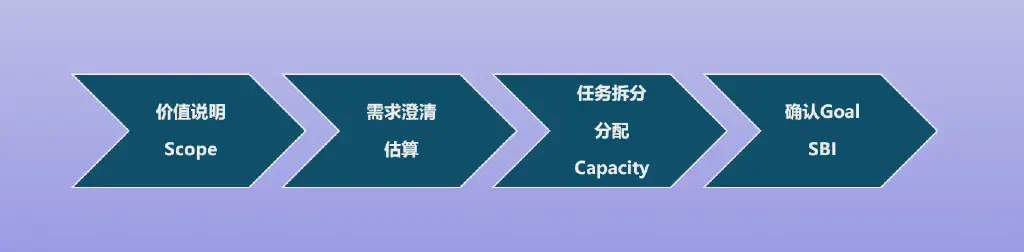
After the SM convenes the meeting,
The PO first explains the expected Sprint goal and the work scope of the current Sprint, and gives the relevant reasons and an explanation of the value to the product. The team discusses this part together and preliminarily determines the scope and goal
Next, the requirements in the Scope are clarified one by one against DOR. For requirements that have not been groomed, refinement, clarification, and workload estimation are completed at this point. At the same time, possible risks and dependencies are identified and response measures are discussed.
These two stages are the first half of the Planning meeting, and also the PO’s home ground
The second half that follows is the development team’s home ground. For the requirements already understood, tasks are further broken down and specifically assigned to people. Based on task claiming, the SM should simultaneously observe how Capacity matches up, ensuring there are no omitted tasks and no over-commitment. In this stage, depending on the situation, the PO is not required to attend; even if attending, it is mainly to answer questions about requirements that come up in the discussion.
Finally, all team members jointly confirm the agreed Sprint goal and produce the SBI. This also represents the team’s commitment to the goal and scope. Finally, the whole team can give a confidence index (0~5) for successfully completing the Sprint.
Throughout the meeting, the SM is responsible for facilitating, and should control the meeting pace and pay attention to progress and time.
Summary
From the explanation above, you should be able to see that the Sprint planning meeting is a very critical meeting in agile operations:
Through the planning meeting, a clear Sprint goal is produced
Before the team officially starts the Sprint, the planning meeting enables full communication, making the overall work scope and goals transparent to all members and enhancing understanding
It matches the team’s capacity with the work tasks brought into the iteration as accurately as possible
Through breakdown and claiming, every backlog requirement has a clear owner
The team collectively completes the SBI and the goal, strengthening mutual cooperation and also laying the confidence for completing the iteration
Follow Qiucao’s WeChat official account to stay up to date with the latest updates
