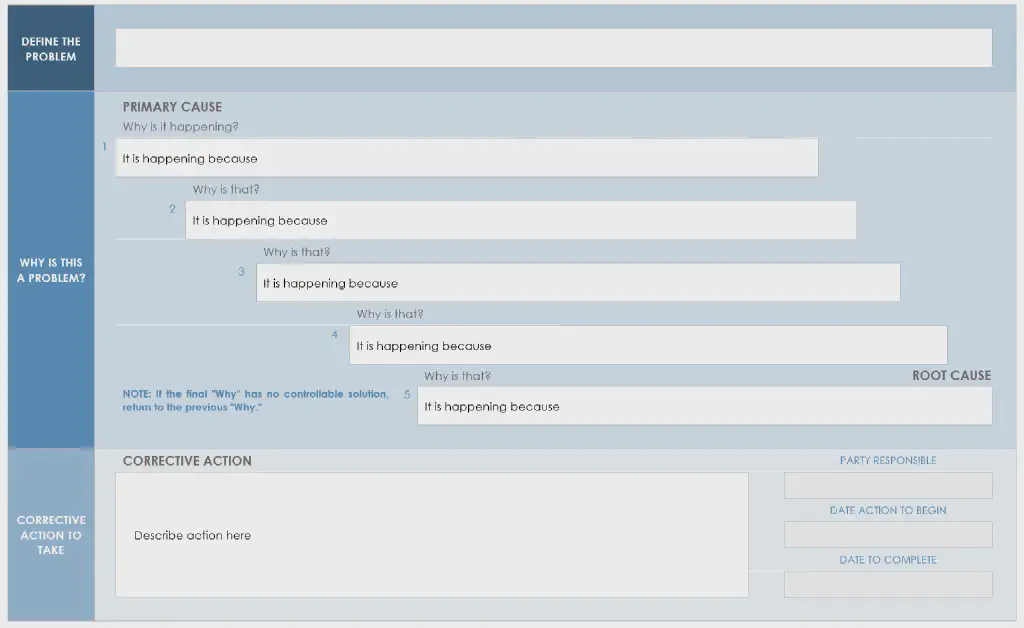
In the field of quality management, an important process for improving quality is discovering problems and solving them. Within this, in the practice of solving problems, a key step is Root Cause Analysis (RCA). There are many RCA methods; commonly used ones include the Fishbone Diagram, the Affinity Diagram, and FMEA (Failure mode and effects analysis), among others.
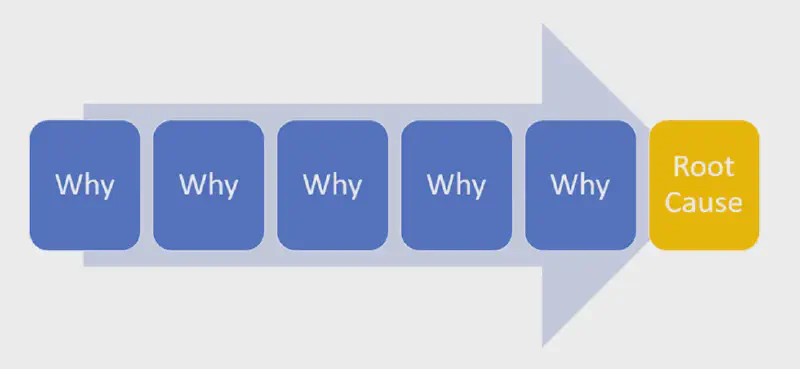
However, the easiest to apply and the most widely used is probably the 5 Whys root cause analysis method
The Origin of the 5 Whys
The 5 Whys method originated at Toyota and was proposed by Akio Toyoda, the father of Toyota. But its introduction into the mainstream was thanks to Taiichi Ohno, the head of the Toyota Production System.
Toyota’s website has the following passage describing Taiichi Ohno’s advocacy of this method:
Whenever a problem cropped up, Taiichi Ohno encouraged his staff to explore problems first-hand until the root causes were found. “Observe the production floor without preconceptions,” he would advise. “Ask ‘why’ five times about every matter.”
The 5 Whys method is based on the following basic understanding:
“Behind every problem there is a cause, but superficial analysis can only describe the symptoms.” To find the root cause behind a problem, continuous investigation is needed; only by obtaining the root cause can targeted, lasting solutions be adopted so that the problem does not recur.
So the 5 Whys is actually about this: when we encounter a problem, we should not look only at the superficial causes that led to it, but should embrace the spirit of “getting to the bottom of the matter” and dig out its root cause. Only by solving the root cause that gives rise to the problem can we possibly avoid its repeated recurrence.
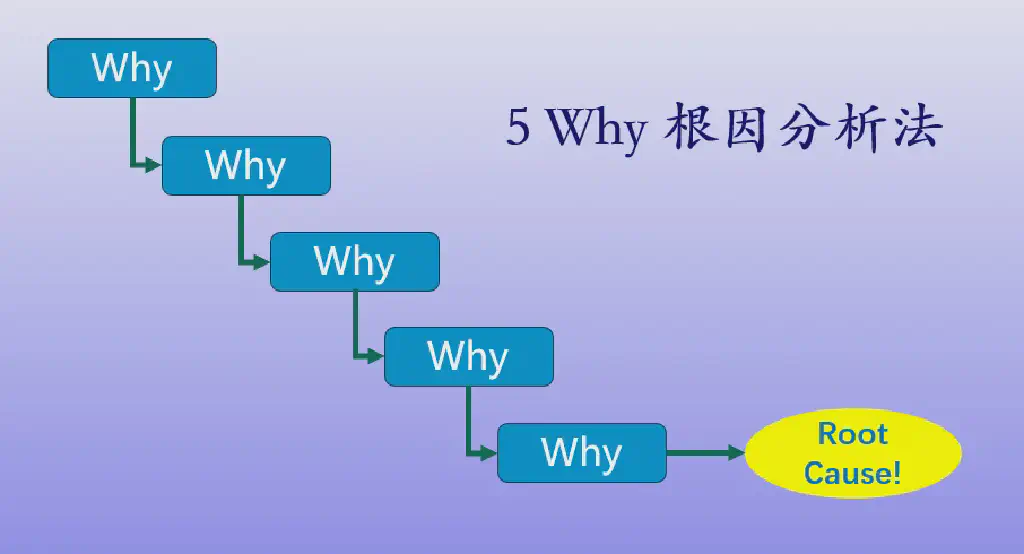
To take an example from the software industry: during customer acceptance, a fairly serious functional bug was found that affected the final delivery of the product. At this point, the 5 Whys method is used to analyze the root cause:
Why did the customer encounter this problem? According to the technical lead, the testing team had not reported any such issue to the development team
Why was the testing team unable to find the problem? The testing team only performed smoke testing and did not carry out complete regression verification of the functionality
Why did the testing team only perform smoke testing? Because they did not have enough time to perform thorough regression verification of the entire application
Why was there not enough time for thorough regression? Because the version submitted by development for testing was only one day ahead of the final delivery to the customer for acceptance, while thorough functional testing requires at least 3 days.
Why did development submit the build for testing only one day before delivery? Because the implementation of one key feature turned out to be more complex than expected and took more time.
Analyzing up to this point, two root causes are actually discovered:
- Team members made a serious misestimation of the workload, and development time was underestimated
- Problems in project management: the build was submitted for testing much later than the testing estimate, sacrificing quality by delivering to the customer without regression. Release-exit control was insufficient.
Therefore, based on the causes identified, improvements are needed in two areas to prevent similar situations from recurring.
- Improve the development team’s accuracy in estimating feature implementation, including training, requirements breakdown, and understanding requirements as early as possible.
- Improve project management by strengthening test entry/exit control and risk prevention. If the build is submitted late, the delivery time should be postponed accordingly; if a product is released without completing regression, at minimum an exception-release review process must be completed.
Implementation Steps of the 5 Whys
Although the 5 Whys method is very simple, its implementation still needs to follow a certain process of steps:

First, of course, the key members related to the problem need to jointly analyze it. In this step, all relevant roles in the team connected to the problem should be able to participate. Otherwise, the absence of key personnel may cause the analysis to be unable to proceed.
After determining the team members who will participate, it is also necessary to ensure that everyone is fairly clear about the problem: what needs to be analyzed? What background information is there? The team should reach a consensus on the understanding of the problem, rather than entering the Why discussion with different interpretations
During the specific analysis meeting, the facilitator should, through appropriate questioning, gradually help the team unearth the real causes
Of course, the ultimate purpose of analyzing a problem is to solve it, so we also need to discuss corresponding corrective measures for the root cause obtained, in order to prevent similar problems from happening again.
Finally, how effective the implementation of the corrective measures is also needs to be tracked with corresponding actions and time nodes, so as to verify and confirm the effectiveness of the root cause analysis.
Only through such a process is it a complete root cause analysis implementation based on the 5 Whys method.
Considerations When Implementing the 5 Whys
Although the 5 Whys method is simple, in practice it is actually not easy to do well. Here are some key points to note:
A Team Activity
The 5 Whys analysis is a team activity that requires the active participation of people related to the problem. Only when the key roles along the problem analysis path can give effective answers can the validity of the analysis chain be guaranteed
Not an Efficient Method
Although this method is simple to understand, because it is a team activity and is closely tied to whether the various background information about the problem is sufficient, activities including information collection, gathering personnel, and brainstorming in meetings all require an investment of time. It is not an activity that reaches conclusions efficiently or quickly; sometimes it even requires multiple meeting discussions.
The Facilitator’s Experience
Whether the 5 Whys method succeeds depends critically on the role of the meeting facilitator. This role should have a full understanding of the 5 Whys method and be fairly familiar with the problem-related domain, able to guide the team to dig for root causes in the right direction and avoid excessive divergence
Focus on the Issue, Not the Person; Avoid Shifting Blame
Root cause analysis is not about assigning blame; that is, the focus of the meeting is to discover points for future improvement, not to define responsibility for the current problem, so as to avoid turning the analysis meeting into a blame-shifting or finger-pointing session
Focus on Controllable Factors
The root causes obtained from root cause analysis should be controllable factors on which action can be taken, rather than finding force majeure factors that simply cannot be corrected. For example, if there is a shortage of staff, the root cause is that the company is not performing well, and the company’s poor performance is due to an economic downturn.. The conclusion would then fizzle out with nothing being done.
All in all, the 5 Whys analysis method is a simple and practical root cause analysis method, but it is not an efficient one, and its effectiveness is closely related to the concerted effort of team members and the way it is implemented. Only by understanding its internal logic and implementing it selectively according to the team’s actual situation can it truly have the effect it should.
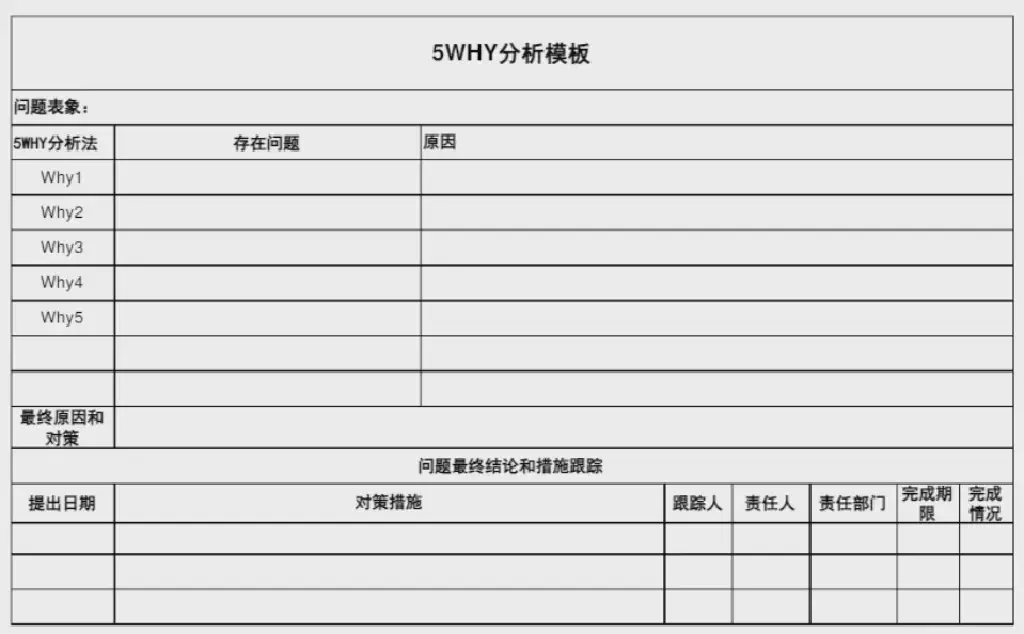
Analysis Templates
Two common analysis templates are attached below for your reference